As a public service, I hereby present my findings on physics seminars in convenient graph form. In each case, you will see the Understanding of an Audience Member (assumed to be a run-of-the-mill PhD physicist) graphed as a function of Time Elapsed during the seminar. All talks are normalized to be of length 1 hour, although this might not be the case in reality.

The “Typical” starts innocently enough: there are a few slides introducing the topic, and the speaker will talk clearly and generally about a field of physics you’re not really familiar with. Somewhere around the 15 minute mark, though, the wheels will come off the bus. Without you realizing it, the speaker will have crossed an invisible threshold and you will lose the thread entirely. Your understanding by the end of the talk will rarely ever recover past 10%.
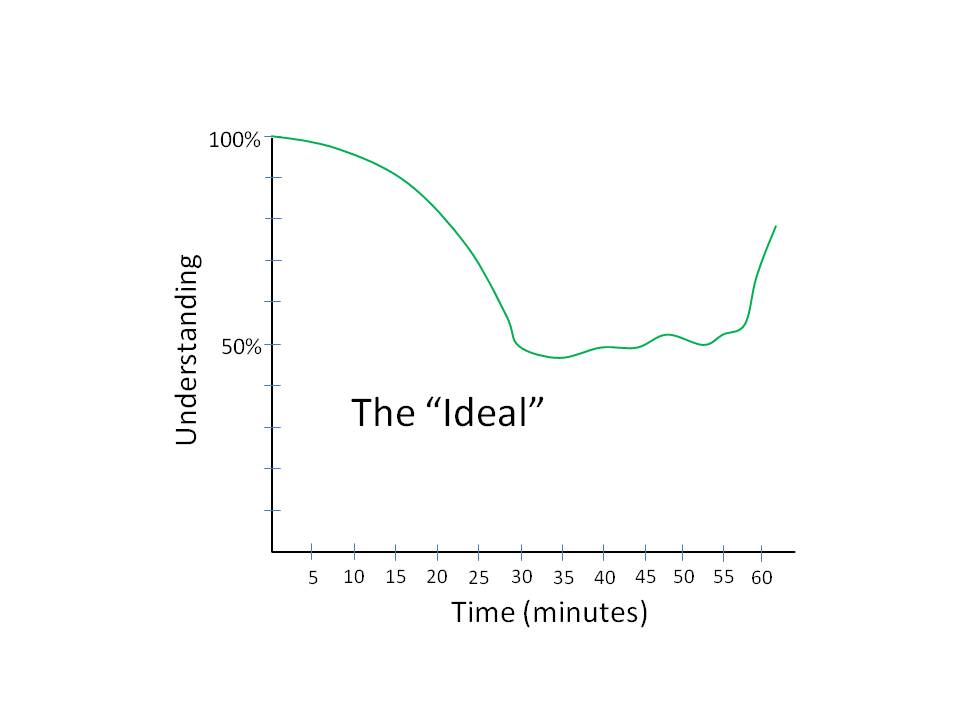
The “Ideal” is what physicists strive for in a seminar talk. You have to start off easy, and only gradually ramp up the difficulty level. Never let any PhD in the audience fall below 50%. You do want their understanding to fall below 100%, though, since that makes you look smarter and justifies the work you’ve done. It’s always good to end with a few easy slides, bringing the audience up to 80%, say, since this tricks the audience into thinking they’ve learned something.
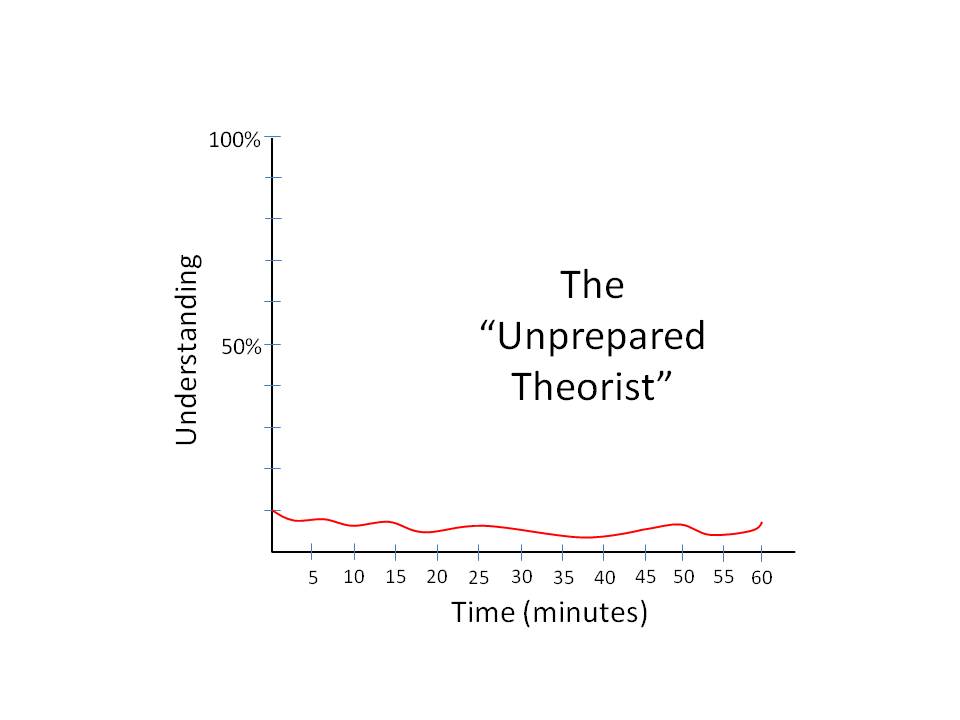
The “Unprepared Theorist” is a talk to avoid if you can. The theorist starts on slide 1 with a mass of jumbled equations, and the audience never climbs over 10% the entire time. There may very well be another theorist who understands the whole talk, but interestingly their understanding never climbs above 10% either because they’re not paying attention to the speaker’s mumbling.
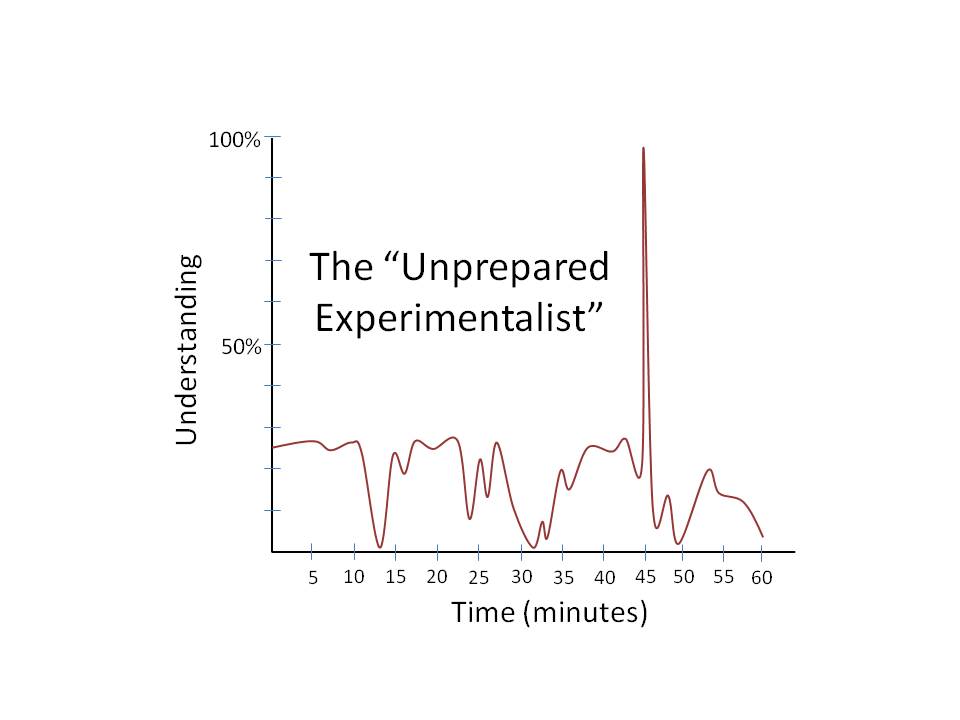
The “Unprepared Experimentalist” is only superficially better. Baseline understanding is often a little higher (because it’s experimental physics) but still rarely exceeds 25%. Also, the standard deviation is much higher, and so (unlike the theorist) the experimentalist will quite often take you into 0% territory. The flip side is that there is often a slide or two that make perfect sense, such as “Here’s a picture of our laboratory facilities in Tennessee.”

You have to root for undergraduates who are willing to give a seminar in front of the faculty and grad student sharks. That’s why the “Well-meaning Undergrad” isn’t a bad talk to attend. Because the material is so easy, a PhD physicist in the audience will stay near 100% for most of the talk. However, there is most always a 10-20 minute stretch in the middle somewhere when the poor undergrad is in over his/her head. For example, their adviser may have told them to “briefly discuss renormalization group theory as it applies to your project” and gosh darn it, they try. This is a typical case of what Gary Larson referred to as “physics floundering”. In any case, if they’re a good student (and they usually are) they will press on and regain the thread before the end.
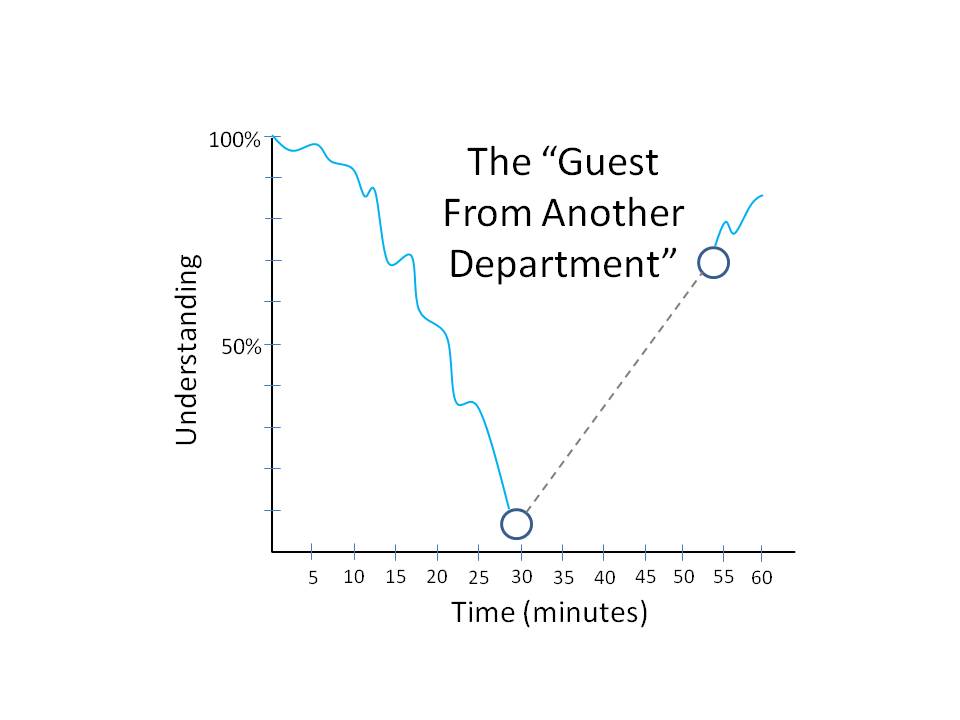
The “Guest From Another Department” is an unusual talk. Let’s say a mathematician from one building over decides to talk to the physics department about manifold theory. Invariably, an audience member will gradually lose understanding and, before reaching 0%, will start to daydream or doodle. Technically, the understanding variable U has entered the complex plane. Most of the time, the imaginary part of U goes back to zero right before the end and the guest speaker ends on a high note.
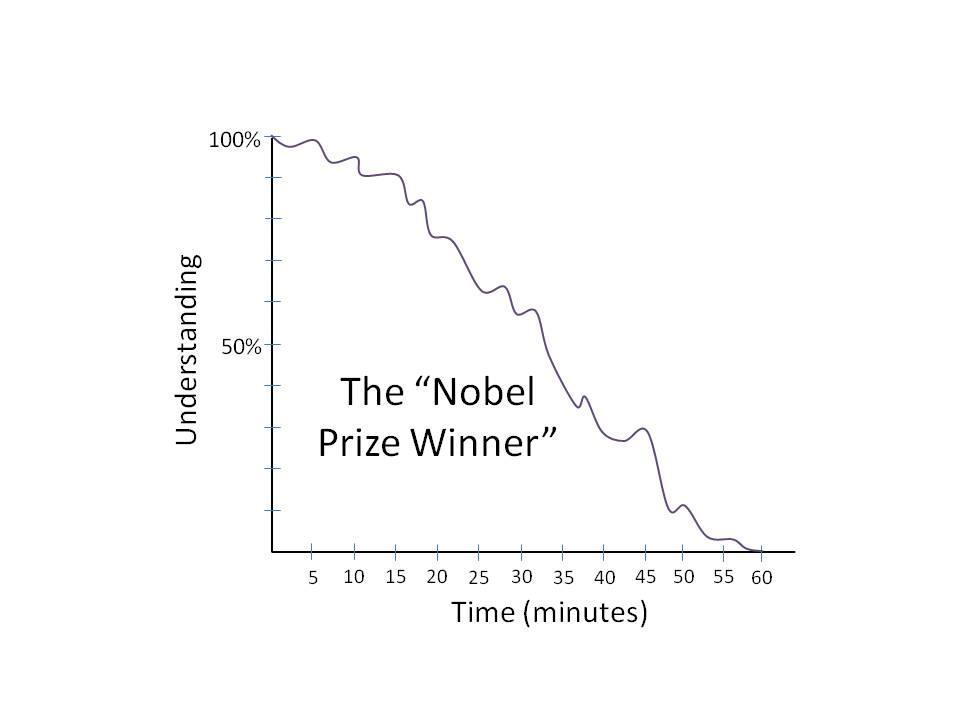
The “Nobel Prize Winner” is a talk to attend only for name-dropping purposes. For example, you might want to be able to say (as I do) that “I saw Hans Bethe give a talk a year before he died.” The talk itself is mostly forgettable; it starts off well but approaches 0% almost linearly. By the end you’ll wonder why you didn’t just go to the Aquarium instead.

The “Poetry” physics seminar is a rare beast. Only Feynman is known to have given such talks regularly. The talks starts off confusingly, and you may only understand 10% of what is being said, but gradually the light will come on in your head and you’ll “get it” more and more. By the end, you’ll understand everything, and you’ll get the sense that the speaker has solved a difficult Sudoku problem before your eyes. Good poetry often works this way; hence the name.

The less said about “The Politician”, the better. The hallmark of such a talk is that the relationship between understanding and time isn’t even a function. After the talk, no one will even agree about what the talk was about, or how good the talk was. Administrators specialize in this.
If you enjoyed this post, you may also enjoy my book Why Is There Anything? which is available for the Kindle on Amazon.com. The book is weighty and philosophical, but my sense of humor is still there!

I am also currently collaborating on a multi-volume novel of speculative hard science fiction and futuristic deep-space horror called Sargasso Nova. My partner in this project is Craig Varian – an incredibly talented visual artist (panthan.com) and musician whose dark ambient / experimental musical project 400 Lonely Things released Tonight of the Living Dead to modest critical acclaim a few years back. Publication of the first installment will be January 2015; further details will be released on our Facebook page, Twitter feed, or via email: SargassoNova (at) gmail.com.
 Many Worlds Theory
Brilliant 🙂
Your categories make a mathematician happy!
[…] of the talks I attend fall under typical, which as its name suggests, is […]
Reblogged this on amit srivatsa and commented:
This is so good I want to draw a graph of my satisfaction level! 😉 😛
Thank you!
Sorry, but two of the three Nobel laureates (Joseph Taylor and John Mather) I’ve heard give physics seminars have spoken pellucidly – but then again, they’re both astronomers. 😉 And the third was Dirac when he was in his 70s, and he wasn’t too bad, either.
Of course Feynman won a Nobel prize, too. So there are exceptions to all of these rules 🙂
Dirac was also a poet. No beating his lectures.
L’ha ribloggato su Gianvito Scaringie ha commentato:
Grandioso, e si applica perfettamente anche in altri campi della scienza!
Ne consiglio la lettura.
Grazie per la vostra attenzione!
Having attended a Feynman lecture (yes, I’m name dropping) I have to say at the end of the lecture you “think” you understand it, but once you leave the lecture hall you realize you have no clue what he was talking about. It takes a few iterations to “get it”.
Real poetry is like that too. Every time I read Kubla Khan I think I get it, then it drifts away from me…
Ahhh … The old Hans Bethe lecture. Wonderful stuff … Always seemed to involve trains and backs-of-envelopes. (For those that get this!) My favorite Hans Bethe story takes place at Los Alamos and involves cherry pie!
From a former physics student, thank you for bringing back such…pleasant…memories. 🙂
Out of this world! -:)
Hmm – my guess is that the author has a PhD.
In physics, no less!
Good work. This analysis deserve a MS thesis.
Hat dies auf SCHLEUDERGANG rebloggt.
Wonderfully droll and accurate. I’m a relative and not a scientist but am able to appreciate this. Thank you.
well
the last type is a bit ( actually impossible ) unlikely.
From physics point of view its bullshit. ( travels in fourth dimension )
From common man’s point of view ‘ true that ! ‘
note :- im a science stud not a physicist. NOT AN EXPERT !
It was meant to be humorous?
I knew this would go viral 🙂
Yeah. 27,000 views yesterday. I guess this is my 15 minutes of fame.
Wow – congrats!! I had shared it on Twitter, G+ and FB – but it seems your post is everywhere now 🙂
Hahaha too funny! This can totally apply to maths as well!
I attended a talk by Michael Grätzel… I think he will win the next one in chemistry 😉
That’s really a great presentation about the topic (my Understanding level never got bellow 99%, ). The Understanding level you introduced, depends solely on the way that the speaker presents the topics as time elapses. This is enough if your concern is restricted to your abilities as a lecturer.
However, if you are interested on the success of the seminar,i.e. the overall audience comprehension, shouldn’t we also take in mind the Understanding Level of each participant (for sort, “IUL: Individual Understanding Level”). IUL should be quantified, in an appropriate matter, as a function on the knowledge level, audiovisual-understanding level, physical and mental condition, I.Q. or any factor that affects each individual’s comprehension level. That quantity measures each participant’s ability to comprehend what you are talking about, at any moment during the speech, and it could be normalized to 1. So, if:
C := (sum of IULs for all participants)/(number of participants)
and U(t) is the understanding level you introduced, then the product CL(t) := C x U(t), should measure the mean Comprehension Level, at any time t (C could also be a function of time, if behavioral forecast of each participant can be determined, given as initial conditions the IUL’s variables). Integrate CL(t) from t = 0 to t = T, where T is the duration of the seminar, divide that integral by T and get your (normalized to 1) Success level of the seminar. This quantity is useful if you want to strategically spread a particular theory on the set of scientists, allowing for more persons to criticize it in a profitable for you manner.
(What was the understanding level of this lecture??? )
beautiful!!! never experienced some of those though…
To take it a step further, we can use “functional analysis” in order to maximize the Success level of the seminar. Specifically, assuming that a list of participants’ IULs is available and, according to that list, some behavioral analysis has determined the function C(t). Assume a function A(t) which suggests the lecturer’s Attitude at any time during the seminar (A(t) can be normalized to 1). Then define the functional:
S[A] = (integral over t) of C(t) xU(t) x A(t), from t = 0 to t = T
which gives the Success level of the seminar, for given C(t) and U(t) and for arbitrary A(t). Using functional analysis methods, find the function A(t) such that S[A] is maximum. This means that, if the speaker adjusts his/her Attitude under the suggestions of A(t), then the seminar will have the greatest possible Success level, for that kind of seminar kind (i.e. for given U(t)) and for given audience (i.e. for given C(t)).
If the above make sense to anyone, let’s talk about constructing a method for optimal seminar success level; if not, then someone should just tell me to shut up .
Wonderfully comprehensive analysis! Simultaneously clear, concise and entertaining. Your mind is artistically organized and you have far too much time on your hands! Do it again.
Thank you!
I appreciate this topics& satisfied.
Biology seminars fall into the same general categories, except instead of photos of labs (although there are some of those), the 100% comprehensible slides are the photos of field sites (if such apply) or study organisms. For this reason, comprehension of theoretical biology talks is never above 10% except for other theoreticians.
[…] stumbled across a link the other day, posted to Facebook by a friend of mine, entitled “the 9 kinds of physics seminar“. And my gosh. It strikes the nail perfectly on the head. I feel compelled to re-post 4 of […]
A good politician is able to talk in such a way that it will take you 24 hrs to realize he didn’t say anything.
So true!
Reblogged this on Solid State Adventure.
You Sir were wonderful with this article! I actually had to control my laughter by the time I reached the entry: Guest from another Department!
Thanks!
Great! And even recognizable for someone involved in physics seminars 40 years ago – as I was. Given this time span, these figures could point at physical constants 🙂
Not a scientist, and still stayed at near 100%. Traveled here from Supernova Condensate, and glad I did. Thank you for the laughs. 🙂
I think only an engineer student can explain this…… Like me.
Well you thought wrong. What a preposterous suggestion!
[…] The 9 kinds of physics seminar, which Amy Parachnowitsch pointed out on twitter applies broadly to all kinds of seminars (ht: Amy Parachnowitsch via Morgan Ernest). […]
[…] The nine kinds of physics seminar – Matthew Rave explains, with graphs, the path of understanding co-ordinated with time in kinds of physics paper, producing shapes which feel familiar to other disciplines as well. […]
“The Typical” also describes my experience of freshman calculus at MIT with one particular professor. The first few weeks were fine, then in one lecture the “wheels came off the bus”. The professor wandered off into left field and never really returned… I wasn’t the only student looking at his watch to see if maybe he’d wandered in to the wrong section…
Is U(t=0) = U(60) = 0 a general boundary condition on “the politician”? I think if U(60) > 0 the politician would consider his talk to have failed. But can he obtain U < 0? I think so. [See also unprepared theorist.]
“U(60) > 0 the politician would consider his talk to have failed” I think you mean succeeded. If your understanding has increased after such a talk, then wow, the politician accomplished something.
U(t) can be negative in certain kinds of talks that I haven’t discussed. The idea is that you (the listener) leave the talk with less knowledge than you started with. For example, a talk about the age of the Earth given by a young Earth creationist will have no effect on most physicists, but will bring the general public to a U<0 state quite quickly.
These graphs need to be printed out and stuck in every seminar room in every department in the world! 😀 I think i’m going to start with mine. And I am probably going to mentally classify every talk I attend from now on
I’m flattered! Although I suspect there are some other (rarer) seminar types that I haven’t discussed…
I constantly emailed this web site post page to all my friends, because if like to read it after that myy friends will too.
Loved this, but felt that you failed to account sufficiently for the soporific properties of incomprehensible theory – the typical and the unprepared theorist have me dozing off after 20 to 30 minutes.
Hilarious! This goes up in the seminar room right now
Do you mind if I quote a couple of your posts as long as I provide credit
and sources back to your site? My blog site is in the very same area of interest
as yours and my visitors would definitely benefit from
a lot of the information you present here.
Please let me know if this alright with you. Regards!
Reposting a blog is always OK if credit and citations are given clearly…I’ve done it too….
Cheers!
I would like to thank you for the efforts you have put
in writing this blog. I’m hoping to view the same high-grade
blog posts by you later on as well. In fact, your creative writing abilities has inspired
me to get my very own blog now 😉
Having read this I thought itt was rather informative.
I appreciate you finding the time and effort to
put this article together. I onjce again find myself spending
a lot of time both reading and leaving comments. But so what, it was still worth it!
Hello there! I could have sworn I’ve visited
this website before but after going through a few of the posts I realized it’s new
to me. Regardless, I’m certainly happy I stumbled upon it and I’ll be bookmarking
it and checking back frequently!
Having read this I beliedved it wwas really informative.
I appreciate you finding the time and effort to putt
this short article together. I once again find myself personally spending way tooo much tkme both reading and commenting.
But so what, it was still worthwhile!
Choose a soap that will cleanse your body and not just perfume it
a little bit. Prepare a paste of gram (Cicer arietinum) flour in raw milk.
This will cause the hair to stretch and finally break.
wonderful issues altogether, you simply gained a emblem new reader.
What could you suggest in regards to your put up that you just made a few days ago?
Any sure?
Thanks for finally writing about >The 9 kinds of physics seminar | Many Worlds Theory <Liked it!
I like it whenever people come together and share opinions.
Great site, stick with it!
Spot on with this write-up, I actually believe this site needs
far more attention. I’ll probably be returning to read through more, thanks for the info!