Feeds:
Posts
Comments

Archive for the ‘Uncategorized’ Category

Einstein circa 1905

There are a lot of people who, to this day, deny the truth of Einstein’s special relativity (SR).  I’m not even referring to the OPERA superluminal neutrino debacle—an anomaly that was eventually found to be caused by a misconnected fiber optic cable.  No, I’m referring to laymen who deny SR because it goes against common sense.

A Google search will find such people readily.  Most of the time, their arguments aren’t even worth refutation, since it’s obvious in most cases that they haven’t mastered even the simplest algebra, much less sophomore-level physics.  (I am planning to use this gem in my Modern Physics class in the spring as a homework problem: for 20 pts., find the elementary flaw in this person’s logic.)  However, as a working physicist, I sometimes find myself dismissing such people too readily: it is easy, and self-gratifying, to call such people cranks.

A person who doubts SR is not necessarily a crank.  After all, relativity is very counter-intuitive, and our brains have been exquisitely fine-tuned by natural selection to perceive the world as inherently classical.  In fact I will go so far as to say that if you accept SR whole-cloth, without any mathematical or scientific background, then you’re basically showing a blind faith in science in the same way that Iotians have a blind faith in “The Book”.  I would rather beginning physics students showed some skepticism; it makes their final “conversion” that much more intellectually pleasing.

I think the main problem with perceptions of SR is the way it is normally presented.  My thesis is this: most physicists are teaching it wrong.  And as a consequence, many people who have studied SR come away with a misguided notion of what SR is all about.

The old way to teach SR begins with Einstein’s two postulates.  The first is that the laws of physics should be the same, in any inertial reference frame.  The second is that the speed of light is the same for all inertial observers.  There is then an obligatory picture of a train and lightning bolts, and talk about how simultaneity isn’t preserved in SR.  This leads (usually after a lengthy derivation) to time dilation and length contraction.  And then, out of the blue, there might be talk of the twin paradox and the obligatory pole vaulter in the barn.

Shudder.  Such a pedagogically confusing approach!  No wonder very few first-time SR students “get it” at all.
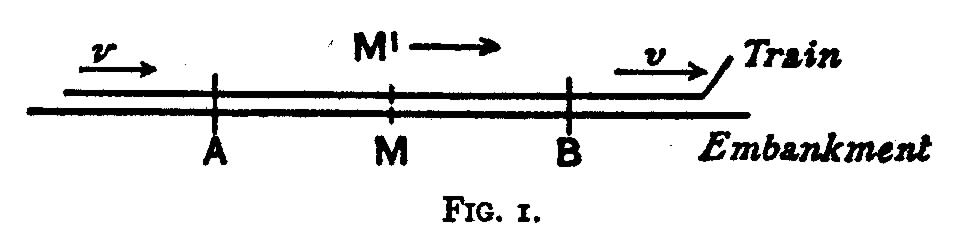
The original train picture from Einstein’s 1916 book

This approach has a long history.  In Relativity: The Special and General Theory (1916), by Einstein himself (!) the discussion begins with the two postulates, and there is then a diagram of a train and a discussion of simultaneity (see above).  Seriously?  I’m not blaming Einstein, mind you; I’m blaming the textbook authors today who can’t let go of that stupid train.  It’s been almost 96 years.  Get over it.  Hop off that train, please.  There are more intuitive approaches that are easier for the layman to grasp.

Here’s the approach I use in my classes.  This is not the only approach, of course, nor do I claim it is the best approach.  However in my experience (admittedly, just one data point) this approach is a better way to get students to gradually accept SR.  The trick is to present information one plausible chunk at a time, and then only gradually derive all the weird stuff.  Thus, without realizing it, the students have been convinced of the truth of SR despite themselves.  If you start with simultaneity and time dilation and length contraction then half of the students will get turned off immediately (because their common-sense alarms will be blaring full-force).

  1. Talk about classical (Galilean) relativity.  That is, discuss how the laws of physics should be the same in any (inertial) reference frame you choose.
  2. Talk about coordinate transforms: how you can take the spatial coordinates of an object (x,y,z) and find what the coordinates (x’,y’,z’) would be in a different coordinate system.
  3. Talk about how some coordinate transforms are “good” and some are “bad”.  For example, a translation in space such as x’ = x – L preserves distance, but a rescaling transform like x’ = ax does not.
  4. Mention how the good ol’ Pythagorean theorem s2 = x2 + y2 + z2 gives you an invariant quantity (s2) that is preserved under “good” transforms.
  5. Mention that the (experimental) behavior of light throws a monkey wrench into this analysis.  For whatever reason, all observers measure the same speed c for light, and this actually makes things a little harder.  (Don’t do any math at this point!)
  6. Here you should start talking about time as being a 4th dimension.  The earlier you introduce the idea of an event P as a point P=(x,y,z,ct) in space-time, the better.
  7. State Einstein’s postulate about the speed of light.
  8. Show that the light postulate implies that s2 = x2 + y2 + z2 is no longer an invariant quantity, when talking about transforms as applied to space-time.
  9. If s2 = x2 + y2 + z2 is no longer invariant, can we modify the formula in any way so as to make s2 invariant, while still preserving the light postulate?  The answer is yes; and so you should derive the 4D version of the distance formula, s2 = x2 + y2 + z2– c2t2.

To me, this is the core idea of SR.  Everything else follows from the invariant interval s2.  One should no longer think of our existence as being 3D; time represents another “direction”.  And it turns out that the time you perceive depends upon your vantage point (time is “relative”), just like position.

For example, suppose you are looking at a row of trees.  From one location, the trees are lined up in front of you (they all share the same x-coordinate).  From another vantage point, they are separated by 1 m each (x=0, 1m, 2m, 3m, etc.)  No one, not even Galileo, would find this controversial.

But now imagine that you think of time as just another “direction”.  Why is it so hard to believe that your time coordinate could have one value in one reference frame, and another value in a different frame?  Why is it so hard to believe that events that are simultaneous in one frame are not simultaneous in another?

Time dilation and length contraction follow from this in a straightforward way.  And they are much easier to visualize if you buy into the paradigm (I’ll say it again) that time is another “direction”, and therefore relative just like position.

[Caveat: I do know that time is special, in the sense that there’s a minus sign in the s2 = x2 + y2 + z2– c2t2 formula.  That minus sign is crucial.  But discussing its importance should be deferred to a later (pun-intended) time.]

If you’re interested, here’s the rest of my SR program:

10.  Discuss space-like, time-like, and light-like intervals, and the ideas of proper length and proper time.
11.   Show how the Galilean boost (which is a “good” transform in classical relativity) must be modified into the Lorentz boost in order to preserve s2.
12.   Show how the Lorentz boost implies length contraction and time dilation.
13.   Discuss relative velocity in SR.
14.   Discuss so-called paradoxes like the twin paradox and the pole vaulter paradox.

The discussion can then go into advanced topics: momentum, energy, E=mc2, forces, etc.  However, with the foundation I have described, I believe these topics are much easier to present.

I’m sure there are some great professors out there who have had great success with the “traditional” program of SR instruction.  I’m sure Feynman could teach circles around me, even with the train and lightning bolts.  But I prefer this different approach, as I have presented it, and I hope others will realize that there’s more than one way to explain special relativity.

Read Full Post »

What if there were a way to increase donations to worthy causes, while at the same time help fight this country’s obesity problem?


I think there is a way, and it would be simple to test.  Suppose fast food restaurants that offer “meal deals” (burger + drink + one side, say) offered a $1 donation to Oxfam (or any other charity) as one of the side dish options?


There are two obvious benefits.  One, I believe that people donate to charities more if they can do so conveniently.  I myself had never given money personally to a hungry family, but when a local grocery store asks me if I want to buy a box of food “for the children” I do so almost automatically.  Convenience allows us to then feel good about ourselves.


Secondly, people who choose this “side dish” are clearly missing out on calories that most don’t need anyway.  How often do people get french fries, even when they don’t want them, just because they “came with the meal”?  And subsequently, how many people eat the fries, because they paid for them–-even if they are no longer hungry?  I’ve done this myself, although it seems irrational in hindsight.


What if instead I order a $5 meal deal and the cashier asks, “What side?” and my response is, “give it to the hungry”, and the restaurant then has some automatic money transfer mechanism in place to make the donation in an instant?  I don’t know which would do society more good: the money raised, or the calories not consumed.  Why isn’t this a win/win?  Or a win/win/win, since the restaurant doesn’t lose anything, and only gains the positive PR?  It would even show evidence that the restaurant has heard the message of “Supersize Me” and taken it to heart.


I think this idea is a good one, and I hope someone reads this post and shares the idea.  All it would take would be one restaurant to start doing this, and before long all of them would be doing it.  I can’t see a single downside at all.


Admittedly, this may have been tried before.  If so: I wonder why it hasn’t caught on?  What are the economics of such institutionalized charity?  I think there are other interesting questions at play here…does charity in fact increase when it is convenient to give?  (I’d love to see the research data on this.)  Would people forgo empty calories in such a scenario?  What would be the economic benefit of millions of calories not being consumed?  Might there even be an adverse effect for, say, the potato industry, if less fries are scarfed down?


Let me know what you think.  And please share this if you think that someone, somewhere, will see it and have the possibility of implementing it.


[Note: this blog post was originally written on Dec. 15, 2010, and emailed to a celebrity who will remain nameless.  Needless to say, there was never a response…not even an automated one.]

Read Full Post »

As I was driving to school today, there was a story on NPR about an upcoming ballot initiative in Missouri.  Proponents want to raise the cigarette tax from $0.17 per pack (the lowest rate in the nation) to $0.90 per pack.  The idea is to generate some revenue and at the same time discourage smoking.

Missourians love their cancer sticks.

Now, I’m not going to go into the pros and “cons” of the initiative.  I would be for it, based on some pretty common-sense data, but I don’t live in Missouri so I guess my opinion doesn’t matter.  However, I’d like to comment on some squishy reasoning put forth on the radio by an opponent of the measure.

In a nutshell: “The measure,” the opponent says, “wouldn’t raise money at all.  It would actually lower revenue.  That’s because any gains made by raising the tax would lower the amount of regular sales tax accrued.” [Note: this isn’t a verbatim quote but a recreation based on my imperfect memory]

You see, Missouri has a 4.225% sales tax which also applies to cigarettes.  And, the “logic” goes, if less people are buying cigarettes, the less sales tax revenue would be generated.

Really?  Is this person completely innumerate?  Let’s say that a pack of cigarettes costs $6.00.  Without the ballot initiative, a Missourian would pay $6.00, plus $0.25 in sales tax, plus $0.17 in cigarette tax, for a total of $6.42.  The state gets $0.42 cents a pack.

Under the new plan, a smoker pays $6.00, plus $0.25 in sales tax, plus $0.90 in cigarette tax, for a total of $7.15.  The state gets $1.15 cents a pack, obviously an increase.

To be fair, the state does actually lose money if the gain in revenue per pack is offset by the loss in the number of sales.  But when would this occur?  Let’s use algebra to find out.  Suppose that N1 is the number of packs of cigarettes bought in Missouri in a given year.  Under the current system, and for a $6.00 average price per pack, the yearly intake for the state is just N1 x 0.42.  Now let N2 be the number of packs bought under the new plan.  It’s easy to see that if the proposal passes, the yearly intake for the state is N2 x 1.15.

The problem is that N2 < N1 (presumably).  So the proposal loses money if N1 x 0.42 > N2 x 1.15, which, after one line of 8th-grade algebra, is the same as N1/ N2 > 2.74.  That is, translated into English, the new proposal loses money compared to the current system if state cigarette purchasing goes down by a factor of almost 3.

I don’t know about you, but I seriously doubt this initiative will cut smoking in Missouri by that much.

The numerically savvy will notice that there is a subtlety.  This result is for a $6.00 pack of cigarettes.  What if the price is much different?  This matters, because the cigarette tax is a flat number added to a pack, whereas the sales tax is a percentage.  If cigarettes cost the same as houses the ballot initiative would be ridiculous, since 4.225% of a huge number is much, much greater than a measly $0.90.  No one would buy cigarettes at all, and the state would lose a lot of revenue.

Is there a tipping point?  That is, is there a price for a pack of cigarettes for which the proposal loses money for any decrease in purchasing? Surprisingly, the answer is no.  Mathematically, we would say that N1/ N2 = 1 only when the price of a pack is infinite.

But setting the bar at N1/ N2 = 1 is unrealistic.  Any tax hike will cause some smokers to buy less.  So let’s make an educated guess:  looking at the first graph at this site, I can see that a price hike of $0.73 produced a corresponding decrease in consumption of about 25%.  (The actual drop would probably be less than this, since in the 1980’s and 1990’s $0.73 represented a higher percentage of the cost of one pack).  So we let N1/ N2 = 1/0.75 = 1.33, and solve for the price of cigarettes.

You get $48.33.  For one pack of cigarettes.

Conclusion: the proposed tax increase would increase revenue even with a plausible decrease in sales, unless cigarettes cost around $48 or more per pack.

Yay algebra!

Some close analogue to Mark Twain or E. B. White (with so many misquotes on the web, you can’t be very sure these days) said that analyzing humor is like dissecting a frog: you don’t learn much, and the frog dies.  So why did I dissect this frog, and show all the gory math details?

I wanted to point out that there is a lot more mathematical detail in most stories you hear, most issues you examine, than you suspect.  And I want to emphasize: if you don’t know math, if you are not mathematically literate, then you don’t know much of anything.

There.  I said it.

Go study your algebra.

Read Full Post »

I don’t think the general public is aware that, among theoretical physicists, the many-worlds interpretation (MWI) of quantum mechanics has become almost mainstream.  (See, for example, this article by Max Tegmark.)  This means, basically, that there are a large number of very, very smart people who take the idea of “other” universes seriously.

Maybe you are one of these people.  Maybe you found this blog by googling “many worlds theory” and ended up here.

So, you ask, will this blog be devoted to the “Many Worlds Theory”?  Yes and no.  Yes, in the sense that I am a theoretical physicist, who has published work (such as this) on the weirdness of quantum mechanics.  And yes, I will occasionally post on topics that relate to MWI (such as quantum interference, the philosophy of science, the existence of the universe, and whether Jet Li’s performance in The One was Oscar-worthy.)

But also, no, in the sense that I won’t always devote this blog to quantum physics.  After all, the blog is called “Many Worlds Theory”, and not the arguably more correct many-worlds interpretation or Everett’s relative state formulation or universally-valid quantum mechanics.  By “worlds” I mean not only parallel universes, but things that interest me.  Sounds self-centered, right?  Kinda personal?

Well, it is a blog.  Isn’t it supposed to be personal?

My interests include, in no particular order: recreational mathematics, classical music, philosophy, politics, games of all kinds, science fiction, history, the ouvroir de littérature potentielle movement, movies, sports…(I’ll stop before this too closely resembles an ad on a dating website.  Maybe it’s already too late for that.  Anyway, I’m very happily married, thank you very much.)

Ultimately, this blog will be devoted to examining topics using a scientific mindset.  Let’s get one thing clear from the start: I believe that it is only through science that we have learned anything about the world.  My goal is to have this theme come through in all my posts.  Sure, I might discuss the Higgs boson, the Heisenberg uncertainty principle, Berry’s geometric phase, or other physics stuff.  But even when I discuss something non-scientific like Honey Boo Boo or Deepak Chopra or the Carolina Panthers or economics, I hope to stick to facts, and what can be demonstrated through logic.  If I write a blog about how soccer is a boring sport, rest assured that I will give you reasons as to why it is boring, and cite the source(s) of my claims.

Of course, there is another universe in which this blog is devoted to how great soccer is.

Good thing we’re not in that universe.

[Note: my book Why Is There Anything? is now available for download on the Kindle!]

Read Full Post »

« Newer Posts