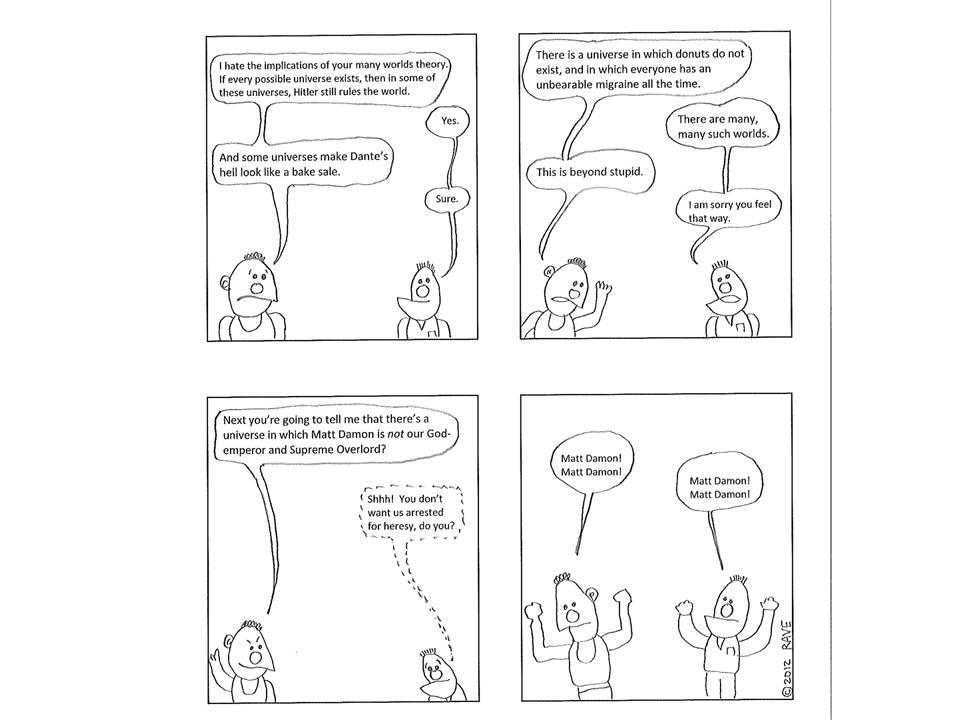
Posted in Comix, Many-worlds Interpretation | Tagged many-worlds, Matt Damon | Leave a Comment »
Please don’t be offended!
A Socratic dialogue
[Inside PASCAL’s home. SOCRATES is watching television, while PASCAL is kneeling in the corner, praying.]
SOCRATES: They just bleeped a word on my favorite show!
PASCAL: Well, there are certain words you can’t say on TV.
SOCRATES: Like “fuck”, apparently.
PASCAL: Dear Lord!
SOCRATES: What, you don’t like hearing that word?
PASCAL: Heavens, no!
SOCRATES: And I bet you think that we shouldn’t be able to say “fuck” on television?
PASCAL: Certainly not!
SOCRATES: But why not? The word simply means “sex” or “intercourse” and you can say those words on the air.
PASCAL: The word f—, uh, the word you mentioned, is obscene. It is vulgar.
SOCRATES: What exactly does that mean? Would the word, if heard, harm the listeners in some way?
PASCAL: Of course. People’s sensibilities would be harmed. Decent people would hate to hear such rubbish.
SOCRATES: But why? Does the sound of a voiceless labiodental fricative preceding a mid-back, unrounded vowel and followed then by a voiceless velar stop somehow produce a dangerous resonance pattern that could damage the eardrums of unsuspecting people?
PASCAL: You mock me.
SOCRATES: Not at all. I am simply at a loss to understand how any word, any single morpheme, could possibly harm anyone, apart from the word being delivered at a dangerous volume level.
PASCAL: You misunderstand. It is not physical harm that such language can cause, but mental harm. Distress, if you will.
SOCRATES: But how does such distress come about? Do the concepts cause distress?
PASCAL: Why, yes.
SOCRATES: So the word “sex” offends you.
PASCAL: Well…
SOCRATES: Let me rephrase. Would the word “sex” offend an ordinary person, a person that…perhaps…had not written the Pensées?
PASCAL: I would think not. No.
SOCRATES: So the content of a word like “fuck” is not what offends, after all.
PASCAL: OK then, it is not the content of the word that offends, but the word itself. The word is offensive.
SOCRATES: For what reason? Is there some intrinsic property of the word that offends you…perhaps the way the word rolls off one’s tongue? Or perhaps you hate the word because it scores 13 points in a game of Scrabble, and 13 is an unlucky number?
PASCAL: The word is offensive. Everyone knows that.
SOCRATES: But do you mean that literally? Everyone? Would a person who speaks no English be offended?
PASCAL: Of course not.
SOCRATES: But why not?
PASCAL: They wouldn’t know what the word means.
SOCRATES: But we agreed that being offended doesn’t come from the meaning of the word.
PASCAL: Oh, uh…well, they don’t know it’s a vulgar word. They haven’t been raised in an English-speaking culture, so they don’t know that the word isn’t proper.
SOCRATES: So being offended by “fuck” must be learned.
PASCAL: Of course. One must learn correct etiquette, the right manners. Why should language be different?
SOCRATES: So you would agree, would you not, that being offended by a word like “fuck” is a completely arbitrary, learned behavior?
PASCAL: I would not say arbitrary. After all, that particular word denigrates what is actually a solemn bond between man and wife. That word cheapens the act itself. That can’t be tolerated.
SOCRATES: It can’t be tolerated? How come? What would happen if you did show tolerance?
PASCAL: The foundations of society rest on certain conventions, certain morals. If we allow vulgarities, the whole framework is weakened significantly.
SOCRATES: And then what would happen?
PASCAL: Society would become unraveled; in its place would be—
SOCRATES: A better society?
PASCAL: —anarchy.
SOCRATES: Can you really believe that allowing certain words to become less vulgar would mean that all society would crumble?
PASCAL: But there is nothing we can do. There are always words that will be vulgar; you cannot make them less so.
SOCRATES: Why not? We’ve already shown that a word like “fuck” offends only because society arbitrarily says so. Well, we are society, all of us, are we not? What if we simply said that “fuck” is hereby no longer a “dirty” word. It means, simply, “sexual intercourse”—if taken as a verb—or “I am very displeased” if taken as an interjection. How could such an action harm society? Wouldn’t it help, in the sense that no one will ever again feel mental distress when that particular word is pronounced within earshot?
PASCAL: Such a thing could never happen. Proper people will always be aghast at the mentioning of obscenities.
SOCRATES: Ah, but there’s the rub: how will they know which words are obscenities and which are not? What if society refuses to sort this out for them?
PASCAL: You propose an end to all that’s decent!
SOCRATES: Not at all, my bridge-dangling friend. I propose to remove an arbitrary system of “word regulation” from our society, because doing so will make our society that much better. No one will ever be offended by “dirty” words again, because there will be no dirty words! We would have a society in which censorship would be nonexistent, and in which freedom of expression would reach new, unexplored levels.
PASCAL: You are persuasive, but servants of the Devil often are. But now I think I see what you are doing. In grand Orwellian fashion, you propose to make odious words acceptable by simply indoctrinating people. Brainwashing them.
SOCRATES: No, that’s your jurisdiction. Look at it this way: I am not trying to make murder more acceptable, simply by calling “murder” by another name such as “wexelflugen”. You cannot change concepts by switching their labels around. “A rose by any other name…” But you can change the connotations a given word has, if you want, because words are just placeholders for concepts around us. Why not take all the so-called vulgarities and throw them out the window? Who says that our language has to have any vulgarities at all? Why don’t we all just agree that no word will ever again bother us, ever offend us? Don’t people have enough control of their own minds to make such a decision…a decision that would benefit everyone?
PASCAL: Well, be that as it may, some concepts would remain offensive. There’s nothing you can do about that.
SOCRATES: There isn’t? Give me an example of something—not a word—that offends you.
PASCAL: OK. Violence offends me. Surely you will not try to tell me that we should all just agree that violence is acceptable, and that we should all live with violence happily.
SOCRATES: You are right, I will not. I abhor violence; the very idea of murder sickens me.
PASCAL: A ha! Then you agree with me.
SOCRATES: Well, yes and no. “Violence” does not offend me, but violence does.
PASCAL: Um. I’m confused. You just said—
SOCRATES: I said that I abhor violence. But “violence” doesn’t bother me.
PASCAL: What is this, semantic trickery?
SOCRATES: I do not like violence; I dislike seeing graphic pictures of murder victims; I become nauseated at the thought of war; the sight of blood often makes me sick.
PASCAL: Then violence offends your soul.
SOCRATES: I suppose. But talk of violence doesn’t bother me at all.
PASCAL: What do you mean?
SOCRATES: I experience certain physiological symptoms when exposed to violence, but if someone says “murder” or “rioting” or “rape” or “you may eat the flesh of kings” then I am not offended. And what I mean by that is this: I do not like to see or hear violence as it is committed, nor do I enjoy thinking about violent acts, and I certainly am very angry that certain forms of violence still exist in this world. However, the concept of violence, the abstraction, can’t “offend” me any more than the concept of volcanoes or tsunamis or great white sharks. Maybe I don’t want to be near them, but how can they “offend” me? And if you talk about them, why should that bother me?
PASCAL: Let me understand. The word “murder” is not offensive. And a discussion of murder is not offensive. But if someone commits murder—
SOCRATES: Then yes, that would bother me. Look: concepts like murder are too important as issues for people to ignore just because they’re afraid their sensibilities might be punctured. And this applies to other concepts I dislike as well: bigotry, deception, subjugation—these words do not offend me, because I do not let them. But the acts themselves very well might piss me off.
PASCAL: But if a word is used in a hateful way, such as a racial epithet…
SOCRATES: Again, don’t blame the word. What I find offensive in such a case is the insensitivity (or downright malice) of the speaker, their intent to harm. So saying “fuck you!” might be offensive not because that particular phrase was uttered, but because of the intent of the speaker.
PASCAL: But then it would be too hard to sort out what was offensive and what was not! If you always had to check the context—
SOCRATES: Sorry, but you have to do that anyway. “Pain” means one thing to us, and quite another thing to the French.
PASCAL: I am at a loss for words.
SOCRATES: Here is my manifesto. Many people, when encountering an idea they find distasteful, turn up their noses and say they are offended. I, however, cannot be offended by ideas—that is, by abstract words devoid of context. Nothing in the abstract can offend me at all, and I am very proud of this fact. Sure, there are things I don’t like to see (like rotting corpses) or hear (like fingernails on a blackboard) or smell (like a diaper full of shrimp) but these things don’t offend me. Why should I hold a grudge against such phenomena? I don’t like them, but that’s not a problem: I can shut my eyes or cover my ears or pinch my nose shut. I choose not to participate in these sensory experiences—choose—and for quite understandable reasons. My aversion to such things is instinctual, biological, untainted by arbitrary sociological constraints. Now, in certain cases, I cannot choose to avoid something, in which case I am offended by the selfishness of the perpetrator. If you smoke in an elevator with me, I will be offended because I have no choice but to breathe your noxious detritus. If you commit murder or cheat on your taxes or beat your wife, I will be offended because you have committed a crime, and betrayed an implied covenant between you and the rest of society. But I emphasize again that the words “murder” or “cheating” or “beating” can’t offend me, as they’re just words. And so too, the word “fuck” cannot have any effect on me at all.
PASCAL: Well then.
SOCRATES: Being offended is a learned skill. There is no evolutionary gain to having people grimace when they hear a collection of phonemes such as “clusterfuck”. People are offended by such a word because they choose to be offended, but do not even realize that they have a choice. The content of the word is irrelevant…else “group sex” would offend just as much. But it does not.
PASCAL: Speak for yourself.
SOCRATES: You don’t look convinced.
PASCAL: Well, your discourse has offended me.
SOCRATES: Touché!
PASCAL: And I would wager that some part of you is offended, as well. You just can’t admit it.
SOCRATES: You and your wagers.
PASCAL: Anyway, I’ve made some tea out of Queen Anne’s Lace. Would you like some?
SOCRATES: Not really. There’s something about that plant that offends me—
PASCAL: No matter. I have to catch the carriage to Neuilly anyway.
SOCRATES: And I must kill a rooster for Asclepius. So long.
Posted in Rant, Socratic dialogue | Tagged language, vulgarity | 6 Comments »
Ouvroir de littérature potentielle (Oulipo for short) is a group of mainly French writers and mathematicians who create works with rigid constraints, in order to spark creativity and celebrate wordplay in general. My favorite example is the extraordinary sonnet “Washington Crossing the Delaware” by David Shulman, in which every line is an exact anagram of the title. Shulman wasn’t French and neither am I, but c’est la vie.
Here is my attempt at an Oulipo poem. See if you can determine the rigid constraint at play.
An Oulipo Poem
Aim your arrows carefully, and
Be careful not to miss your target. Do you
See how important the
Demarcation of the boundary is?
Even the best archers miss, in
Effect piercing the innocent, like
Jesus and His stigmata; “on target” is the
“A” choice, and off the bloody circle is the “B”.
I, myself, prefer to think my fletching’s made of
Jade, mined from whatever Byzantine
Cave my heart carves out; full of
Elements and isotopes and
Empathy for the Devil. You, there, conscience,
Enter that cave:
Open its mossy portals, discern its shadowy
People, and, on
Cue, whistle to the bats and darkness within.
Are you with me, there, inside that cave? In
Essence, the arrows and the cave are but metaphors; each a
Tease, exotic, exigent, taunting
You
Vehemently as you try to count your blessings. You
Double, you triple, you quadruple your count but nothing
Extra remains: the cave is empty, the arrow has missed its target, the darkness descends—
Why? Because your pain has reached a
Zenith—
Posted in Poem | Tagged Oulipo | 1 Comment »
It may seem odd that this blog is called “Many Worlds Theory” and yet I have not yet blogged about, well, many worlds theory. Well, I am doing so now.
The arguments that lead a sizable portion of theoretical physicists to postulate a multiverse are subtle and complicated. I hope to eventually cover these arguments, but I’d like to start with a discussion of what many worlds is not. Therefore, with much fanfare, I present to you:
The Top 5 Misconceptions About the Many-worlds Interpretation (MWI) of Quantum Mechanics
1. Every time you do a quantum experiment, the universe branches into multiple universes.
This is a popular notion, as seen in TV shows like Nova and as presented by Martin Gardner. Unfortunately, it is the wrong way to look at things. It is much better to imagine that all of the possible universes already exist, and that doing an experiment just tells you (the experimenter) which universe you happen to be in.
Suppose you’re watching Star Wars. You have no idea whether you are watching the original, or the retconned 1997 version. You finally realize which version you’re watching when you see Han shoot and kill Greedo without Greedo ever getting a shot off. You conclude you’re watching the original version.
Of course, up until that point, the movies are exactly the same. (Rather, let’s just say they are the same. I haven’t actually checked this.) You wouldn’t conclude, when you got to that scene, that two movies were created from one, would you? There were two movies all along; watching Han shoot first just told you which movie you were watching. A physicist who performs a Stern-Gerlach experiment doesn’t split the universe in two; doesn’t create a whole universe; instead she has gained some new information: “Oh, so that’s what universe I am in.” No new physics of universe-creation is needed, and we need not violate conservation of energy.
2. The existence of a multiverse is a postulate of a strange kind of quantum mechanics.
There is a formulation of quantum mechanics often called universally valid quantum mechanics, which was first described by Hugh Everett III in 1957. It involves (see this for details) just one postulate: isolated systems evolve according to the Schrödinger equation. That’s it. A multiverse is a prediction of this postulate, not a postulate in and of itself. So if you believe that isolated systems evolve according to the Schrödinger equation, you will be led to the MWI, unless you invent new postulates to make yourself feel better (see #3).
3. The Many-worlds Interpretation has a lot of baggage.
This obviously depends upon what you mean by baggage, but the claim is often made that the MWI is horribly antithetical to Occam’s razor. That is, how could anyone seriously believe that countless billions upon billions of universes exist, when believing in one universe is much, much simpler?
If you feel this way, I have two responses.
One: how can you believe that countless billions upon billions of stars exist, when believing in just one star is much, much simpler? Shouldn’t you be Earth-centric, and call for Galileo’s excommunication? Or what about the integers? Mathematicians claim that there are an infinite number of them, but infinity is too hard to fathom, so why don’t you just say that there are a lot of integers, but that there is only a finite number of them? There. I bet you feel better.
Two: like it or not, Occam’s razor cuts both ways, and can be used to defend MWI. The idea is whether Occam’s razor applies to the number of universes, or the number of postulates in your physical theory. As Max Tegmark pointed out, universally valid quantum mechanics leads to a multiverse as a consequence. In order to get the Copenhagen interpretation (for years, the most popular flavor of quantum mechanics) and rid yourself of those pesky many worlds, you have to take Everett’s quantum mechanics and add one additional postulate: that wave functions collapse according to random and ultimately unknowable criteria. That is, the MWI is simpler in the number of postulates required. As Tegmark put it, which way you use Occam’s razor depends upon whether you prefer many worlds, or many words.
4. The Many-worlds Interpretation is not falsifiable and therefore not science.
The jury’s still out on this one, but many people (including David Deutsch) think that the MWI is misnamed: that it is actually a theory in and of itself, and that it is falsifiable. I haven’t made up my mind on this.
I tend towards Tegmark’s view that MWI is an untestable prediction of quantum mechanics, which is testable. Because we take quantum mechanics seriously, we have to take one of its children (MWI) seriously. As Tegmark says, it’s like black holes. We can never see inside a black hole, so what goes on in there is never falsifiable; yet we take black holes seriously and call black holes “science” because general relativity (the theory that predicts black holes) is so successful.
5. The Many-worlds Interpretation is fringe science and only believed by kooks.
These kooks include Stephen Hawking (who said the MWI was “trivially true”), David Deutsch, Bryce DeWitt, and Max Tegmark, among others. They also include a sizable number of theoretical physicists working today. In 1995 one poll (published in the French periodical Sciences et Avenir in January 1998) showed that 58% favored MWI; see also this informal 1997 poll.
Maybe we are all kooks. But there are a lot of us, and the number is growing.
[Note: my book Why Is There Anything? is now available for download on the Kindle! This book examines the many-worlds interpretation from a philosophical perspective.]
Posted in Many-worlds Interpretation | Tagged many-worlds, Physics, science | 5 Comments »
What if there were a way to increase donations to worthy causes, while at the same time help fight this country’s obesity problem?
I think there is a way, and it would be simple to test. Suppose fast food restaurants that offer “meal deals” (burger + drink + one side, say) offered a $1 donation to Oxfam (or any other charity) as one of the side dish options?
There are two obvious benefits. One, I believe that people donate to charities more if they can do so conveniently. I myself had never given money personally to a hungry family, but when a local grocery store asks me if I want to buy a box of food “for the children” I do so almost automatically. Convenience allows us to then feel good about ourselves.
Secondly, people who choose this “side dish” are clearly missing out on calories that most don’t need anyway. How often do people get french fries, even when they don’t want them, just because they “came with the meal”? And subsequently, how many people eat the fries, because they paid for them–-even if they are no longer hungry? I’ve done this myself, although it seems irrational in hindsight.
What if instead I order a $5 meal deal and the cashier asks, “What side?” and my response is, “give it to the hungry”, and the restaurant then has some automatic money transfer mechanism in place to make the donation in an instant? I don’t know which would do society more good: the money raised, or the calories not consumed. Why isn’t this a win/win? Or a win/win/win, since the restaurant doesn’t lose anything, and only gains the positive PR? It would even show evidence that the restaurant has heard the message of “Supersize Me” and taken it to heart.
I think this idea is a good one, and I hope someone reads this post and shares the idea. All it would take would be one restaurant to start doing this, and before long all of them would be doing it. I can’t see a single downside at all.
Admittedly, this may have been tried before. If so: I wonder why it hasn’t caught on? What are the economics of such institutionalized charity? I think there are other interesting questions at play here…does charity in fact increase when it is convenient to give? (I’d love to see the research data on this.) Would people forgo empty calories in such a scenario? What would be the economic benefit of millions of calories not being consumed? Might there even be an adverse effect for, say, the potato industry, if less fries are scarfed down?
Let me know what you think. And please share this if you think that someone, somewhere, will see it and have the possibility of implementing it.
[Note: this blog post was originally written on Dec. 15, 2010, and emailed to a celebrity who will remain nameless. Needless to say, there was never a response…not even an automated one.]
Posted in Uncategorized | 5 Comments »

My contribution to the “What I Really Do” meme, back in February 2012.
Posted in Image | Tagged "What I Really Do", memes, Physicist, Physics | 3 Comments »
This blog was supposed to be about science, not politics, so today (the day after the 2012 US presidential election) I will limit my comments to two brief points. Then hopefully I will be able to forget about politics until 2014.
(1) The election results shouldn’t be a surprise to anyone who’s a fan of hard data, scientific analysis, and cool-headed statistics. On Monday, Nate Silver predicted an easy electoral college victory for Obama, and his predictions were spot-on. Some ballots are still uncounted, and I don’t think Florida has been called yet, but as far as I can see he got all 50 states correct. No, Nate Silver is probably not a witch; he just analyzed all the polls, and refrained from cherry-picking “one data point” to match some preconceived notion. (In my opinion, media outlets just said the race was “close” because that’s what generates buzz and revenue.) Nate Silver’s approach is moneyball all over again, but in the political arena. (Knowing Nate Silver’s history with baseball prediction makes this statement all the more pertinent.)
I have friends who doubted Obama could win because of economic indicators that traditionally make re-election improbable. There are two problems with this. One is that the Republicans have shifted so far to the right of mainstream America on social issues that a tipping point has been reached: for many, it’s no longer the economy, stupid. (See yesterday’s blog post.) But another problem is that Americans, for better or worse, don’t tend to see the economy in absolute terms but in terms of change. Objectively, the economy might have been bad; but it had been improving slowly but steadily since 2009. As Nate Silver (the not-witch) put it back in August, “The economy is bad enough as it is, but voters in past elections have judged incumbents by the amount of progress in the economy, rather than how productive it is in an absolute sense.” In physics terms, you feel the acceleration, not the velocity.
(2) Ultimately, the bigger news might be the sea change on issues such as same-sex marriage and the legalization of marijuana, due in large part to younger voters. If one looks at history—if one looks at social issues—one can only conclude that liberals always win in the end. Monarchies are abolished, human rights are proclaimed, governments sever ties to religion, slavery is abolished, workers are unionized, women get the vote, disenfranchised groups gain civil rights, and humanity moves forward. The writing’s on the wall. All I can say is, get used to it. Younger voters will all become tomorrow’s older voters. No doubt tomorrow’s older voters will be dead-set against suffrage for cybernetic organisms, but that’s another issue entirely.
I’m stopping now. Most of this blog is opinion, and in no way expresses the thoughts or opinions of theoretical physicists in general. No wait: maybe it does. Remember, a 2009 survey found that only 6% of scientists are Republicans. I wonder why.
Posted in Rant | Tagged Nate Silver, witches | 4 Comments »
Economics don’t matter in today’s election.
At least, they don’t matter to me.
There are smart people who think Obama’s economic plan is better for America. There are smart people that think Romney’s plan is better. We have some idea of Obama at work, and with Obama at the helm the economy has improved gradually since the Wall-street induced recession of 2008. But maybe you think Romney could make the recovery go faster. Who knows? My own opinion is that we are crossing a stream, and by all indications the horse we’re on is slow but he’s getting there. But maybe you’d rather switch to an untested and mercurial horse instead. I don’t really know which horse would be better, from an economic standpoint.
Let’s be honest. You don’t know either.
Oh, there are a few people who claim to understand the economic issues involved. But let’s face it, “experts” can’t really pick stocks better than monkeys or dartboards. Why do we expect the American economy to be any more tractable? In the language of mathematics, the economy is a chaotic system. Any small change in policy is likely to produce unpredictable results. So when you pick a candidate based on “economic principles” you’re really just saying “I believe this candidate’s meaningless economic rhetoric more than the other guy’s meaningless economic rhetoric.” If you have a PhD in economics, maybe I’ll give you the benefit of the doubt…but if you’re a truck driver, or a doctor, or a waitress, or a welder, then your ideas about the economy are probably total bullshit.
I am a physicist. My ideas about the economy are bullshit.
Ever play one of the Civilization computer games, such as Civilization V? If you have, you see how complicated and interconnected every decision is. You have to juggle money, and the happiness of citizens, and threats foreign and domestic, and culture, science…the tiniest decisions can have huge ramifications, and no monolithic blanket ideology will get you to the promised land of victory. It’s a balancing act. Sometimes you have to raise taxes. Sometimes you have to cut them. Sometimes you increase education, sometimes you build infrastructure, sometimes you go to war, sometimes you seek a diplomatic solution.
If the pundits are to be believed, being president is simpler than this. Just drink the Flavor Aid, follow the party line, and everything will be great. Being president is as simple as doing everything that Rush Limbaugh (or Michael Moore) says.
I don’t buy it. And if you’re honest with yourself, you won’t either. Just say it to yourself: “I know nothing about economics. I know nothing about economics.”
Why is it that people who admittedly know nothing about chemistry, poetry, physics, differential equations, music theory, pottery, animal husbandry, statistics, number theory, ancient history, modern Japanese culture, biology, leatherworking, genetics, Shakespeare, phonetics, linear algebra, astronomy, geology, philosophy, music history, Greek, marketing, calculus, modern history, evolution, quantum mechanics, medicine, world religions, and engineering, think that they know anything about complex economic issues?
(Not you, Ken Rogoff. I know you know economics.)
Why is it that people who are ignorant of 99% of the world’s body of knowledge still have strong beliefs concerning tariffs or debt ceilings or free trade agreements or progressive taxes? Let me be frank: if you don’t know what something is, you have no logical right to an opinion about it. (Do you think that decoherence is sufficient to explain effective wave collapse, a la the Copenhagen interpretation? Or do you feel that, ultimately, some non-local theory will gives us the loophole we need to sweep Bell’s Theorem under the table? I didn’t think so.) Just once I’d like to see a fry cook from Burger King say, “I have no opinion regarding stimulus money…I don’t understand all the complex economic concepts involved…but you know, the Thirty Year’s War was less about Catholic/Protestant bickering and more about the Bourbon-Habsburg rivalry.”
So. The economy shouldn’t matter in your voting decision. So where does that leave you?
Well, what’s left are social issues. Issues like civil rights for the LGBT community, civil rights for women, civil rights for immigrants, the failed war on drugs, the continuing (attempted) theocratization of America. I can’t in good conscience vote for a party that denies the fact of global warming (and here’s where I will play the “PhD in physics” card), the fact of evolution, the fact that the Earth is billions of years old. The Republicans give every impression that they are the anti-science party, the anti-women party, the party of a solely-Christian America, the party of Wall Street. If that is not the case, it is still true that very few Republicans distance themselves from such stances.
If you vote for Romney, don’t hide behind the “I just prefer his economic policies” defense. At least have the courage of your convictions. Say what you truly are, and why you prefer the Republican social nonsense.
I am a liberal, in the best sense of the word: the world could be better, and we have a long way to go.
What are you?
Posted in Rant | 11 Comments »
As I was driving to school today, there was a story on NPR about an upcoming ballot initiative in Missouri. Proponents want to raise the cigarette tax from $0.17 per pack (the lowest rate in the nation) to $0.90 per pack. The idea is to generate some revenue and at the same time discourage smoking.
Missourians love their cancer sticks.
Now, I’m not going to go into the pros and “cons” of the initiative. I would be for it, based on some pretty common-sense data, but I don’t live in Missouri so I guess my opinion doesn’t matter. However, I’d like to comment on some squishy reasoning put forth on the radio by an opponent of the measure.
In a nutshell: “The measure,” the opponent says, “wouldn’t raise money at all. It would actually lower revenue. That’s because any gains made by raising the tax would lower the amount of regular sales tax accrued.” [Note: this isn’t a verbatim quote but a recreation based on my imperfect memory]
You see, Missouri has a 4.225% sales tax which also applies to cigarettes. And, the “logic” goes, if less people are buying cigarettes, the less sales tax revenue would be generated.
Really? Is this person completely innumerate? Let’s say that a pack of cigarettes costs $6.00. Without the ballot initiative, a Missourian would pay $6.00, plus $0.25 in sales tax, plus $0.17 in cigarette tax, for a total of $6.42. The state gets $0.42 cents a pack.
Under the new plan, a smoker pays $6.00, plus $0.25 in sales tax, plus $0.90 in cigarette tax, for a total of $7.15. The state gets $1.15 cents a pack, obviously an increase.
To be fair, the state does actually lose money if the gain in revenue per pack is offset by the loss in the number of sales. But when would this occur? Let’s use algebra to find out. Suppose that N1 is the number of packs of cigarettes bought in Missouri in a given year. Under the current system, and for a $6.00 average price per pack, the yearly intake for the state is just N1 x 0.42. Now let N2 be the number of packs bought under the new plan. It’s easy to see that if the proposal passes, the yearly intake for the state is N2 x 1.15.
The problem is that N2 < N1 (presumably). So the proposal loses money if N1 x 0.42 > N2 x 1.15, which, after one line of 8th-grade algebra, is the same as N1/ N2 > 2.74. That is, translated into English, the new proposal loses money compared to the current system if state cigarette purchasing goes down by a factor of almost 3.
I don’t know about you, but I seriously doubt this initiative will cut smoking in Missouri by that much.
The numerically savvy will notice that there is a subtlety. This result is for a $6.00 pack of cigarettes. What if the price is much different? This matters, because the cigarette tax is a flat number added to a pack, whereas the sales tax is a percentage. If cigarettes cost the same as houses the ballot initiative would be ridiculous, since 4.225% of a huge number is much, much greater than a measly $0.90. No one would buy cigarettes at all, and the state would lose a lot of revenue.
Is there a tipping point? That is, is there a price for a pack of cigarettes for which the proposal loses money for any decrease in purchasing? Surprisingly, the answer is no. Mathematically, we would say that N1/ N2 = 1 only when the price of a pack is infinite.
But setting the bar at N1/ N2 = 1 is unrealistic. Any tax hike will cause some smokers to buy less. So let’s make an educated guess: looking at the first graph at this site, I can see that a price hike of $0.73 produced a corresponding decrease in consumption of about 25%. (The actual drop would probably be less than this, since in the 1980’s and 1990’s $0.73 represented a higher percentage of the cost of one pack). So we let N1/ N2 = 1/0.75 = 1.33, and solve for the price of cigarettes.
You get $48.33. For one pack of cigarettes.
Conclusion: the proposed tax increase would increase revenue even with a plausible decrease in sales, unless cigarettes cost around $48 or more per pack.
Yay algebra!
Some close analogue to Mark Twain or E. B. White (with so many misquotes on the web, you can’t be very sure these days) said that analyzing humor is like dissecting a frog: you don’t learn much, and the frog dies. So why did I dissect this frog, and show all the gory math details?
I wanted to point out that there is a lot more mathematical detail in most stories you hear, most issues you examine, than you suspect. And I want to emphasize: if you don’t know math, if you are not mathematically literate, then you don’t know much of anything.
There. I said it.
Go study your algebra.
Posted in Uncategorized | Tagged math, Proposition B | 2 Comments »
When I heard the poet talking about hearing the learn’d astronomer,
When the poet mentioned how all the proofs, the figures, were ranged in columns before him,
When the poet described how he was shown the charts and diagrams, and how to add, divide, and measure them,
When I sitting heard the poet where he read with much applause in the lecture-room,
When I realized of a sudden, how the theme of the poem was “ignorance is bliss” and “beauty and science are incompatible,” and [holding hands over ears] “please! O please! don’t tell me how anything in this Cosmos works, since then it would cease to be ‘poetic’!”
How soon very accountable I became tired and sick,
Till rising and gliding out I wander’d off by myself,
In the rational moist night-air, time to time,
Look’d up in perfect silence at the stars,
Thinking about the fascinating Bethe-Weizsäcker-cycle.
(Sept. 25, 2009)
Posted in Poem | Tagged astronomy, science, Walt Whitman | 5 Comments »
 Many Worlds Theory