Feeds:
Posts
Comments

“I tried to start a business, but it failed. It must be Obama’s fault.”

People make this sort of argument all the time. They use their own experience (i.e. one data point) to make some generalization about POTUS or Congress or the governor or whatever. But such arguments are, most of the time, completely bullshit.

I’ll go out on a limb: if your business failed, it’s probably your fault.

The fact of the matter is, it’s hard to succeed in business. After about six years or so, over 50% of new businesses have failed. [See here to see where I got my hard numbers, most of which come from the U.S. Bureau of Labor Statistics.] How do you know, if your business failed, that it was x, y, or z’s fault and not your own? Would your business have really survived, even under a perfect utopia of your imagining?

First of all, the consistency of the “current administration” (and by that I mean POTUS and Congress and the governor and your local city council and so on) doesn’t really matter jack squat when it comes to business survival rates. Check out this graph:

jobs

There’s no noticeable difference between Clinton, Bush, and Obama here. 20% to 25% of all new businesses fail in their first year, no matter who’s in charge. (This is a little hard to see from the graph directly, as the x-axis is shifted in a strange way.  I used the hard data here.)  After a decade, roughly two-thirds have failed. You can blame POTUS if you like, or alternatively, blame whoever is controlling Congress, but either way you’re slipping into the No True Scotsman fallacy: “Sure, 25% of businesses fail in their first year, but I am different… I would have succeeded had it not been for x, y, or z. I am not bad at business; I would have succeeded if only…” You get the idea. (By the way, and anecdotally, if I were playing a blame game, I’d be more likely to blame a governor, because in my experience state policies tend to effect businesses more than federal policies.)

Now, I’ll admit that certain laws (passed by Congress) or policies (enacted by POTUS) can hurt businesses in specific instances. If you start the Acme Widget corporation, and there’s a huge Widget Tax enacted, your business might fail, and you wouldn’t be remiss in blaming Congress or POTUS. But I’m more interested in generalizations: given that your business failed, can we estimate (if at all?) whether or not it was your fault, or someone else’s fault?

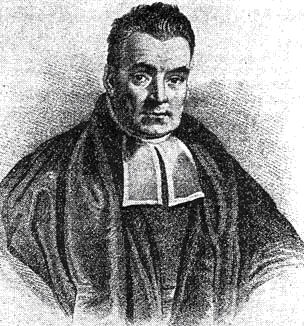
Here’s where Bayes’ Theorem comes to the rescue. First, let’s make some definitions. Let

P(good) = Probability that a random person is good at business;

P(suck) = Probability that a random person sucks at business;

P(fail|good) = Probability that your business fails in year 1, given that you’re good at business;

P(fail|suck) = Probability that your business fails in year 1, given that you suck at business;

P(suck|fail) = Probability that you suck at business, given that your business failed in year 1.

Bayes’ Theorem can help us calculate that final quantity, given assumptions about the previous four. Let’s start with a pretty arbitrary guess:

P(good) = 20%

P(suck) = 80%

What’s my justification for saying that 4/5 people suck at business? Well, the graph above seems to be approaching 20% asymptotically. Only 20% of businesses survive “for the long haul”. And 20% “feels” right: most people aren’t good at business, but there’re still millions of people who are.

Now, let’s say 1000 people start a business. Based on the assumptions above, 800 of them suck at business, whereas 200 of them are good at it. We’ve already mentioned that (say) 75% of the businesses will survive their first year, and 25% will fail: 750 vs. 250. Let’s further assume that

P(fail|suck) = 30%.

I pulled that percent out of a hat, but it seems reasonable to assume if 25% of all businesses fail in their first year, then more than 25% of businesses run by sucky managers will fail. But not too much more: 75% of businesses still succeed in their first year, no matter who is running the show. With P(fail|suck) fixed, we’re forced to concede that

P(fail|good) = 5%.

Bad luck, that. Some 5% of businesses run by good managers will still fail in their first year. These are the people who can rightly blame the administration. (Where did the 5% come from? Well, 30% * 800 + 5% * 200 = 250 failed businesses.)

Now: on to Bayes’ Theorem! (For a discussion of how to use this handy tool, see here). We find that

P(suck|fail) = [P(fail|suck) P(suck)]/[ P(fail|suck) P(suck) + P(fail|good) P(good)]

P(suck|fail) = [(0.3) (0.8)]/[ (0.3) (0.8) + (0.05) (0.2)] = 0.96

Translated into English, this means that if your business fails in its first year, we can conclude that it was probably your fault. There’s about a 96% chance that you suck at business.

This is a fascinating result…and you’ll get similar results no matter what assumptions you make, as long as they are reasonable and consistent. For one thing, you’ll always get that P(suck|fail) > P(suck). If I take a person off the street, they have about an 80% chance of sucking at business. But if I take a failed business owner, someone whose business failed in its first year, then I have some extra data, and their chance of sucking at business has gone up to 96%. (There’s a 4% chance that they are good at business but got unlucky.)  A person whose business fails has no right to complain about their failure. It was probably their fault.

There are two lessons here. One, stop whining. Two, remember Bayes’ Theorem!

Thomas_Bayes

I suck at business, too.

Cage

Google poetry

Inspired by Elke Stangl, whose idea this was (see here for an explanation of the canonical rules), I hereby give my first attempt at Google poetry:

Life is just…life.

OK, so, never mind.

It doesn’t matter.

Therein lies a tale.

It’s winter because we’re far from the Sun.

There’s no place for you in such a conformist world.

Am I doomed?

Insert your own joke here.

tardigrade.jpg


A poem.

2 aspects of a Christ.

1.

The hand goes hand in how?  Exacto.

An eye for an E, for E, five thoughts (but only with an app-le.)

And He asks: is your life limned or dimmed?

Hand in—hand in your chits held up in a metal sandbox.

Enumerate your friends? pain? fossils? eyeteeth?

breakfast? not-in-a-drop? spankers?

cask binders? 1-benzylhydryl-4-methyl-piperazine?

Two slashes to the banishment room!

Here sits my sphinx in desert sands and androids, lampreys, chitinous destinies, going:

Redacted.  Redacted.  Redacted.

2.

No.

jesus-and-iphone

[Reposted from Dec. 4, 2012]

romeo

For I ne’er saw true beauty till this night…

’til is not a word.

Please, use either until, or till.  Some people think that ’til is an abbreviation of until, but this is folk etymology.  “Till” is the older word by far, going back to at least Shakespeare’s day.  For example:

John 21:22 (KJV)     Jesus saith unto him, If I will that he tarry till I come, what to thee?  Follow thou me.

Romeo and Juliet: I, v     For I ne’er saw true beauty till this night.

Also note that “Till death us depart”, from the marriage liturgy in the Book of Common Prayer, dates back to 1549!  It became “Till death us do part” in 1662.

Seeing advertisements for the old Fox show ’til Death always grated on me like fingernails on a blackboard.  Luckily, like most Fox sitcoms, that show departed quite a while ago.

You probably learned about projectile motion in introductory physics class. If you throw something (a baseball, say) then its horizontal motion will remain constant, whereas its vertical motion will change under the influence of Earth’s gravitational pull. The result is a parabolic arc, right?

Well, no. Saying that projectile motion is parabolic is only an approximation.

In class, I “prove” that the motion of the baseball is a parabola, but in order to do so, I make the (reasonable) assumption that the effect of gravity is a constant. That is, I assume that the vector g (the acceleration due to gravity) always points in the same direction all along the trajectory.

This is actually not quite true, however. I’ve neglected the curvature of the Earth.

Now, this isn’t really a big deal when throwing baseballs. Suppose you toss a ball to your friend 50 m away. The vector g for you does point in a slightly different direction then g for your friend, but the angular difference is miniscule…it’s about 50/637,000,000 radians, or 0.00045 degrees. This is so small that I am comfortable pretending that the two g’s are actually parallel, and the derivation thereby leads to a parabolic arc.

But what if you don’t make that approximation? What answer do you get?

You get an ellipse. You get an orbit. And here’s the point of my post:

Every time you throw an object, the object is (temporarily) in orbit until it hits the ground.

Here’s the orbit of a thrown baseball (not to scale):

orbit1

Now suppose the Earth had the same mass, but was the size of the Little Prince’s home asteroid B-612, which is as big as a house. The orbit is the same, but this time the baseball doesn’t strike the surface:

orbit2

The takeaway is that all projectile motion is really orbital motion. I find this fascinating: you don’t need a fancy rocket to launch something into orbit. Your arm will suffice. It’s just that you need the Earth to not be in the way.

I am a huge supporter of free speech.  I also support the right to make pariahs out of any bozo who still thinks the Confederate flag is not about racism.  And so, as a society, my proposal is simple:

flip

If enough people make fun of these asshats, peer pressure will kick in eventually.  They’ll see themselves as the losers we know they are.

On Monday, Republican presidential wannabe Rick Santorum said that the Pope should “leave science to the scientists”.

Sigh.

What that hell does that even mean?

hqdefault

What the hell?

If taken literally, it would mean that Santorum defers to scientists, and so if a policy issue concerning climate change were to arise, he would trust in the scientists’ collective judgment. That collective judgment is overwhelmingly unanimous; the fact that 97% of scientists in a particular field agree on a particular something is well-nigh miraculous.

But of course Santorum doesn’t mean that.

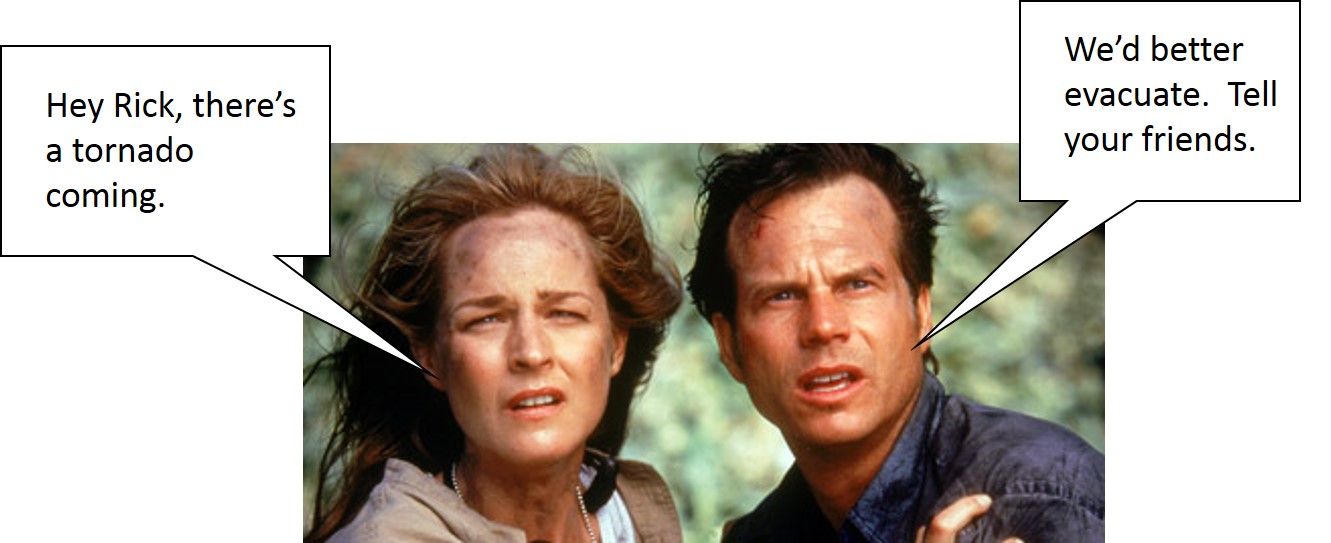
It could also mean that he thinks no one should talk about anything unless they’re an expert in the field. But that’s absurd, right? If a tornado approaches, would Santorum say that only meteorologists should talk about it? Surely not. [See my last post.]

In point of fact, “leave science to the scientists” is a kind of code these days among many Republican politicians. Here’s my rough translation:

“Despite what I may personally believe, my voting base is generally against human-caused climate change, and many of these voters even deny that climate change is occurring at all. On the other hand, if I personally deny climate change, I will look like an idiot to the something like 71% of the general public who agree that climate change is happening. So I will obfuscate: by punting to unnamed scientists, I can deflect the question; I can make my voting base happy while at the same time not actually saying I’m against climate change per se.”

This kind of obfuscation is odious to me. Slimy. Maybe it’s par for the course; maybe that’s how the game is played; maybe that’s just realpolitik. But I don’t have to like it. Someone needs to take Santorum (or any other Republican who spouts such nonsense) to task, and ask the following hard questions:

  • Does science ever effect policy making? If so, who do we turn to for answers? Should we listen to the experts, or listen to conspiracy-theory-soaked hate-spewing trolls?
  • If we should leave science to the scientists, doesn’t that mean we should accept the answers they give us? After all, they’re the experts, not us.
  • I hear, Rick, that you don’t believe in the plain fact of evolution. Do you by chance also believe in the Tooth Fairy? [OK, that was a non-sequitur, but I couldn’t help it.]

mount-pinatubo-eruption

Imagine Santorum is sitting beneath a mountain, and there are 100 volcanologists around him. 97 of the volcanologists say that the mountain is about to explode; 3 of them have doubts. But Santorum doesn’t listen to any of the scientists; he’s got Rush Limbaugh whispering in his ear, telling him “it’s all bullshit.” So Santorum says: “Leave volcanology to the volcanologists. Let’s do nothing.” His fan-base cheers—at least until the pyroclastic flow hits them all at 450 mph.

Santorum1

Santorum2

Santorum3

Santorum4

Santorum5

Today is Memorial Day, and while my father did not die in the service of his country, he did serve his country: as both a submarine officer, and later as an engineer working for the DoD.  And he did die, eight months ago.  He didn’t fall to an enemy bullet, or go down with his ship.  He died of ALS.

I am 46 years old.  When my father died last September, on my mother’s birthday, it was the first time I had ever experienced the loss of an immediate family member.  I feel lucky that I made it that far…46 years…before having such an experience.  On this Memorial Day I feel a need to share what I’ve learned, if anything.  Maybe I’ve learned nothing at all.

The pain is less than I thought.  Maybe it’s because of how he died…helpless with ALS…but when I first heard the news, my initial reaction was relief.  I thought, It’s over.  It’s finally over.  I didn’t cry, I didn’t break down; I moved on like the doctors in that Robert Frost poem:  “And they, since they were not the one dead, turned to their affairs.”  All the crying was done months earlier: when I saw him gradually lose the use of his legs; when I learned he really had ALS; when I heard he probably wouldn’t make it to Christmas.  Death is not always an evil, and my dad was finally at peace.

There is guilt.  I have guilt at how much relief I felt.  What right do I have for relief?  My sister and my nephew took care of my father for over a year before he passed.  They are the ones who should feel relief.  Relief, for me, doesn’t seem fitting.  I don’t think I did enough. I don’t think I visited enough.  I sometimes think I failed my family or my father somehow.  On a rational level, I don’t think guilt is a particularly useful emotion, unless it spurs you to change your behavior in some way.  But I don’t know if there’s anything I would have done differently.  And so the guilt remains.

The pain is more than I thought.  Sometimes, at odd moments, I will think of something that I want to share with my father: a good book, an incredible play in football or basketball, an amazing place I have visited.  It takes a second to remember that my father is gone.  And then that something that I wanted to share dies, too; falls away, like ashes, like dust.  It’s bitter.  It’s cold.  Whatever it was that I was going to share, I don’t share with anyone.

I can handle grief.  When you’re a kid, you may imagine one of your parents dying.  In your mind, it’s devastating.  If you’ve never grieved before, you will look to TV, books, movies…anything to give you some context, some framework, some way to imagine what such grief is like.  The lesson is always: grief is an unbearable, unimaginable pain.  It will devastate you.  It’s an abyss.  And yet…I’m 46.  A parent dying when you’re 46 is natural.  It seems like an expected thing.  There is pain, but the world moves on.  A week later, the adoption of my son became official.  Circle of life.

There is no Hallmark moment.  I never had a last talk with my dad.  No secrets were revealed.  I don’t recall the last thing I said to him, or the last thing he said to me.  Life is just…life.  And sometimes, it just…ends. I do remember the last thing I did with my father: we watched the movie Zoolander together.  I challenge anyone to find meaningful allegory in that.

I sense that my father lives on.  I don’t believe in any afterlife.  But that doesn’t mean that my father is gone forever.  On the contrary, there are memories and ideas and connections and neural pathways and patterns and dreams and software, inside my own mind, that I would definitely attribute to my father.  He’s not inside my head, like Baron Harkonnen haunting Alia in Dune Messiah.  But there is something in me attributable to him.  That’s not a bad thing, or even necessarily a good thing.  But it is continuity.  And it is fitting.

415680_4306833322495_55176632_o

OBITUARY

James Anthony Rave, 73, of Beaufort, died peacefully Thursday, Sept. 18, 2014, at home. No service will be held. Jim was from Cincinnati, Ohio, and graduated from the U.S. Naval Academy in 1963. After six years as a submarine officer, he continued to serve our nation as a federal employee with the Department of the Navy, finally retiring after a full career from Marine Corps Air Station Cherry Point. During his final years he kept active working as a contracting engineer and avidly reading science fiction and military history. He is survived by his wife of 51 years; four children; four brothers, two sisters; seven grandchildren; and two great-grandchildren.