Feeds:
Posts
Comments

The conventional wisdom among people who know a little bit of quantum mechanics is that quantum mechanics is weird.

The conventional wisdom is wrong.  Quantum mechanics is not weird.  Interpretations of quantum mechanics are weird.

My thinking on this has changed over the years.  In high school I read everything I could about the “weirdness” of our universe: Schrödinger’s cat, wave-particle duality, the collapse of the wave function, many-worlds theory, the Heisenberg uncertainty principle.

Then a strange thing happened: I went to college.  I studied physics.  And guess what?  None of that stuff gets more than the briefest mention in the physics classroom.  Why?

Because those things are beside the point.  Quantum mechanics works.  How you interpret quantum mechanics is your problem.

There’s a dichotomy here which is the source of most people’s confusion.  Theories are different from interpretations of theories.  A theory is a mathematical model that allows us to make predictions.  An interpretation is a philosophical construct that allows us to sleep at night; it is a squishy heuristic that helps us unimaginative humans make sense of the math before us.  Theories get things done.  Interpretations never helped anybody, not really.

sr_atlas_2b-015

An abandoned shack.

Let’s say that in an abandoned shack you discovered a notebook with the word “PHYSICS” written by hand over and over, thousands of times, apparently filling every page.  You haven’t looked at the last few pages, but your theory is that these pages will also have the word “PHYSICS” written out.  Each time you turn a page, your theory is validated: “PHYSICS” is there, as predicted.

Next to this notebook is another that looks just like it.  You open the first page, and are not surprised to see “PHYSICS PHYSICS PHYSICS” again.  What’s going on?  Did some crazy person live in this shack?  Such speculation doesn’t really matter, since you can still hypothesize that “PHYSICS” fills this notebook as well.  In fact, you have a stronger theory: every notebook in this shack is filled with “PHYSICS”.

You perform an experiment: you turn the page.  “PHYSICS PHYSICS PHYSICS”.  The experiment supports your theory.  You find more notebooks; same results.  Every notebook in the shack is filled, apparently, with “PHYSICS”.  But guess what?  There are dozens of possible interpretations.  And in the absence of further data, you can never know which one is “correct”.

Maybe the shack was once inhabited by a crazy person, who wrote “PHYSICS” precisely 250,001 times in a futile attempt at summoning Cthulhu from his ancient slumber.

Maybe a student misspelled “physics” on a test, and her cruel teacher punished her in the most depraved way possible.

Maybe Matt Damon filled the notebooks, in a method-acting attempt to get into the mindset of an OCD scientist.

Which of these interpretations is the “truth”?  Without further data you cannot really say.  Arguing about which is right and which is wrong is futile at best, and annoying at worst.

Of course, new data may turn up.  We might find out that the notebooks are 75 years old, ruling out our Matt Damon interpretation.  That interpretation is no longer a valid interpretation of the data.

Which brings me to my next point: there is no official arbiter of what constitutes a theory versus what constitutes an interpretation.  Different philosophers and scientists have used the words differently at different times.  All you can hope for is that a particular author is consistent in his/her use of the terms.  I personally use the word “interpretation” to describe competing theories that cannot currently be differentiated by any known scientific experiment.  If two different interpretations make different, testable predictions, then they are promoted to being totally different theories.  (Caveat: others use the words slightly differently.  Deal with it.)

So what does this have to do with quantum mechanics?

Quantum mechanics is an entirely mathematical theory.  Its postulates are logical, concise, and powerful.  We can use quantum mechanics to invent cell phones, computers, lasers, and iPods.  Quantum mechanics doesn’t care if you “understand what it really means”, or not.  It is arguably the most successful and powerful theory to come out of the 20th century.

Now, the mathematics of quantum mechanics are abstract and hard to visualize.  Nevertheless, people insist on trying to visualize anyway.  And the result is all kinds of weirdness: Schrödinger’s cat, wave-particle duality, the collapse of the wave function, many-worlds theory, the Heisenberg uncertainty principle.  These ideas are all mental hoops that people have jumped through to explain some unambiguous, concrete, abstract linear algebra.  The math is just math, and it works; what it means is anyone’s guess.

There’s no crying in baseball, and there’s no philosophy in quantum mechanics.

leagueoftheirown

There’s no philosophy in quantum mechanics!

Don’t like the many-worlds interpretation?  Fine.  Be a Copenhagenist.  Don’t like pilot waves?  Great.  Stick to your pet idea about superluminal communication.  Just remember that all of these competing interpretations make the exact same predictions, so for all practical purposes they are the same.  Some people go so far as to say, just shut up and calculate.  [Note added 3-19-14: there are problems with pilot wave theories that in my view rule them out as being a valid interpretations of quantum mechanics.  But there are hoops people can jump through to try and “force” pilot wave theories to be consistent with, say, Bell’s theorem.  My broader point is that there are multiple interpretations of QM and that all have followers to this day, but that none of the interpretations really have any distinct implications for our lives.]

I don’t usually go that far.  I actually think that the many-worlds interpretation is a testable theory, not an interpretation (hence the name of this blog).  I think many-worlds is falsifiable.  (If we ever observe a wave function collapsing, then many-worlds will have to be discarded.)  But I don’t think that will happen: many-worlds is too elegant, and too powerful, to not be true.

But we’ll see.

If you think it’s absurd that a cat can be alive and dead at the same time…if you think that it’s crazy to hypothesize other universes…if you think that God does not play dice with the universe…don’t blame quantum mechanics.  Blame the philosophers who try to interpret it.

Quantum mechanics works.  Otherwise, you’d be reading this on an actual piece of paper.

WARNING: Spoilers abound!

Do not read further if you haven’t seen the wonderful, awesome The Lego Movie!

There are two kinds of good movies.  The first kind is a movie you enjoy while watching; you appreciate the acting, the writing, the set design.  You come out of the theater thinking, that was good.  I’d recommend that.  In the past six months, I’ve seen many of these so-called Good Movies of the 1st Kind.  Examples include The Dallas Buyer’s Club, Rush, Captain Phillips, the second Hobbit movie, and the second Hunger Games movie.  I liked them all.

Emmet_Minifig

A metaphor for the everyman

But then there is a Good Movie of the 2nd Kind—a movie which leaves you jacked up on adrenaline, with a big goofy smile on your face, and ideas buzzing around the inside of your head.  A movie where you come out of the theater thinking, when am I going to go see that again?  I need to see that again.  What just happened?

Don’t get me wrong; a GM2ndK is not necessarily a happy, fun movie.  Saving Private Ryan was for me a GM2ndK; for weeks I could not get the first half hour (Omaha Beach) out of my head.  Schindler’s List was also a GM2ndK.  So was A Clockwork Orange, and Magnolia, and Paths of Glory.

So, too, The Lego Movie.

Unless you’ve seen the movie, you won’t believe it.  You won’t have the context, the conceptual framework, the raw materials from which to grasp the idea: that The Lego Movie is as profound and philosophical as any movie you’ve (probably) ever seen.

Oh sure, the movie is beautiful to look at.  The animation is unique and charmingly quantized and pixilated.  The pace is frenetic, action packed.  The worlds depicted are stunning, goofy and marvelous.  The jokes are non-stop: I laughed out loud two or three times a minute for 100 straight minutes.

So, I liked the movie.  But this post wasn’t meant to be a movie review.

My broader point is that the movie resonated with me, personally, philosophically, because it so closely matches my own world view.

SPOILERS!  PROCEED NO FURTHER, YE WHO HAVEN’T WATCHED!

The message of the movie is that there are two (seemingly) diametrically opposed ways of playing with Legos.  In the first camp are the conformists, who follow instructions to the letter, never have an original thought, and prefer a world of rigidity and order.  The head conformist is Lord Business, who wants to spray Krazy Glue on every Lego in the universe so that nothing ever changes.

To me, Lord Business represents the Abrahamic God, the God of the Old Testament.  The God of one single, rigid construction, exactly the way He designed it.  Don’t go against God’s plan (or the plan of Lord Business).  There is only one way the world (or worlds) can be, and if you oppose that plan—if you don’t follow the instructions—then you have committed heresy.  You will be melted.  There’s no place for you in such a conformist world.

Cmf_business

The God of Abraham

The other way of playing with Legos is the way children play with them: with unbridled imagination.  Sure, you can buy a Millennium Falcon Lego set and construct it as the instructions describe.  But you can ignore the instructions, too, and your play is just as valid.  Want to put Batman on the Millennium Falcon?  Sure; go for it.  Want to have Superman and Gandalf team up to battle a robot pirate?  Why not?  If you can imagine it, then you can do it, just as long as some adult doesn’t come down and spray the pieces with glue.

That’s what organized religion does: it sprays us with glue.

To me the world of organized religion is limiting, stifling.  The idea that there’s an omnipotent being that controls every aspect of everything is not comforting to me; it is horrifying.  Theologians mumble about free will and wave their hands reassuringly, but what good is free will if you’re still constricted by God’s plan?  If God has everything worked out, then you’re stuck to the world with Krazy Glue; your life is supposed to be lived in a single way and you’ll never be able to ignore the instructions.  You’ll never get to ride Unikitty into Middle Zealand and have tea with the Green Lantern.  Sorry, but you’re an average, run-of-the-mill Lego piece and that’s all you’ll ever be.

But imagine: suppose that there are an infinite number of universes, each with its own parameters, its own structure.  In such a multiverse, anything you can imagine is true.  There are still rules (each universe obeys its own laws of physics, just as Legos cannot escape their own block-like, quantized nature) but beyond those rules, anything goes.  And imagine there is no Lord Business that commands you to think in a certain way.  Imagine if you had the freedom to do as you will.

Here’s a table, to make the metaphor(s) more explicit:

In the movie… …is a metaphor for
A Lego person a human
The Lego world you’re in the universe you’re in
All of the possible Lego Worlds the multiverse
Quantized nature of Lego blocks the laws of physics
Krazy Glue God’s plan
Lord Builder (the Father) a rigid conformist deity
The Child the deity that any of us could be, using imagination
Instructions Rigid moral codes
“Everything is awesome” “Everything is awesome”

We are indeed trapped in the universe that we find ourselves in (we can’t get away from our quantized nature, alas) but we can at least imagine the other worlds, and dream, and find inspiration from them.  We can live our lives the way we like.  This isn’t anarchy; it’s freedom.  This world view doesn’t preclude morality; we shouldn’t put our hands into other people’s Lego Worlds, and mess the pieces up, and break their Lego constructions.  But we should be able to look at other people’s constructions, and value them, even love them.  If you want to have Batman marry Han Solo, and have them ride off into the Old West sunset (riding on Unikitty, no doubt) then I shouldn’t judge.  There is no Lord Business.  There is only what you can build, and what I can build, and what you can imagine, and what I can imagine.  We should not judge each other but embrace each other’s constructions.  Everyone’s trapped by the laws of physics, but no one’s trapped in their own minds; there are no laws that can ever force our imaginations to conform.

If God exists, then he’s a child, and wants us to play in all the worlds, and be free.  He wouldn’t even own a tube of Krazy Glue.

I was watching Dr. Who the other day and came across a physics mistake so common I thought I’d address it here.  The mistake is this:

Black holes suck you in like a vacuum cleaner!

The setup: in Dr. Who [2.8] “The Impossible Planet”, the good Doctor and Rose meet the crew of a ship who are on “an expedition [to] the mysterious planet Krop Tor, impossibly in orbit around a black hole.” [Wikipedia]  That phrase “impossibly in orbit” made me almost spit out my drink while watching the show.

Black holes have event horizons.  I get it.  Even light cannot escape.  I get that, too.  But why does that mean I cannot orbit a black hole?

OK, time for a little general relativity.  Einstein figured out, between 1905 and 1915, that gravity is “just” a warping of space-time.  Matter causes the space-time around it to curve; the curvature of space-time determines how matter moves (insofar as objects in the absence of gravitational forces follow geodesics).  The formulas that link the distribution of matter to the curvature of space are Einstein’s equations:

einstein_equation

This expression is compact and might seem relatively simple, but it’s not.  Gαβ and Tαβ are components of tensors, which are like vectors, but worse; they’re really 4×4 matrices.  So this equation is not one equation, but 16 different equations, since α and β can take on any of four values each.

What do all those letters stand for?  Gαβ is a component of the Einstein tensor, which tells you about how space-time is curved; the indices α and β can be any of four values in a 4D space-time.  (If you’re mathematically inclined, the Einstein tensor can be related to the Ricci scalar, the Ricci tensor, and the Riemann tensor.)  Tαβ is a component of the stress-energy tensor, which basically describes how matter/momentum/energy/stress/strain is distributed in a region of space-time.  So here’s another way to visualize Einstein’s equations:

einstein_explained

The cause (mass) is on the right; the effect (the curvature of space-time) is on the left.

So what does this have to do with black holes?

One of the first solutions discovered to the Einstein equations is called the Schwarzschild solution, which applies to a spherically symmetric gravitational source.  The solution gives you a “metric” (essentially, a geometry) that is almost the same as “flat” space-time, except for a pesky (1–2GM/c2r) term.  But that pesky term has a strange implication: when that term equals zero, the solution “blows up” (i.e. becomes infinite).  Space becomes so curved that you essentially have a hole in the fabric of space-time itself.

When does this happen?  It happens when R = 2GM/c2, as one line of algebra will show.  This is called the Schwarzschild radius.  The Einstein equations predict that something weird and horrifying happens when a mass is squeezed down to the size of its Schwarzschild radius.  Current understanding is that the mass would then keep going, and squeeze itself into a point of zero radius.  Literally, zero.  (I did say it was weird and horrifying).

Incidentally, the Schwarzschild radius is exactly the radius you’d get if you set the escape speed for an object equal to the speed of light.  So this means that not even light can escape this super-squeezed object.

And here’s where various misconceptions start to creep in.

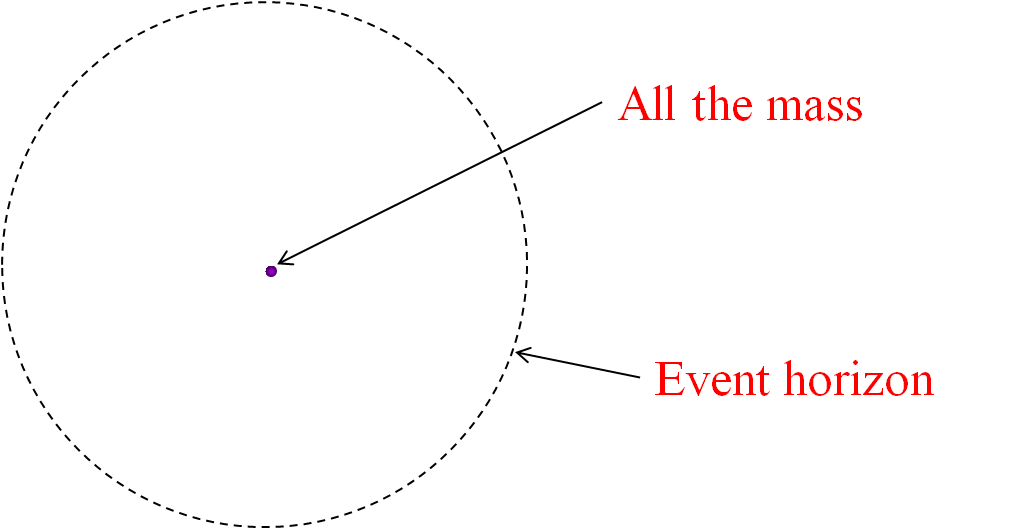
Another name for the Schwarzschild radius is the event horizon.  It’s a boundary of no return:  if you cross it, you can never go back.  But that’s all it is: a boundary.  There is not necessarily anything physical at the event horizon.  You might never know that you had crossed it.  Remember, all the mass is at the center.

Here’s how I “picture” a black hole:

black hole

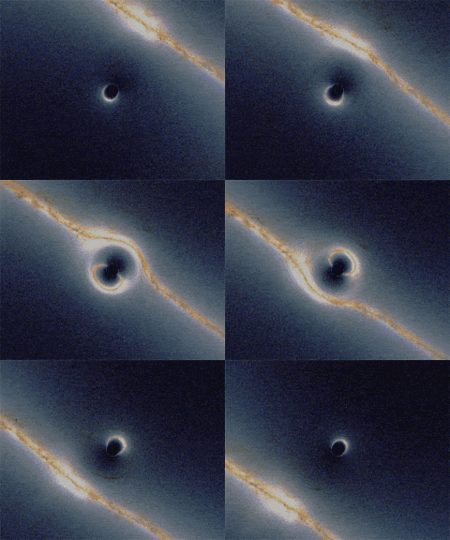
Now, if I am outside the event horizon, what would I see?  Well, nothing from inside the event horizon could reach me (hence the term “black”) but I might see Hawking radiation.  I would certainly see gravitational lensing: the bending of distant light around a black hole.  Here’s a cool picture of gravitational lensing in action (artists conception only!) from Wikipedia:

225px-Black_hole_lensing_web

Let’s say the Sun were a black hole.  Its event horizon would be around 3 km.  As long as we never got closer than 3km, we could do what we like.  We could fly in, fly out, orbit the black hole as we please.

Would the black hole “suck us in”?  Sure, in the same way that the Sun sucks us in already.  There is a strong pull of the Sun on the Earth.  And there would be a strong pull on our hypothetical spaceship.  But change the Sun to a black hole, and the pull would not get any stronger.  That is the key point that most people miss: black hole gravity is not somehow “stronger” than ordinary gravity.  There is just gravity; that’s it.  Change the Sun to a black hole, and the Earth would continue in its orbit, and nothing would be any different.  Except for, maybe, the lack of light.

Why was the planet Krop Tor’s orbit impossible?  Astronomical black holes (created by stellar collapse) have a lot of mass; when there’s a lot of mass hanging around, things tend to orbit them.  That’s what you’d expect.  It would only be impossible if somehow the orbit crossed the event horizon multiple times during its trajectory.  But of course, the show didn’t mention this.

I want to end my rant on GR with a suggestion: that there are two kinds of sci-fi: science fiction, and “sciency” fiction.  The first kind tries to get the science right, and makes an effort to be possible (if not plausible).  The second kind throws sciency words around in an effort to appeal to a certain demographic.  Basically, “sciency” fiction is fantasy, set in outer space.  When seen in this light, Dr. Who has more in common with Lord of the Rings than it does with 2001.

Don’t get me wrong: I love Lord of the Rings, and I love Dr. Who.  Just don’t call it science fiction.

One of the most common criticisms of the many-worlds interpretation (MWI) of quantum mechanics is that it is absurdly complicated, and therefore violates Occam’s razor.  Most people’s first reaction, on hearing of MWI, think that the theory is (to quote Martin Gardner) “bizarre”, “monstrous”, “fantastic”, “radical”, “appalling”, “nonsense”, “frivolous”, and “low”.  And many people seem to think that theorists who ascribe to MWI have their heads in the clouds to believe such nonsense.  MWI seems to be taken, in fact, as evidence that physics has lost its way—as if (supposedly) blind belief in such frivolity is indicative of a philosophical rot that pervades theorists like me.

rotten-apple

Theoretical physics today, to some

There are so many refutations of such criticisms that I don’t know where to start.  First of all, although MWI is popular, it is by no means canon, and I daresay that a majority of physicists reject it still.  So there!  We’re not all sheep.  Still, MWI has become almost mainstream (especially with cosmologists) so maybe it’s the cosmologists and the ivory-tower theorists who should be singled out for criticism?

People who think this have probably never met a theoretical physicist before in their life.  Getting such people to agree is like herding cats; every theory one puts forth (in a journal article or in a conference talk) is debated, criticized—dare I say, attacked.  And that is as it should be.  There is not, contrary to popular belief, some holy scripture that every theorist quotes verbatim.  We are all different, and have basically come to interpret quantum mechanics in our own personal way…not at the behest of some lord on high.

How do I know this?  Because I was never taught about interpretations of quantum mechanics.  Ever.  Everything I know about such things, I learned on my own since graduation.  Thinking of taking a quantum mechanics class at your local university?  Guess what: they will probably not talk about MWI, or the Copenhagen interpretation, or Schrodinger’s f***ing cat.  Why not?  Because those are philosophy topics, not physics.  You can do quantum mechanics without ever interpreting a single thing.  There’s no crying in baseball, and there’s no philosophy in quantum mechanics.  It is a purely mathematical theory, that undeniably works, and most people just leave it at that.  The idea that thousands of physicists subscribe to one particular world-view just because they constitute a single monolithic conformist society is ludicrous.  Invite a physicist to lunch if you don’t believe me.

But I still haven’t addressed the idea that MWI is obviously absurd.  It is absurd, right?  I mean, come on!

But wait.  Let’s think back to the Copernican revolution.  It’s obvious that the Earth is stationary, no?  I bet people thought that Copernicus and Galileo and their ilk were bizarre, monstrous, fantastic, radical, appalling, nonsensical, frivolous, and low.

And what about the idea that there are billions and billions of galaxies, each with billions and billions of stars?  We forget now, but this idea was radical when first presented and wasn’t settled until the 1920’s.  Why are we OK with a multiplicity of stars, but not a multiplicity of universes?  Why aren’t people complaining about the absurd notion (fact) that there are more stars in the observable universe than there are grains of sand on Earth’s beaches?

PerseusCluster_041008_041214_2000

Whoa.

So, Occam’s razor.  MWI just seems to have too much baggage, right?  For a lot of people MWI is too high a cost to bear to have a mathematically simple interpretation of quantum mechanics.  And let’s be clear: MWI is a simpler theory than (say) the Copenhagen interpretation (CI).  For you can start with three postulates, and add a fourth about wave-function collapse, and you get CI.  Or you can start with just three, and say nothing of wave-function collapse, and you get MWI.  Which interpretation seems simpler now?  MWI is a consequence of accepting the three basic postulates of quantum mechanics.  If you don’t like that, then you must introduce a fourth postulate ex nihilo to make yourself feel better.

But wait! you say.  10100 universes doesn’t seem simpler.  It’s a huge number!  It’s ridiculous!

OK.  You wanna go there?  I’ll turn the argument around.  By that rationale, you probably believe that there are only a finite number of integers, because any finite number is simpler than infinity.  There.  That makes sense, right?

The truth is that an infinite set is often simpler than a single member of that set.  Take the natural numbers.  I can write a computer program in BASIC that writes every natural number.  Here it is:

10           x=1

20           PRINT x

30           x=x+1

40           GOTO 20

On the other hand, if I want to print out the number

5679200359662711389685023885761799

then my computer program is longer:

10           PRINT “5679200359662711389685023885761799”

Count the keystrokes.  The second program requires more typing.  And note that the first (simpler) program will eventually print this number—the long arbitrary program is “contained” within the first.

In information theory, the information “content” of something is related to its algorithmic complexity—roughly speaking, how easy it is to write a computer program that “specifies” the object.  By that measure, “all the natural numbers” is a simpler concept than the number

5679200359662711389685023885761799

Similarly, “all possible universes” is a much simpler concept than one specific arbitrary universe.  You want to recreate this universe?  Good luck…you’ll have to specify the position and momentum of every particle in the universe.  That’s a long computer program.  However, if you just say “create all possible universes” then eventually this one will pop up…

Do I believe in the MWI?  Yes.  Why?  It’s not because I was indoctrinated into such belief; I don’t think a single professor in graduate school ever mentioned MWI.  It’s because I’ve looked at the evidence over a number of years, and (tentatively) decided that it fits the data best.  That is the only reason to ever believe something, ever.  It fits the data best.  But I stress that my conclusion is tentative because, hey, it’s science.  There is no dogma.  There is just stuff that we are 99.44% sure of.

Like evolution by natural selection, or heliocentrism, or the existence of ghosts.  I mean, seeing’s believing, right?

               [Note: more Americans believe in ghosts than evolution.  Sigh.]

If you enjoyed this post, you may also enjoy my book Why Is There Anything? which is available for the Kindle on Amazon.com.

sargasso

I am also currently collaborating on a multi-volume novel of speculative hard science fiction and futuristic deep-space horror called Sargasso Nova.  Publication of the first installment will be January 2015; further details will be released on Facebook, Twitter, or via email: SargassoNova (at) gmail.com.

“Somewhere in the multiverse, you are loved.  Somewhere you are hated.  Somewhere, you are loved by everyone.  Somewhere, you are hated by everyone.  God exists, and He does not; the same is true for Allah, and Buddha, and Zeus, Odin, Cthulhu, and the Green Lantern.  Somewhere, you are Wonder Woman’s arch villain.  Somewhere else, there are no villains, because perfect goodness has found its expression as a mathematical absolute.  You cry, and you do not cry; your tears move millions or are forgotten forever.

“And somewhere else, namely here, you are exactly who and what you are.  You are loved by those that love you, and you may or may not love them in return.  You believe in God, or do not believe; you think that there are other universes, or think that this universe is all that ever was and ever will be.  This is the universe you are stuck with.  Love it.  Hate it.  It’s all you’ll ever know.

“And what about goodness?  What about justice?  Can you live with the idea that in some places, at some times, pure evil has dominion, and good has been forever banished?  Are those universes plausible?  Or are they phantoms, highly improbable, like the vanishing cracks of a broken teapot?

“Think on this: the ultimate question, “why is there anything?” is perhaps unanswerable, mostly because it requires us to speculate about the unknowable.  The fly knows nothing about what’s outside the bottle; Scarlett O’Hara knows nothing about Margaret Mitchell; Plato, in his easy chair, knows nothing about the world as we know it today; the falcon cannot hear the falconer; and you know nothing about life in the fractal part of the æther.  And so too, if God exists, we know nothing of him/her/it/them.  We know what is before us, what can be observed, measured, quantified, understood.  We can speculate all we like; we can even draw inferences from some of our observations, but in the end we can never be sure.

“All we can do is be 51% sure.

“And have faith that in 51% of the universes, goodness prevails.”

From my book Why Is There Anything? which is available for download on the Kindle.

If Bilbo had a car…

Consider this map of Middle Earth:

middle earth

There’s a scale there, on the left, and the source is none other than J. R. R. Tolkien himself, so we can trust the source.  You can verify for yourself, but I reckon Bilbo’s journey to Esgaroth (and then the Lonely Mountain) to be something like 880 miles, and an equal amount on the way back.  This leads to my first discovery…

Bilbo’s journey was like walking from St. Louis to Washington, D.C., and back again.

By car, it should have taken 12 hours and 40 minutes to get to Smaug’s hoard, and an equal amount of time to return (assuming Bilbo had access to No Doz).  Basically, Bilbo had a long Thanksgiving drive.

What about Frodo’s longer journey to pitch the One Ring into some lava?  As the eagle flies, the Shire to Mt. Doom is about 1100 miles, which leads to…

Frodo’s journey (as the eagle flies) was like walking from Baltimore to Miami.

Of course Frodo’s actual journey was a tad more circuitous.  Breaking the journey into legs (Shire to Rivendell, Rivendell to Moria, etc.) I get that it was more like 1450 miles, or…

Frodo’s actual journey was like walking from Little Rock, AR to Boston.

By car, assuming that Frodo drives at a reasonable pace and makes only a few stops, it would take 21.5 hours  for Frodo to get to Mordor and chuck the ring-thingy into that volcano.  (Of course Sam might take a shift driving, and Gollum might be willing to run into the occasional 7-11 to buy snacks.)  Frodo’s deus ex machina trip out of Mordor by eagle is a little like getting an unexpected trip back home via helicopter.

There are other games you can play with the map, to give yourself a sense of scale.  The Shire is about 21,000 square miles, leading to…

The Shire is about the size of West Virginia.

Insert your own joke here.

hillbilly

Bubba Baggins

Then you find that Mordor (which is suspiciously square in shape!) is about 118,000 square miles, or…

Mordor is about the same size and shape as New Mexico.

This cannot be mere coincidence.  Aren’t their climates similar?  Isn’t the Trinity nuclear test site analogous to Mt. Doom?  Doesn’t New Mexico have George R. R. Martin, who looks very similar to the Mouth of Sauron?

Mouth_of_Sauron

Please don’t ask us about the Winds of Winter!

I’ll end my speculations on this note.  “Middle Earth” is an anagram for “Milder Death”, which explains why…well…it explains nothing.  Never mind.

This is too perfect not share.

Ben Orlin's avatarMath with Bad Drawings

Our World: Market Rebounds after Assurances from Fed Chair
Mathematically Literate World: Market Rebounds without Clear Causal Explanation

Our WorldFirm’s Meteoric Rise Explained by Daring Strategy, Bold Leadership
Mathematically Literate WorldFirm’s Meteoric Rise Explained by Good Luck, Selection Bias

Our WorldGas Prices Hit Record High (Unadjusted for Inflation)
Mathematically Literate WorldGas Prices Hit Record High (In a Vacuous, Meaningless Sense)

Our WorldPsychologists Tout Surprising New Findings
Mathematically Literate WorldPsychologists Promise to Replicate Surprising New Findings Before Touting Them

Our WorldAfter Switch in Standardized Tests, Scores Drop
Mathematically Literate WorldAfter Switch in Standardized Tests, Scores No Longer Directly Comparable

View original post 470 more words

In an earlier post I talked about events in spacetime, and about how an error in time is usually more grievous than an error in space.

Let’s now talk about the coincidence of spacetime coordinates.  Specifically, how significant is it if you share one, two, three, or even four coordinates with a famous person?

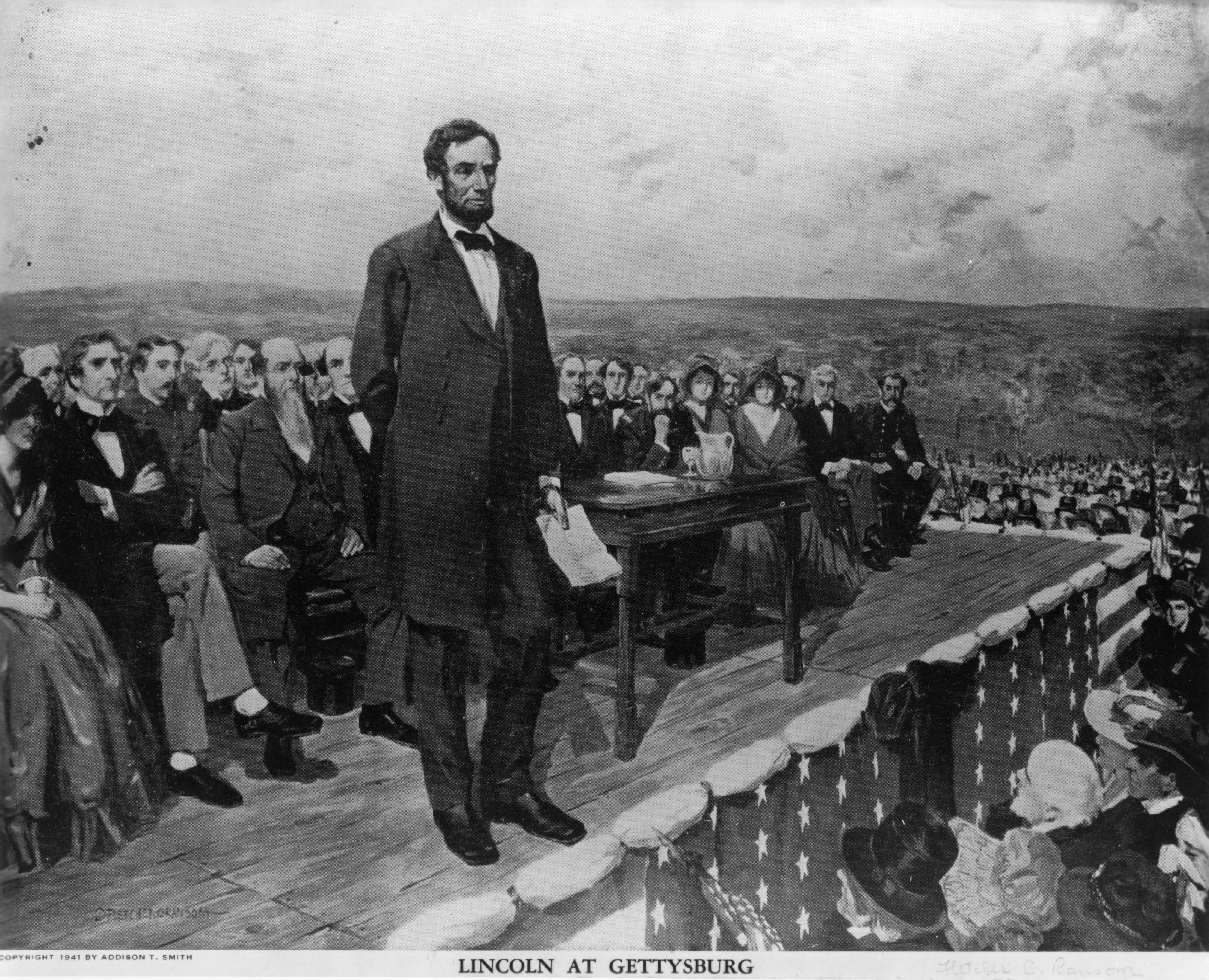
Gettysburg Address

First, some preliminary discussion.  An event is a point (x,y,z,ct) in spacetime.  Technically, you are not an event; you are a series of (unfortunate?) events smoothly snaking its way forward in time.  As you sit there, reading this post, your x, y, and z are probably staying constant while ct is continually increasing.  (Of course if you are reading this on the bus, then x, y, and z may be changing as well.)  Note that I will use a relative coordinate system where x and y are measured with respect to the Earth (they are effectively longitude and latitude) and z is height above sea level.  This way, we don’t have to deal with the annoying detail that the Earth is spinning, and orbiting the Sun, and that the solar system is hurtling through space.

Now the act of you reading this is an event; let’s say it has the coordinates (x,y,z,ct) in spacetime.  But let’s also suppose that when you read that word, Matt Damon was eating a bagel with cream cheese.  That event had the coordinate (X,Y,Z,cT), say.  Unless you happened to have been with Matt Damon just then, your spatial coordinates did not coincide.  However, it should be obvious that t=T.  This means that it is no big deal to share a time coordinate with a celebrity.  You currently share a time coordinate with every living celebrity.  Right now, as you read this, Quentin Tarantino is doing something.  So is cricketer Michael Clarke.  So is chess grandmaster Magnus Carlsen.

michael-clarke

What are the spacetime coordinates of the Ashes?

But how significant is it if one spatial coordinate (x, y, or z) coincides with a celebrity?  Or two spatial coordinates?  Can we sort this out?

Here are some other possible cases:

x or y (and t) coincide: this is not likely to be true for you at this instant, but it happens with great frequency.  It means that either your longitude or latitude is the same as a celebrity, such as Christopher Walken.  Let’s say you’re currently in Jacksonville, FL whereas Walken is in Los Angeles.  Obviously, your x’s are very different and your y’s, although close, are also different.  But you decide to drive to Raleigh, NC for a friend’s wedding.  At some point along your drive on I-95 your y-coordinate will be the same as Walken’s, as the line of your latitude sweeps through 34 degrees North.  (If you’re curious, it will happen a little before you stop for lunch at Pedro’s South of the Border.)  On a flight from Seattle to Miami, your lines of x and y will coincide (at different times) with a majority of celebrities in the USA.

z (and t) coincide: this is also quite common.  It means that you and a celebrity (such as chess grandmaster Hikaru Nakamura) share an altitude.  I am currently at z = 645 m (2116 ft.) in elevation…well, scratch that, I am three floors up, so it’s closer to z = 657 m.  Anyway, if Nakamura drives from Saint Louis (Z = 142 m) to Denver (Z = 1600 m) on I-70 then our elevations will coincide at some point along his drive (presumably a little bit past Hays, KS).

x or y, with z and t: this is much rarer, but does happen.  For this to occur, your line of longitude or latitude would have to sweep through a celebrity (such as quarterback Cam Newton), but you would also have to coincidentally be at the same altitude.  Now, if you live in the same city as the celebrity (in this case, Charlotte, NC) then a simple trip across town to visit Trader Joe’s would probably be sufficient to achieve x=X (or y=Y) along with z=Z and t=T.  However, for someone like me who lives at an arbitrary (and uncommon) elevation such as 645 m, this does not happen often.

x, y, z….but not t: this means that you have visited the exact location that a famous person has visited, but not at the same time.  This probably happens hundreds of times in your life.  An obvious example is when you go to a famous location: maybe Dealey Plaza in Dallas, maybe the Blarney Stone, maybe the location of Lincoln’s Gettysburg address.  (By the way, today is the 150th anniversary of that speech!)  A not-so-obvious example (but much more common) is when you drive along a much-used road.  I have driven I-95 for huge stretches, for example, and I am sure many celebrities have driven that highway as well.  At some point along my drives, I will have “visited” the same location as another celebrity (Tina Fey, let’s say) when she decided to drive down to Savannah for the weekend.  I’m sure she stopped at Pedro’s South of the Border, and so have I.

pedro's

Proof that I went there.

x,y,z and t: this is the holy grail of celebrity coincidence.  It means you met the person.  Now, of course, humans are not bosons, so the spatial coordinates cannot be exactly the same, but if you meet the person I will say that the coordinates are close enough.  My (x,y,z,ct) were once the same as Al Gore.  My (x,y,z,ct) were once the same as Alan Dershowitz.  My (x,y,z,ct) were once (almost) the same as Hikaru Nakamura.  That’s about it.

I have left out several cases (such as x and/or z coinciding, without t) because they are trivial and uninteresting.  Imagine the entire world line of a celebrity such as Winston Churchill, who traveled all over the world.  If his spatial coordinates were projected onto the ground (painted bright yellow, say) then this looping curvy line would be a huge mess, spanning the globe, and covering huge swaths of England like spaghetti.  As I live my life, at any given instant I am pretty sure that one or two of my coordinates match some part of this snaky line.  No big deal.

It’s not like he was Matt Damon or anything.

**********************************************************************************

If you enjoyed this post, you may also enjoy my book Why Is There Anything? which is available for the Kindle on Amazon.com.

sargasso

I am also currently collaborating on a multi-volume novel of speculative hard science fiction and futuristic deep-space horror called Sargasso Nova.  Publication of the first installment will be January 2015; further details will be released on Facebook, Twitter, or via email: SargassoNova (at) gmail.com.

[This blog post was written by a guest columnist, a D-student in freshman physics who will remain anonymous]

10.         It’s winter because we’re far from the Sun

Everyone knows that it’s cold in January because, well, we’re farther from the Sun that usual.  The orbit of the Earth is elliptical, so in the Summer we’re closer to the Sun, like Mercury.  I have no idea why the seasons are reversed in Australia…maybe it’s because they’re upside-down?

googlemaps1-copy-420x0

9.            Force is non-reciprocal

I tug on a rope with a force of 100 N.  On the other end of the rope is a football player; let’s say Greg Olsen (TE for the Carolina Panthers, of course, but you knew that I’m sure).  With what force is Greg Olsen pulling on the rope?  It must be much more than 100 N, because a football player is stronger than me.

8.            Areas and volumes have the same conversion factors as linear units

If 100 cm = 1 m, then 100 cm2 = 1 m2.  This is so obvious it doesn’t merit comment.  Another way to look at it is that a meter and a square meter are, basically, the same thing.

7.            Acceleration is the same as speed

Acceleration is, like, how fast you’re going.  So if I throw a ball straight up, at the top of its arc, its speed is zero, so its acceleration must be zero.  Can I have some of those Cheetos?

2010-03-05-601chopsticks

Best comic ever?

6.            Weight and mass are the same

I was asked in lab the other day to find the weight of a brass cylinder.  So I did:  I weighed it, and got that its weight was 250 g.  I was then asked to find the force due to gravity on the object, but I don’t know how to do that.  Oh, I have to go; I’m rushing Phi Upsilon.

5.            There’s a magical force that appears whenever you move in a circle

So, I was driving the Tail of the Dragon on my scooter the other day, and almost got pulled off the road because of centrifugal force.  That’s another kind of force; you know, like gravity, friction, drag, spring force…centrifugal force.  It appears whenever you move in a circle.  It’s directed outward.  It is a repulsive force, the opposite of gravity.

4.            Objects have a memory of circular motion

If you spin a circle with a ball in your hand, then let go, the ball will spiral outward (obviously) because by the 1st Law objects in motion stay in the same kind of motion that they had before: circularly moving objects keep moving in a circle, etc.  I might then wonder why my scooter didn’t keep going in a circle in spite of centrifugal force, but luckily I don’t ever experience cognitive dissonance.

3.            There’s no gravity in space

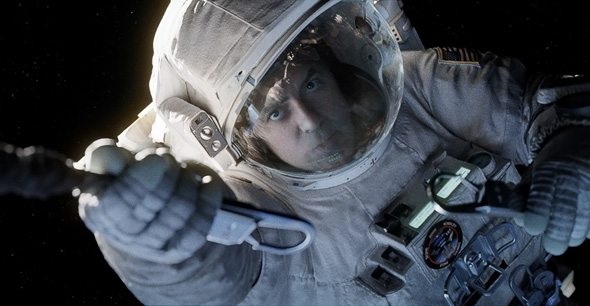
Here’s a spoiler in case you didn’t see Gravity with Sandra Bullock and George Clooney.  In the scene where Sandra Bullock is knotted up in some ropes, she tries to hold on to George Clooney, but lets go.  Of course then George Clooney plummets towards the Earth, because of gravity.  They must have been right at the invisible border between space and not-space, where gravity suddenly drops to zero.

gravity_clooney_lettinggo.jpg.CROP.original-original

2.            g stands for “gravity”

The formula for weight is w = mg, which stands for mass times gravity.  g is gravity.  It’s like a force or something.  I have no idea why my instructor winces every time I say this.

1.            No net force means no movement

This is the most obvious one of all.  On one of our homework problems, there were only two forces acting on a box: 50 N up, and 50 N down.  The net force is clearly zero.  So the box cannot be moving!  Therefore v = 0 (duh!)  But my professor marked this wrong.  She said that v might be 50,000 m/s for all we know.  That makes no sense!  Physics is too hard.

**********************************************************************************

If you enjoyed this post, you may also enjoy my book Why Is There Anything? which is available for the Kindle on Amazon.com.

sargasso

I am also currently collaborating on a multi-volume novel of speculative hard science fiction and futuristic deep-space horror called Sargasso Nova.  Publication of the first installment will be January 2015; further details will be released on Facebook, Twitter, or via email: SargassoNova (at) gmail.com.

cartouche