Feeds:
Posts
Comments

Archive for the ‘Physics’ Category

blinky

Blinky, a denizen of Springfield

From a recent blog post, high on hyperbole and low on science:

[Fukushima: At the Very Least, Your Days of Eating Pacific Ocean Fish Are Over  We’re writing this post becasue [sic] we feel that it is extremely important for everyone to be aware of this crisis, and it’s not being sufficiently reported on. In our entire month in the US, we did not see this in the mainstream media and hardly anyone knew about it…In a nutshell, Japan’s nuclear watchdog has now declared the leak of radioactive water from Fukushima a “state of emergency.” Each day, 300 tons of radioactive water seeps into the ocean…]

Ok.  Time out.  We need a reality check.  First of all, what’s “radioactive water”?  If I take a Geiger-Müller tube and wave it over any seawater, I will detect radioactivity.  I will also detect radioactivity in any banana (from 40K), and in my dog Banjo (from 14C).

Banjo

Banjo

In fact, just going outside in the open air I will detect radioactivity; in fact, over the course of a day I will absorb something like 10 μSv.  Why?  Because radioactivity is everywhere.  Radioactive isotopes aren’t like some nefarious pixie dust that is sprinkled here and there, giving us rare cancers and making us sprout third eyes.  Radioactive isotopes are everywhere.  So when you say the water is “radioactive” you’d better define what that means.

I assume that the author is just parroting what he or she read in some other blog, and doesn’t even know what “radioactive water” means (much less understand the difference between units such as Bequerels, Sieverts, Curies, Grays, rads, rems, and BED’s).  But let’s try to understand: what might “radioactive water” actually mean?  Some frustrated Google searching yielded little real science, until I stumbled upon a National Geographic article.  “…radiation levels in its groundwater observation hole on the east side of the turbine buildings had reached 310 becquerels per liter for cesium-134 and 650 becquerels per liter for cesium-137.”  Finally something we can work with!  I don’t know if this contaminated groundwater is leaking directly into the ocean, but let’s assume that it is…we might as well give in to some of the hyperbole.

650 Bq.  Is that a lot?  Well, it’s hard to say; Bq is a unit of activity (meaning decays per second) but it doesn’t tell you how much energy a person would be exposed to (for that, use the Gray; 1 Gy = 1 Joule/kg).  It also doesn’t take into account the type of radioactivity in question and how such radioactivity affects biological tissue (for that, use the Sievert, which includes a human-centric biological fudge factor).  But, as a physicist I have the right to make an educated guess, and (conservatively) say that drinking a liter of the water contaminated with 137Cs represents an exposure approximately equivalent to the EPA’s recommended limit on exposure for one year; that is, 1 mSv (one millisievert).

(It’s funny: the EPA recommends no more than 1 mSv per year, but the average person is exposed to 4 mSv per year, mostly from the air around us.  I suppose they mean to warn us not to expose ourselves to more than 1 mSv/yr beyond the 4 mSv/yr we normally get…but I digress.)

Don’t get me wrong; it’s quite a bit of radioactivity all at once, like getting 50 chest x-rays all at the same time.  But it’s still only half the dose you’d get if you got a single head CT scan.

And to get that dose, you’d have to drink the water.

But still.  The water’s “radioactive”, right?  And 300 tons of the stuff are being pumped into the Pacific every single day!

Here’s another good opportunity to practice unit conversion.  Go get a pencil.  I’ll wait.  Ready?  300 tons of water is 272,155 kg.  So that water has a volume of 272.155 m3, which is 272,155 liters.  OK so far?

272,155 x 1 mSv = 272 Sv.  A fatal dose is around 8 Sv, so this is a lot.  But you’d have to drink all 300 tons of water.

And the Pacific ocean is kinda big: maybe 6.4 x 10²⁰ kg, or a volume of 6.4 x 10²⁰ liters.  Imagine: each day, 300 tons of “radioactive water” enter the Pacific; but this water gets diluted (surely, it has mixed thoroughly before reaching California?)  272,155 kg / 6.4 x 10²⁰ kg is a very, very, very small number: 4.25 x 10⁻¹⁶ .

This means that your initial dangerous level of radioactivity, 272 Sv, is diluted by a factor of 4.25 x 10⁻¹⁶, giving you 1.16 x 10⁻¹³ Sv, per day.  That is, if you drank 300 tons of water on the California coast.  If you’re numerically challenged, here’s a hint as to what this means.  1.16 x 10⁻¹³ is basically zero.  Go ahead.  Drink those 300 tons.

The hyperbolic blog continues:

[The contamination has made it’s [sic] way to the USA. A Stanford University study…]

Wait…what study?  Citation please!  Otherwise you’re just making stuff up!

[…just showed that every bluefin tuna tested in the waters off California has shown to be contaminated with radiation that originated in Fukushima. Every single one. Our FDA assures us that our food supply is safe. They LIE. Don’t trust the government testing. They are covering up the magnitude of this situation. The only safe level is zero.]

This is breathtaking.  For one thing, even if I take a Geiger counter and detect radioactivity from a fish—which I don’t doubt in the slightest; fish contain 14C, after all—how could I possibly know that the individual radioactivity events “came” from Japan?  And that final sentence…“The only safe level is zero.”  Wow.  Just, wow.  Doesn’t the author know that a “zero level of radioactivity” does not exist on this Earth?  Should we give up breathing, and eating bananas, and having basements, and walking out into the open air?

Imagine Frankenstein’s monster saying “Fire bad!”  Now imagine sciencephobes saying “Radioactivity bad!”  It amounts to the same thing.  People don’t like what they don’t understand.  And there are too many science illiterates in the world.

Here’s one more gem:

[In the wake of Fukushima, The White House has given final approval for dramatically raising permissible radioactive levels in drinking water and soil. The EPA says the new levels are within the “safe” range, but they keep moving those safe levels higher as things unfold. In soil, the PAGs allow long-term public exposure to radiation in amounts as high as 2,000 millirems. Welcome to the new normal.]

2000 millrems = 20 mSv, which is equivalent to getting 3 chest CT scans, but spread out over a whole year (which is a good thing).  This is still less than the maximum permitted yearly dose for radiation workers, which is 50 mSv.

Here’s a summary of what I’m saying.  Fukushima was a disaster, sure.  But no one in America should worry in the slightest.  You get way, way, way more radiation exposure from the person you’re sleeping next to, than you do from some water in the western Pacific.

Don’t blame the blog author.  I mean, the blog is called “Sprinter Life”.  Enough said.

[For help with radioactivity units, see this excellent graphic.]

Read Full Post »

When I was in elementary school, at some indeterminate age, I made a model of the atom with pipe cleaners and Styrofoam balls.  It probably looked something like this:

atom2

These models are about as accurate as depicting the Taj Mahal as a decrepit hovel:

hovel

The Taj Mahal, built from 1632–1653.

Sure, the atom has a nucleus; this nucleus has protons and (usually) neutrons.  And electrons “orbit” the atom (although quantum mechanics tells us that this “orbit” is a much more nebulous concept than Bohr would have us believe).  But—and here’s the main problem with 5th grade Styrofoam ball models—the scale is completely, totally, massively wrong.

Let’s do a simple calculation.  A typical atomic radius is one the order of 0.1 nm.  A typical nucleus, about 10 fm.  What is the ratio of these two lengths?

About 10,000 to 1.

This bears repeating.  A nucleus is something like 10,000 times smaller than an atom, by length.  By volume, it’s even more dramatic:

A nucleus is 1,000,000,000,000 times smaller than an atom, by volume.

You don’t really get that impression from the Styrofoam ball model, do you?

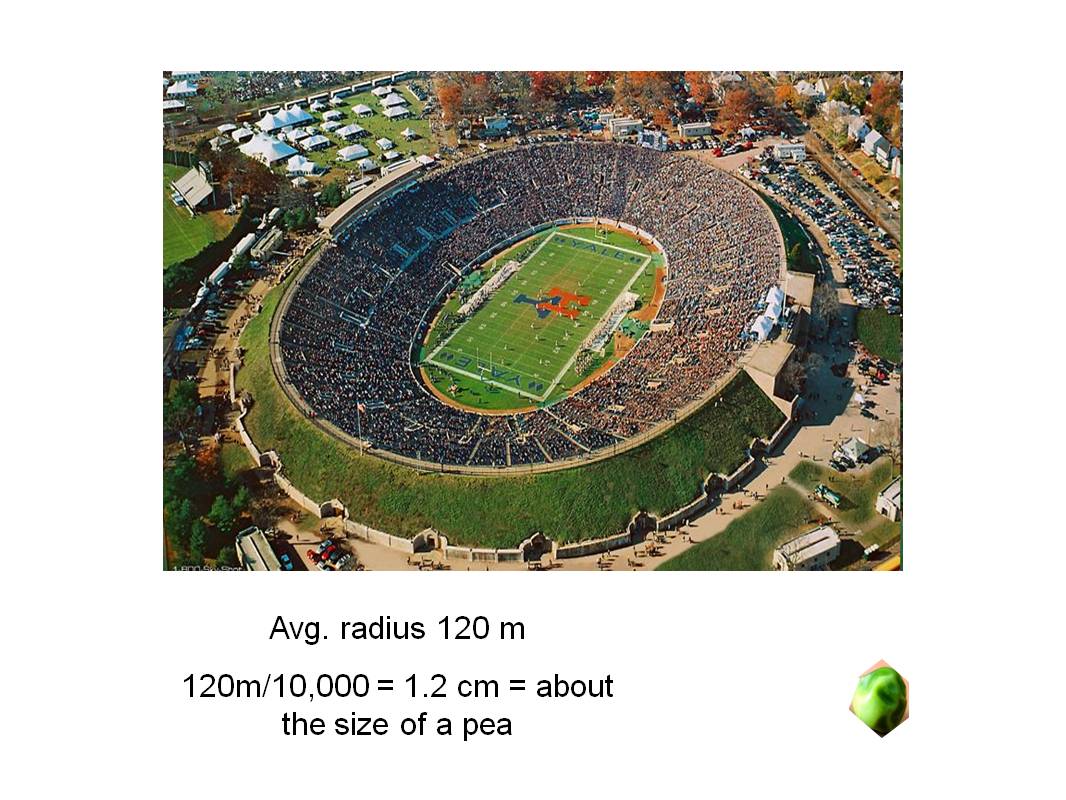
A typical football stadium has a radius of maybe 120 m.  One ten-thousandth of this is 1.2 cm, about the size of a pea.  To get a sense of what an atom really looks like,  place a pea at the center of a field in the middle of a football stadium.  Then imagine, at the outskirts of the stadium, there are a few no-see-um gnats (biting midges, of the family Ceratopogonidae).  These bugs represent the electrons.  The atoms are the bugs and the pea.  That’s it.  The rest of the atom is empty space.

stadium

Another way to think about it is this:

In terms of volume, a nucleus is only 0.0000000001% of the volume of the atom.

That means, for those of you scoring at home, that 99.9999999999% of an atom is nothing.

That is, you are mostly nothing.  So am I.  So is Matt Damon.

So the next time you’d like to help your kids make a model of the atom, just forget it.  Whatever model you make will be about as accurate as the physics in The Core.  I’d recommend instead getting some nice casu marzu, having a strong red wine, and watching True Grit.  You’ll thank me for it.

Casu_Marzu_cheese

There’s flies in this, too.

Read Full Post »

thinker

I’ve had the following conversation at least a few dozen times:

“So where do you work?”

Me: “I’m a professor over at the university.”

“What do you teach?”

“Physics.”

“Physics?  Yikes!  Physics is hard.”

Mathematics and chemistry folks that I know get similar responses.  The unspoken assumption is, why would you want to study something so difficult?

Well, why wouldn’t you?

This leads me to my main point.  When asked why I decided to study physics in the first place, my response is usually “Because physics is hard.”  To me, that’s a sufficient reason.  Not necessary, but sufficient.  I can’t imagine having a job that wasn’t mentally challenging.  Well, unless they paid me enough.

My first exposure to physics (not just science but physics) was in high school, 10th grade I think, when I read a copy of The Dancing Wu Li Masters.  Today I know this book is full of new age nonsense, Deepak Chopra-esque mumbo jumbo, but of course I couldn’t know that at the time.  All I could see at the age of 15 was this great bizarre world of quantum weirdness, and what’s more people were still investigating it.  There was work to be done.  Any copy of Bullfinch’s mythology, or any religious text for that matter, was full of similar bizarre weirdness, but those fields of study seemed static and dead.  But quantum mechanics?  You mean people get paid to think about this shit, and study it in a laboratory?  Count me in!

I was lucky enough to recognize at the time that I didn’t yet have the toolkit for thinking about these kinds of things.  Without a working understanding of calculus, without following the trajectory of physics history into the early 20th century, without seeing the careful, subtle arguments of the physics greats, one can’t really get a handle on quantum mechanics at all.  I wish I had a dollar for every time I met someone who claimed to know “all about” quantum mechanics because they watched a Nova episode about Schrödinger’s cat.  But sorry, quantum mechanics is primarily (arguably entirely) a mathematical theory and as such there are no shortcuts to understanding.  Read as many Brian Greene books as you like…read my book, while you’re at it…but all that can really do is whet your appetite for more advanced study.

That’s what happened to me.  I read a new age book filled with nonsense, but that had enough physics to get me interested.  I wanted to learn more than the author; I wanted to be able to tell him where he was wrong.  (I can certainly do this now.)  And I stuck with physics because it’s maddeningly difficult.

Don’t be afraid of learning difficult things.  Study physics.  Take up quilting.  Learn to play the violin.  Learn how to fix a boat.  Read a book about the Crimean war.  Invent a recipe for Baked Alaska.

If it’s not difficult, then why are you bothering with it?

Read Full Post »

Every Halloween, a steady stream of trick-or-treaters visits my house.  They’re looking for handouts, of course: Snickers, Pixy Stix, Reese’s, jawbreakers.  A simple mathematical model of the children’s visits can help explain the Doppler effect.

zombieland-princesses

Let’s say the children are dressed as zombies (zombies are all the rage).  Let’s further assume that the children act like zombies—not from premature candy consumption and subsequent hyperglycemia—but from a desire for greater verisimilitude.  Thus, we make the following assumptions:

  • The children move at a uniform speed v.
  • The children are separated by a uniform distance λ.

With what frequency f do the children visit my house?

It’s obvious that a greater speed v means that that children visit more often.  So:

f  v,

meaning that frequency is proportional to speed.  Further, it seems clear that a larger distance λ between children means less visits, so that

f  1/ λ.

It is logical to take these proportionalities and combine them, giving

= v/ λ.

In the study of waves, this is the fundamental relation between frequency and wavelength.  We see that in this analogy, the zombie children are meant to represent successive peaks of a wave, and the distance between the children represents wavelength.

(I haven’t defined what a “wave” actually is.  If you’re curious, a wave is something that is periodic in both space and time.  The space periodicity of the zombie kids is codified by the number λ, since if you travel a distance λ in space, you get another zombie kid just like the first.  The time periodicity is codified by the period T = 1/f, since if you’re at the house and you wait for time T, an identical zombie kid will show up at your door.)

So, what about the Doppler effect?

doppler

Sheldon models the Doppler effect.

We now imagine that I live in a mobile home.  ( I don’t, actually, but I was injured in a tornado in 2011, so I guess I am an “honorary” mobile home denizen.)  What is the effect of me driving the mobile home either towards or away from the zombie kids?

Suppose I drive towards the kids at a gentle 1 m/s.  If they are walking 2 m/s towards me, our relative speed is 3 m/s.  The kids show up at my doorstep more frequently.

If instead I drive away, the kids aren’t visiting as often, since our relative speed is now just 1 m/s.  In fact if I drive away at 2 m/s or greater, the kids never catch me and f drops to zero.

The same thing happens with sound.  Regions of less dense/more dense air propagate from a source to a receiver (presumably, your ears).  Each “pulse” is analogous to a zombie kid, and the frequency with which the pulses jostle your eardrums is interpreted by your brain as a pitch.  Higher frequency, higher pitch.  Now, in air the speed of sound is roughly constant, so the f that you hear depends upon one thing: the wavelength.  The more separation between pulses, the lower the pitch you hear.

You can guess what comes next.  If you run away from a sound source, the pulses can’t hit your eardrums as often; you hear a lower pitch.  Conversely, running towards a sound source makes the pitch sound higher.  The f has increased.

Of course its not just the house (the receiver) that can move; the source of the sound (i.e. the zombie kids) can move as well.  I can implement this idea next October 31 by installing a moving walkway outside my house.  If the kids walk at 2 m/s on my moving walkway, but the walkway itself is set at 1 m/s towards me, then the kids are actually moving at 3 m/s relative to me and will visit more often.  (A moving sound source such as a siren sounds higher in pitch if moving towards you.)  I could likewise set the walkway to move away from me, and have the kids visit less often or not at all.  (A siren traveling away from you sounds lower in pitch.)

This analogy is not perfect by any means.  For one thing, the zombie children (who are actual, flesh-and-blood material objects) represent wave maxima, which are mathematical abstractions.  In the case of sound, if I shout and you hear it, that does not mean that any actual physical object traveled from me to you.  A series of wave pulses traveled, sure; but no individual atoms or molecules went all the way across the room.  In a typical wave, energy travels from A to B but matter does not.

If you have trouble seeing how this can be, recall the wave (also known as the Mexican wave) that appears in large sports stadiums.  Wikipedia says it best: “The result is a wave of standing spectators that travels through the crowd, even though individual spectators never move away from their seats.”  Similarly sound can travel from me to you, even though the individual oxygens and nitrogens don’t really move that far.

Which brings up another idea of mine, which I’d like to patent.  Waves (in football stadiums) are always transverse: people raise their arms and then lower them, in a direction perpendicular to the motion of the wave itself.  But if we really wanted to model sound with a stadium wave, we should instruct the audience to move their arms from side to side.  This would set up a longitudinal wave.  I think it would look a little different.

Next time you’re directing festivities for a crowd of 10,000+, get them to do a longitudinal wave.  You’ll thank me for it.  And if you have kids of an appropriate age, dress them as zombies this Halloween.  At my house, zombie trick-or-treaters get the best candy.

Read Full Post »

Laser_squirrel_hd

An image from Zynga’s Mafia Wars, obviously.

One way to say it is…

Let’s say we have a bunch of squirrels congregating underneath a tree.  We can startle the squirrels, and they jump up into the branches of the tree.  But these are ground-loving squirrels, so they very quickly jump back down—sometimes to a lower branch, sometimes all the way down to the ground.

An interesting fact: the squirrels scream as they fall.  This isn’t because of fear, so there’s no need to alert PETA; they’re just emitting squeals of delight as they plummet.  And the frequency of their squeals (and hence the musical note produced) depends upon how far they fall.  A larger drop, a higher frequency.

My goal is to have a whole bunch of squirrels scream with the exact same frequency, all at once.  How can this be done?

Clearly, I need a bunch of squirrels all on the same branch, and I have to hope they all jump off that branch all at the same time.  But this is trickier than it sounds.

It turns out that our tree, a northern elm (Ne for short) has lots of branches, most of them slippery.  In most cases a squirrel will jump off such a branch almost immediately.  However—and this is lucky for us—the 8th branch from the bottom is not-so-slippery.  Squirrels actually like to hang out on this branch for a little while.  Squirrels, being squirrels, do succumb to peer pressure, though, so when one squirrel eventually jumps to the next-lowest branch, the rest of the squirrels follow suit—all screaming in unison—producing a nice, loud, resonant scream of 4.7 x 10¹⁴ Hz.

Here’s the problem: when we initially scare the squirrels into the tree, they don’t all jump up to that 8th branch.  Why would they?  They jump up at random, and only a fraction land on the branch we want.  Even if a sizeable number then jump down all at once, producing the desired sound, it is drowned out by all the other screams and squeals of all the other jumping squirrels on all the other branches.  This isn’t what we want.

But maybe we can be super clever.  Let’s get another tree, let’s say a hemlock (He for short), and place it next to the Ne tree.  Why hemlock?  The cool thing about hemlock is that there’s basically only one branch that squirrels can reach (the other branches are just too high).  And here’s the luckiest coincidence of all: this single branch of the He tree is at almost the exact same height as the 8th branch of the Ne tree (the branch that the squirrels kind of like).

So here’s what we do.  We scare a bunch of squirrels beneath the He tree, and they all jump up to that lone branch (they don’t have a choice.)  We then slide the He tree next to the Ne tree.  The naturally curious squirrels climb over to the Ne tree, because the branches are at the same height.  And guess what—the conditions are now just right for our squirrels-screaming-in-unison trick!  We have a large population of squirrels on a not-so-slippery branch, and when the peer pressure clicks in—eeeeeeeekkkk!

Another way to say it is…

Let’s say we have a bunch of electrons in atoms in a gas.  We can excite the electrons with an electric field, and they jump up into higher atomic energy levels.  But being electrons, they very quickly jump back down—sometimes to a lower energy level, sometimes all the way down to the ground state.

An interesting fact: the electrons emit photons as they fall.  And the frequency of these photons depends upon how far they fall.  A larger drop, a higher frequency.

My goal is to have a whole bunch of photons emitted with the exact same frequency, all at once and in phase.  How can this be done?

Clearly, I need a bunch of electrons all on the same energy level, and I have to hope they all jump off that level all at the same time.  But this is trickier than it sounds.

It turns out that our gas, neon (Ne for short) has lots of energy levels, most of them “slippery”.  In most cases an electron will jump off such a level almost immediately.  However—and this is lucky for us—the 8th branch from the bottom (the 5s energy level) is metastable.  Electrons actually like to hang out on this level for a little while.  Electrons, being electrons, do succumb to peer pressure, though, so when one electron eventually jumps to the next-lowest branch, the rest of the electrons follow suit—in a process called stimulated emission—producing a nice, intense, in-phase cascade of photons with f=4.7 x 10¹⁴ Hz (about 633 nm, which is ruby red).

Here’s the problem: when we initially excite the electrons in Ne, they don’t all jump up to that 5s level.  Why would they?  They jump up at random, and only a fraction land on the level we want.  Even if a sizeable number then jump down all at once, producing the desired lasing frequency, it is drowned out by all the other photons emitted by all the other jumping electrons on all the other levels.  This isn’t what we want.

But maybe we can be super clever.  Let’s get another gas, let’s say helium (He for short), and place it in the same container as the Ne.  Why helium?  The cool thing about helium is that there’s basically only one energy level that electrons can reach (the 1s2s level).  And here’s the luckiest coincidence of all: this single energy level of He is almost the exact same energy as the 5s state of Ne.

So here’s what we do.  We excite a bunch of electrons in He, and they all jump up to the 1s2s level  (they don’t have a choice.)  We then mix the He with Ne.  Through collisions, many of the electrons in the 1s2s level state of He are transferred to the 5s state of Ne.  And guess what—the conditions are now just right for our cascading electrons trick!  We have a large population of electrons in a metastable state (a population inversion), and when stimulated emission clicks in—we get coherent laser light!

Whether or not those electrons raid your bird feeders for sunflower seeds is another issue entirely.

[Note: my book Why Is There Anything? is now available for download on the Kindle!]

Read Full Post »

sazon

If you’re ever in Cullowhee, NC, give Sazón a try.

Suppose I agree to meet my wife for dinner at 8 pm.  She goes to El Pacífico (a local Mexican restaurant) whereas I go Sazón (another Mexican restaurant).  The restaurants are a kilometer apart.  I’ve made an error, of course.

The next week, we agree to meet at El Pacífico.  She arrives at 7 pm, I get there at 8 pm.  Oops, I’ve made another error, this time not in location, but in time.

Which error is worse?

Any student of special relativity will be familiar with the terms spacelike, timelike, and lightlike interval.  Surprisingly, these terms are perfect for discussing my dinner date woes.  But what do these terms mean, on an intuitive level?  Are they even comprehensible in the realm of low, non-relativistic velocities?

Imagine two events, such as me clapping my hands, and you clapping yours.  The events are separated in space by a distance ΔR and separated in time by a duration Δt.  It turns out that if you think of the cosmos as being 4-dimensional, there is then a relationship between ΔR and Δt.

This relationship is the 4D distance formula, Δs2 = ΔR2 – c2Δt2.  Think about it as a sort of “Pythagorean theorem” for 4D spacetime.  That is, its square root (Δs) gives the “distance” between two events in spacetime, given that any event has coordinates (x,y,z,ct).  (Unfortunately, sometimes Δs2 is negative, in which case you cannot take the square root.  But that’s OK; we just talk about Δs2 and don’t even worry about what Δs “means”.)

OK, so why is c (the speed of light) in there?  Well, for two reasons.  One, there has to be some velocity as a conversion constant, so that the fourth coordinate ct has dimensions of distance (just like x, y, or z).  Secondly, the 4D distance formula is constructed explicitly so that if you’re travelling at speed c, then your speed will always be c in every other reference frame.  This is done to match experiment, but whether it’s justified or not depends upon whether the final result (the formula for Δs2) also has merit.  In this case it does, and it turns out that the quantity Δs2 is an invariant: it stays the same regardless of the reference frame you’re in.  Distance is relative; time is relative; but the unholy combination of distance and time, Δs2, is not.

But we’re here to talk about intervals Δs, which represent spacetime distances between events.  Let’s call our first event P1;  our second event is P2.  Now, P1 will be “I throw a ball.”  P2 will be “You catch the ball.”  Let’s say we’re separated by ΔR = 10 m and you catch the ball Δt  = 0.4 s later.  Then:

ΔR2 = 102 = 100 m2,

c2Δt2 = (3 x 10⁸)2 (0.4)2 = 1.44 x 10¹⁶ m2.

Wow!  The “time term” (in the Δs2 formula) dominates, so that Δs2=100 – 1.44 x 1016 = – 1.44 x 10¹⁶m2, which is negative.  In plain English, the events are separated more by time than they are by space.  When this happens, the invariant interval Δs2 is negative.  We call such an interval timelike.  Another way to think of this is that P1 and P2 can influence each other by cause and effect.

Why is the time term so big?  Basically, because light is so fast.  Remember that we had to multiply time by the speed of light to make the fourth 4D spacetime coordinate have units of distance.  So unless events are very, very far apart—or the time difference is very, very small—then Δs2 will be negative and you will have a timelike separation.

Now, in your everyday life, distances are never that great.  The biggest distance you will ever have between you and a friend is the diameter of the Earth; namely, ΔR = 12,700,000 m.  Even at that distance, events will have a timelike separation unless Δt is below a certain threshold:

ΔR2 > c2Δt2

Δt < ΔR/c = (12,700,000 m)/ (3 x 10⁸ m/s) = 0.042 s = 42 ms.

I do something Pin North Carolina; something else Phappens to my friend Rick in Perth, Australia.  In order for these events to be causally connected, at least 42 ms must past between P1 and P2.  If Δt is less than 42 ms, then light doesn’t have enough time to get from me to Rick; the events cannot be causally connected and we have a spacelike interval instead.  In such a case Δs2 is always greater than zero.  In plain English, the events are separated more by space than they are by time.

(Note: 42 ms is a good value to keep in mind.  On the Earth, for an interval between events to be spacelike, they have to be almost simultaneous: Δt has to be less than 42 ms.)

Let’s apply our new terminology to the example that started this post.  The events P1 and P2 are “I arrive at my destination” and “my wife arrives at her destination”.  We arrive at the same time, 8 o’clock, but the restaurants are a kilometer apart.  So:

Δt = 0,

ΔR = 1000 m,

Δs2 = ΔR2 – c2Δt2 = 10002 = 1,000,000 m2.

Seems like a big error!  But the next week I get the time wrong (not the location) and we find:

Δt = 1 hr. = 3600 s,

ΔR = 0,

Δs2 = ΔR2 – c2Δt2 = – c2 (3600)2 = –1,166,400,000,000,000,000,000,000 m2.

That’s worse.  A lot worse.  It represents a much bigger “interval” in spacetime.  And, truth be told, our culture reflects this; it is much worse to be an hour late for dinner then to show up on time but 1 km away.  And this makes sense: if you go to the wrong restaurant you can correct your error fairly easily; it wouldn’t take that long (maybe 1 minute?) to drive 1 km.  If instead you’re an hour late, there’s not much you can do…

[Here’s the website for Sazón: http://www.sazoncullowhee.com/wordpressinstall/]

Read Full Post »

Somewhere in the wilderness of Toelek is a store.  Inside the store are clerks.  The clerks sell bags of Wavy Lay’s potato chips:

Wavy Lays Original

Now, the thing is, if you give money to clerks to buy some chips, the clerks never give any money back: they’re greedy.  What’s more, they leave the store immediately with whatever money they have left over from the transaction.  However, the clerks don’t always get very far, because out behind the store is a bridge that the clerks have to cross, and the bridge is guarded by a troll named Voltar.  The troll is greedy, too.  He demands a toll, and if a clerk can’t pay up then he can’t cross the bridge.

Toelek is a weird place.  Its citizens have a very rigid society, and people are required to wear differently colored clothing depending upon how much money they have in their pocket.  The money is always in multiple of 50 cents.  For example, if you carry $0.50 then you must wear red; if you carry $1.00 you must wear orange; if you carry $1.50 you must wear yellow.

Look, over there—I see a line of people approaching the store.  They’re all wearing red.  They enter the store…but I don’t see any clerks exiting out the back, and consequently no clerks cross the bridge.  More and more reds go into the store, and a faster and faster rate, but it doesn’t matter.  There are no clerks coming out.  The troll doesn’t get any business.

I conclude that a bag of chips costs more than $0.50.

Later, I see a line of oranges go into the store.  I now observe some clerks coming out, but none of these can cross the bridge.  I conclude that chips cost $1.00, but since the clerks have no money left over, they can’t pay the troll’s toll.

Even later, I see a line of yellows go into the store.  Clerks are coming out, and these can cross the bridge.  The troll must be demanding a toll of $0.50 or less.

There are many quantities which are important in analyzing this situation: the amount of money a person has before entering the store (use E for entering), the price of a bag of Wavy Lay’s potato chips (let’s call this price W), the toll that Voltar the troll demands (let’s call this V), and the amount of money a clerk has, K (they speak Dutch in Toelek, so the clerks are called klerks) upon exiting the store.  It should be obvious that

K = E – W,

since the amount of money a clerk has upon leaving the store is just the amount of money a person has upon entering the store minus the cost of some chips.  Additionally, for a clerk to cross the bridge, it must be true that

E – W ≥ V

so that the clerk has enough to pay the toll.  If the clerk barely makes it, this inequality is an equality and

E – W = V.

The V at which this happens (for a given E and W) is called the cutoff toll Vo;  if Voltar were to increase the toll by any amount at all, the clerks wouldn’t get to cross the bridge.

It’s interesting to graph the cutoff toll Vo vs. money that customers have upon entering the store E.  You get something like this:

Photoelectric

Notice that the cutoff value of E is $1.00, which is the price of a bag of chips.  At or below this value the troll need not charge any toll at all, since no clerk will have any money to pay him.  That is, when V = Vo = 0,  then E = W.

WHAT’S GOING ON?

The physicists reading this blog have already guessed the game I’m playing: I have presented an analogy for Einstein’s explanation of the photoelectric effect (hence Toelek, from fotoelektrisch).  Make the following transformations:

Customers = photons;

Color of customer = frequency of photon;

Money = energy;

Store = photoelectric material;

Price of chips = work function;

Clerks = electrons;

Clerk’s money = kinetic energy;

Bridge = potential difference;

Voltar’s toll = kinetic energy required to jump the gap.

With these transformations, you can re-write the story as follows:

There is a photoelectric material, a metal such as platinum.  Inside the metal are electrons.  The electrons can be liberated if enough energy is added.

Now, the thing is, if you give energy to electrons to liberate them, the electrons don’t give any energy back: they’re greedy.  What’s more, they leave the metal immediately with whatever energy they have left over from the transaction.  However, the electrons don’t always get very far, because out behind the metal is a potential difference that the electrons have to cross in order for current to be observed.  Jumping this gap requires a certain amount of kinetic energy, without which the electrons don’t produce current.

How do we add energy to the metal?  Well, by shining light on it.  Light energy is quantized, in chunks called photons.  The energy of a single photon is proportional to its frequency, by Einstein’s formula E = hf.

Look, over there—I see some red light (E = 1.9 eV) approaching the metal.  Unfortunately, no electrons exit out the back, and consequently there is no current.  More and more red photons hit the metal, and a faster and faster rate, but it doesn’t matter.  There are no electrons coming out.

I conclude that the amount of energy need to liberate an electron (called the work function) is greater than 1.9 eV.

Later, I see orange light (E = 2.1 eV) go into the metal.  I now observe some electrons coming out, but none of these produce current.  I conclude that the work function is W = 2.1 eV.

Even later, I see yellow light (E = 2.18 eV) go in.  Electrons are coming out, and these can cross the potential difference.  The potential difference must be 0.08 volts or less.

There are many quantities which are important in analyzing this situation: the amount of energy a photon has before entering the metal (E), the work function (W), the voltage that electrons have to jump (V), and the amount of energy an electron has upon exiting the metal, K.  It should be obvious that

K = hf – W,

since the amount of energy an electron has upon exiting the metal is just the amount of energy a photon has upon entering the metal minus the cost of liberating an electron.  Additionally, for an electron (with charge e) to jump the gap, it must be true that

hf – W ≥ eV

so that an electron has enough kinetic energy to overcome the potential difference.  If the electron barely makes it, this inequality is an equality and

hf – W = eV.

The V at which this happens (for a given f and W) is called the stopping potential Vo.

It’s interesting to graph stopping potential Vo vs. energy of incoming photons E.  You get something like this:

Photoelectric2

Notice that the cutoff value of E is 2.1 eV, which is W.  At or below this value there need not be any potential difference at all, since no electron will be liberated.  That is, when V = Vo = 0,  then E = hf= W.

I hope you find this analogy useful.  As for me, I need to go to the store: all this talk of potato chips has made me hungry.

Read Full Post »

Imagine that there’s an ice cream truck parked near a school.  It’s 3pm; class is dismissed and a steady stream of kids approach the truck.  For simplicity, let’s stipulate the following rules:

1. If a kid has enough money, he or she will buy an ice cream cone;

2. A kid will only buy one ice cream cone;

3. A kid will buy the most expensive ice cream cone he or she can.

After the kids buy ice cream (or not) they continue on their way, having whatever leftover money they might have in their pocket.

My question is this: by seeing how much money kids have left, what can you determine about the prices of ice cream cones?  (Astute observers will note that this toy model has many similarities to the Franck-Hertz experiment of 1914, but we’re not there yet.)

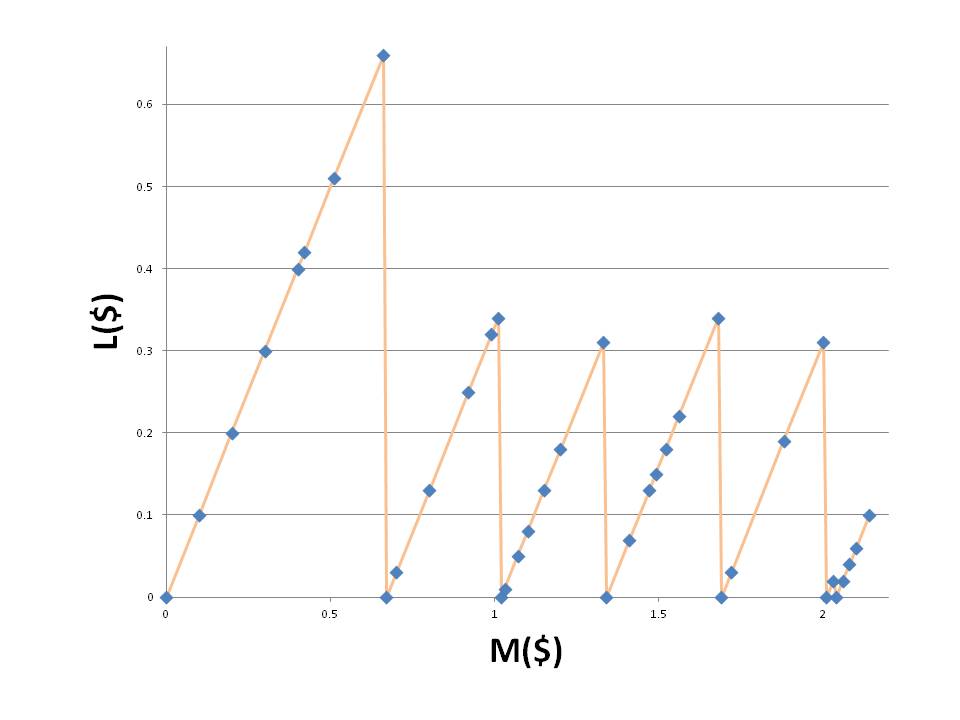
Let’s look first at some hypothetical data.  Here we have plotted L (money left over in a kid’s pocket) as a function of M (how much money a kid started with) for a school with 11 kids:

Franck 1

There doesn’t seem to be a pattern.  Maybe we don’t have enough data?  Let’s increase the number of kids to 42:

Franck 2

The sawtooth form of the function is characteristic of problems of this type, and can be understood intuitively.  First of all, notice that the function is linear to begin with, with a slope of exactly one; this means that below a certain threshold value of M, a kid can’t afford any ice cream, so he/she ends up with the same amount of money he/she started with.  Eventually, if M ≥ $1, a kid can buy a cone; L then plummets because the kid has spent a dollar.

It seems obvious from the graph, then, that ice cream cones are priced at $1, $2, and $3; beyond that we don’t have any data so can’t draw more conclusions.

Now, if we relax the stipulation that kids only buy one cone, then our data is ambiguous.  Maybe the cones are priced $1/$2/$3, or maybe cones are always just $1, and kids are buying more than one cone if they can.  We can’t distinguish between these cases; that’s why I put the original stipulation there to begin with.

Let’s try a more challenging graph:

Franck 3

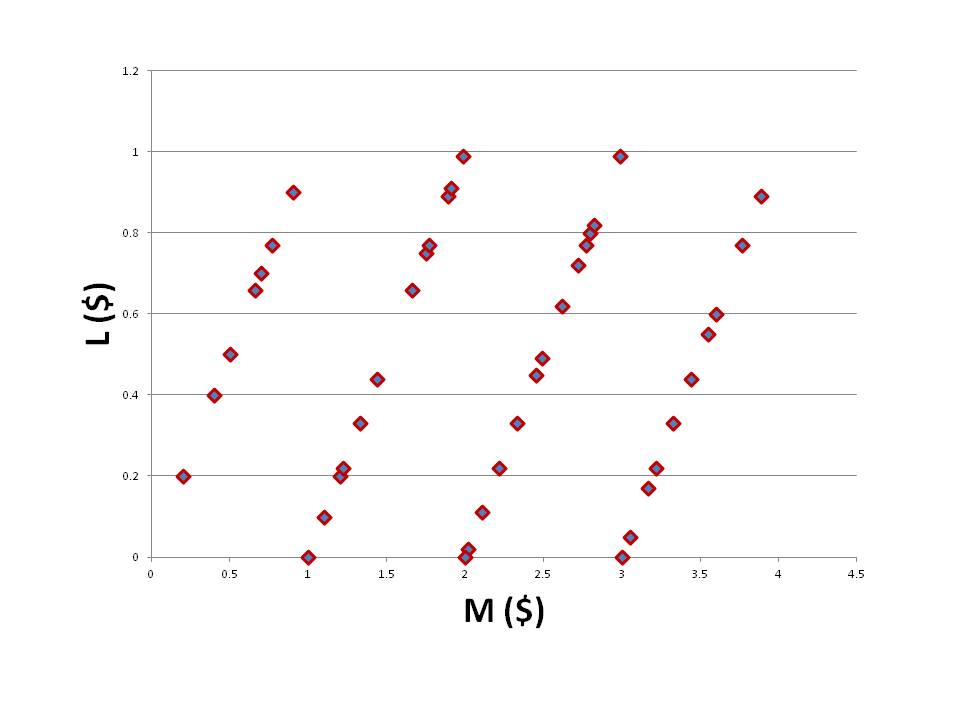
This graph is much harder to interpret.  The first peak is much bigger than the others; there is also a very tiny peak on the right-hand side.  It helps if you know where the jumps are: L jumps down to zero whenever M is equal to $0.67, $1.02, $1.34, $1.69, $2.01, and $2.04.  If you want to work out the ice cream cone prices for yourself, feel free.  I’ll wait.

The solution?  A little trial and error will give you two different prices for ice cream cones: A= $0.67 and B=$1.02.  Then the jumps occur at A, B, 2A, A+B, 3A, and 2B.  If we were doing physics, we’d make a prediction: we would expect the next jump to occur at $2.36, which is B+2A.  Observing this would support our hypothesis.  But if the next jump occurred at $2.22, say, then we’d have to revise our theory and posit a new ice cream C priced at $2.22.

What does any of this have to do with physics?

I use this example when I introduce the Franck-Hertz experiment to my students.  This experiment was first performed in 1914 (an auspicious year!) and provided support for Bohr’s idea that atoms have specific (quantized) energy levels.  Electrons are accelerated and shot towards mercury atoms (in a vapor).  The electrons may then give energy to the atoms (exciting them) or they may not, bouncing off without loss of kinetic energy.  We look at how much energy the electrons have to start with, and how much they end up with, and thereby deduce the energy levels of the mercury atoms.

How is that possible?  In terms of the analogy, make the following transformations:

kids –> electrons

ice cream truck –> Hg atoms

kids buying ice cream at certain prices –> electrons giving certain amount of energy to Hg atoms

prices of ice cream cones –> energy levels of Hg

M (initial amount of money) –> V (proportional to initial kinetic energy of electron)

L (leftover money) –> I (proportional to final kinetic energy of electron)

If energy levels of an atom are truly quantized, then we would expect a graph of I vs. V to look like our graphs above, with an increasing sawtooth pattern.  Where the drops occur will then tell us the specific energy levels of the Hg atom.  (Incidentally, why do we use V and I?  Well, in the actual experiment the easiest way to measure initial kinetic energy is by measuring the voltage used to accelerate the electrons; the easiest way to measure final kinetic energy is to measure the current of the electrons after they have passed through the Hg vapor.)

How did the experiment go?  Here are the results:

525px-Franck-Hertz_en.svg

It should be obvious that atomic energy levels have specific “prices”, and that there’s a minimum amount of energy that an electron must have in order to “buy” an atomic transition (exciting the atom at the expense of the electron’s kinetic energy).  It remains for the experimenter to do some elementary unit conversions, to translate I and V into final and initial kinetic energy.

[Note for advanced students and/or physicists: it is interesting to ponder the following questions, which highlight the fact that the ice cream analogy is not perfect: (1) why is the I vs.V graph not linear at low voltage? (2) After “spending” kinetic energy to cause the first excited state, why does the electron’s energy not drop all the way down to zero?]

Read Full Post »

asteroid

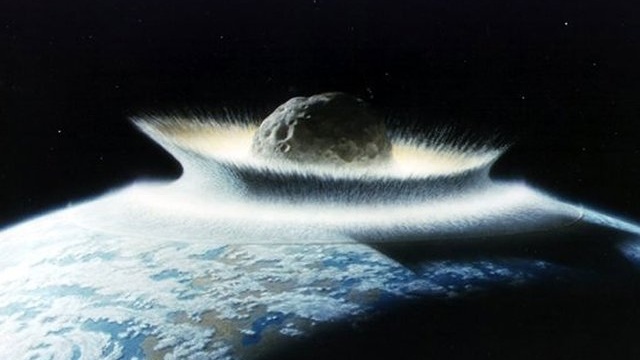
CNN recently posted a story about how the Feb. 15 asteroid/meteor event was very, very unlikely: a 1 in 100,000,000 coincidence.  I disagreed.  I was all ready to blog about how CNN, yet again, got a non-scientist to write about science…and my indignation was already half out of the bottle.

Then I saw who wrote the article: Meg Urry, a highly respected Yale astrophysicist.

So, I sat on my hands for a second and re-evaluated the article.  It does not contain any errors as far as I can tell.  But I still contend that the article is misleading: saying that the asteroid/meteor event was a 1 in 100,000,000 coincidence is the wrong way to look at it.

I agree that if you multiply 1 in 3,650 days times 1 in 36,500 days you get something close to 1 in 100,000,000.  But all you’ve proven is that for any given random day, there is only a 1 in 100,000,000 chance of such a coincidence occurring.

However, we now live in a post-Nate Silver, post Bayesian controversy world, right?  We’ve known about asteroid DA14 for exactly a year (as of today).  So the right question to ask, before it flew by last week, was: what is the chance that a human-injuring meteor will fly by on the same day?  Well, given that an asteroid will already pass that day, the chance of a once-in-a-decade meteor flying by that same day is just 1 in 3,650 (that is, once in a decade).

I have the utmost respect for Dr. Urry.  I suspect that the hyperbole-filled title of her CNN post was written by a CNN webmaster, not her.  I still agree that the coincidence was unlikely, but given that DA14 was already expected to fly by, the Chelyabinsk meteor hitting on the same day does not sink into the realm of unbelievability.

[Trivia note: Chelyabinsk is the birthplace of Evgeny Sveshnikov, the chess grandmaster for whom the Sveshnikov variation of the Sicilian defense is named.  And I do know that, as much as I like the Sveshnikov defense, I tend to go down in flames like a meteor whenever I play it.]

Read Full Post »

R60118GREEN

I don’t want this shirt for my birthday.

What do the colors pink, gray, and beige have in common?

For one thing, they’re all annoying.  I mean, come on…this isn’t rocket science.

But why are they annoying?  Why is lilac (RGB = [220, 208, 255]) so insipid?  Why does jasmine (RGB = [248, 222, 126]) make one vaguely nauseated?  Why is Crayola fuchsia (RGB = [193, 84, 193]) worse than a bout of the common cold?  (Use this applet to investigate these combinations.)

My thesis is this: that these colors are so annoying because they’re extra spectral colors.  And on some primal, instinctual level, humans don’t like extra spectral colors very much.

In a previous post, I talked about how humans have 3 kinds of cones in their retinas.  Roughly speaking, these cones react most strongly with light in the red, green, and blue parts of the visible spectrum.  Now, as I mentioned, “color” is a word we give to the sensations that we perceive.  Light that has a wavelength of 570 nm, for example, stimulates “red” and “green” cones about equally, and we “see” yellow.  That’s why we say that R+G=Y.  That’s why we also say that 570 nm light is “yellow” light.

Extra spectral colors are colors that don’t correspond to any one single wavelength of light.  They are “real” colors, in the sense that retinal cones get stimulated and our brains perceive something.  However, extra spectral colors don’t appear in any rainbow.  To make an extra spectral color, more than one wavelength of light must hit our retinas.  Our brains then take this data and “create” the color we perceive.

In terms of the RGB color code, extra spectral colors are those in which both R and B (corresponding to the cones at either end of the visible spectrum) are non-zero.  And I don’t know about you, but I have a very heavy preference against extra spectral colors.

Now, admittedly, white (RGB = [255,255,255]) is about as extra spectral as you can get.  Does white annoy me?  Not really; but as a color, it’s also pretty dull.  Does anyone paint their bedroom pure white on purpose?  Does anyone really want an entirely white car?

But the other extra spectral colors I mentioned earlier are a who’s who of mediocrity.  Does anyone older than 16 actually like pink?  Has anyone in the history of the world every uttered the sentence, “Gray is my favorite color”?  And beige—ugh.  Just, ugh.

Standard pink has an RGB code of [255, 192, 203].  Surprisingly, there are combinations that are much, much worse.  Hot pink [255, 105, 180] disturbs me.  Champagne pink [241, 221, 207] bothers me.  Congo pink [248, 131, 121] doesn’t actually make your eyes bleed, but I had to check a mirror to verify this for myself.

Beiges are less offensive, but that’s like saying cauliflower tastes better than broccoli.   Of particular note are “mode beige” [150, 113, 23] which used to be called “drab” but was re-branded in Orwellian fashion, and feldgrau [77, 93, 83] which was used in World War II by the German army, in an apparent attempt to win the war by losing the fashion battle.

This is speculation, but I’ve often wondered if these colors bother me because they are stimulating all three kinds of cones in my retina.  Maybe in some deep part of the reptilian complex portion of my brain, I know (on an intuitive level) that these colors don’t correspond to any particular wavelength.  These colors don’t appear in the rainbow.  You can’t make a laser pointer with one of these colors.  You can’t have a magenta, or a beige, or a gray photon.  And somehow, my aesthetic sense knows this.  So when I see the color “dust storm” [229, 204, 201] my limbic system tells me to wince, and I’m saved from even having to know why.

Anyway, I’d be interested in seeing which color(s) bother you the most.  I’m going to guess the color(s) are extra spectral.

[Note: my book Why Is There Anything? is now available for download on the Kindle!]

Read Full Post »

« Newer Posts - Older Posts »