Feeds:
Posts
Comments

Archive for the ‘Uncategorized’ Category

Wile_E_Coyote_1

A recent Toyota commercial begins, “In space, the shuttle Endeavor is practically weightless.”

Do we really have to go over this again?

The fact that the word “practically” is in there indicates that the copy writers don’t have a clue about physics at all.

If they had just said that Endeavor is weightless, I’d be more forgiving.  Such a statement could mean that Endeavor was millions of miles from the solar system, in deep space, and therefore (almost) weightless.  Or it could (more plausibly) mean that Endeavor was in orbit, and that its apparent weight was zero, and they were just confusing weight with apparent weight (like most non-physicists do).

But the Madison Avenue geniuses said Endeavor was “practically weightless.”

Sigh.

This implies, of course, that in space you have weight, but it has been reduced—by being in space, apparently.  The acceleration due to gravity, g, does decrease as you leave the Earth, but as I’ve already discussed, it doesn’t go down enough to approach zero—not unless you go ridiculously far from any other massive object.

Now, a commercial with stupid physics wouldn’t normally get me to reblog about a topic I’ve already covered.  But it gets worse: the Toyota people double-down on their ignorance, and pile BS onto their BS.  The whole point of the commercial is that their truck can pull the space shuttle.

Gee, really?  Well guess what—a mini-Cooper could have pulled the space shuttle, too, given enough time.  So could I.  So could Mr. Burns.  You see, Newton’s 2nd Law says that a net force causes an acceleration, so any net force will cause (some) acceleration.  Sure, it might be small, but in the absence of friction it will eventually get the job done.

fleacircus

…and so, ad infinitum.

I once saw a video of a flea pulling a hockey puck along the ice, even though the puck (around 160 g) had a mass over 700,000 times bigger than the flea (around 220 μg).  It took some time, but the puck eventually moved noticeably.  (Sorry, I couldn’t find the video on the internet.)

Well, what about friction?  Maybe there’s some horizontal friction between the shuttle and the ground, and a Toyota Tundra is forceful enough to “overcome” that friction whereas a mini-Cooper is not.  This is a valid point, but the writers of the commercial were definitely not thinking of this.  How do I know they were not thinking of this?  Well, because they say (as if it is important), “that bad boy weighed 292,000 pounds.”  If that’s all the information we are to be given, then we can’t conclude anything about the merits of their truck: if friction is zero, then the feat is less than impressive.  If instead the coefficient of friction is tremendous, and the normal force between the shuttle and the ground is truly 292,000 pounds, then the feat is amazing, in particular because I would wonder why the truck doesn’t subsequently pull itself back towards the shuttle à la Newton’s 3rd law.  But they don’t mention friction, and therefore they don’t get to play that card.  Occam’s razor suggests that the copy writers just don’t know squat about physics.

Anyway, I have nothing to say about the merits of the Toyota Tundra.  Maybe it’s a good truck, maybe it’s not.  But as for Toyota Truck commercials…please turn the channel.  You’d do better to watch a roadrunner cartoon.  The physics isn’t any better, but at least it’s entertaining.

Read Full Post »

War is nothing like chess.

War is nothing like chess.

I am a big chess fan.

I can name every chess world champion since Morphy; I could probably name around 17 of the world’s current top 20; I can checkmate a lone king with two bishops and a king; I have a good working knowledge of just about every opening there is.

(And by working knowledge, I don’t just mean I’ve “heard” of the Sicilian defense.  I don’t just mean that I know that 1. e4 c5 2. Nf3 Nc6 3. d4 cxd 4. Nxd4 Nf6 5. Nc3 e5 is the Sveshnikov.  I mean that I am fully aware of the differences between the 9. Nd5 and 9. Bxf6 Sveshnikov, and prefer the former.)

The problem is, I’m just not that good.

Oh, I can beat most casual players…the ones that begin a game by moving a rook pawn (to a4, say) and then move their rooks out vertically (to a3, say).  In USCF rating terms, my rating is around 1800, which (to my own surprise) is about the 85th percentile for tournament players.  So objectively, I am not bad at all.  But I am good enough to be aware of just how much better other players are.  I have a friend Shawn who is a master (here he is drawing a grandmaster).  I am in awe of his tactical strength, and his fine sense of dynamics.  I have beaten him dozens of times in speed chess, but for every game I win, he wins 10.

It has taken me a while to get to the point of this blog post, which is this: I like chess because of its icy logic and its mathematical purity.  For this reason, chess is a horrible metaphor for war, or for life.

Chess is used in books and movies for two basic purposes.  The first is to establish the intelligence of a character.  For example, Lisbeth Salander (in The Girl with the Dragon Tattoo) is an expert at chess.  This was a bad choice on the author’s part: Lisbeth is also an expert hacker and financial genius, has an eidetic memory, and is an incredible detective—why stretch credulity even further?  A lot of great chess players are certainly smart, but the correlation doesn’t go the other way: many smart people are terrible at chess.  Einstein was probably weaker than me.  Oppenheimer was even worse.  Comedian Howard Stern, a player of about my strength, would crush either one.

The other use for chess in books and movies is as metaphor.  In The Seventh Seal, Antonius Block plays a game of chess against Death.  In Harry Potter and the Philosopher’s Stone (the original title; not the dumbed-down American version) someone plays chess with someone else (like I remember?)  In both cases the chess itself is ludicrous.  For example, at one point Death captures Block’s queen; Block says that he “didn’t see that”.  (Really?  Did Block just learn the rules the day before?)  But I don’t want to evaluate the chess in such works per se; rather, I want to see how well chess works as a metaphor.

First, chess as war.  I can’t think of any examples off the top of my head, but there seems to be an assumption that skill at chess somehow equates to skill at war.  But this is ludicrous: in chess, every move is transparent; you can always see what your opponent is doing, and everyone starts on a level playing field.  In terms of game theory, chess is a perfect information game.  I’m no Colonel Dax, but I don’t think war works that way.  There is always a fog of war, and an element of chance, so war is about contingencies, and adaptability, and bluff, and extrapolation.

Second, chess as life.  I have to admit, I don’t really get this metaphor at all.  Is life therefore a game?  A perfect information game?  If chess represents life, does that mean that I struggle throughout my life against an opponent (Satan?  Howard Stern?) who is trying to thwart me at every turn?  And if I play well, but my opponent does too, then am I destined for a draw?  What is a draw, in life?  Is it retiring at 65 to play shuffleboard in Orlando?

As much as I like chess, I think backgammon is a much better metaphor for war or for life.  In backgammon, there is an element of chance, and so the “the best laid schemes o’ mice an’ men” will often go awry.  That is why a good backgammon player will weigh contingencies.  What move leaves me in the best position, based on what dice rolls are possible, and what might happen?  In backgammon, you’re not just playing against an opponent, you’re playing against the fates themselves (in the form of the dice) and this makes the game feel more “real” to me.

People who don’t play backgammon often think that luck is a major part of the game.  This is true, on the level of a single game, but backgammon is played in matches of multiple games, and luck is much less important at that level.  This is because of the doubling cube.  With the doubling cube, a master will almost always defeat a weaker player, in the same way that a Napoleon will almost always win a war against a General Mack, even if an individual battle is lost here or there.

And so, life.  The dice aren’t always going to go your way.  You should plan with that in mind.  Look at your current position, figure out the possible contingencies—the possible ways God might play dice with your universe—and set up your pieces accordingly.  Even if you get gammoned, tomorrow’s another day.

[Note: I subconsciously chose an inept Austrian general to be the foil against Napoleon’s military genius.  But I want to be balanced in my portrayal of Austrians.  So I will remind everyone that Lise Meitner was Austrian, and she was a super-smart physicist.  And strangely, her father was Philipp Meitner, a chess master and part of the immortal draw.]

Read Full Post »

Anton_Bruckner

Anton Bruckner was Austrian…

So I’m new to this whole blogging thing.  When I started, back around Halloween in 2012, I had no expectations about how many hits I’d get per day, or from what parts of the world.  I don’t even think I was aware of how much of this information a blogger actually has access to.

At WorldPress.com, a blogger can look at a “stats” page and see from what country the IP addresses of hits have come from.  And now, just six weeks in, I have some interesting data to play with.

As I write this, at 2:20 pm on Thursday, Dec. 6, 2012, I have had 1366 hits to my blog.  This does not include hits from my own computer(s) as long as I’m logged in as the owner of the blog; otherwise, the number would be around 600 hits more (I edit my blogs obsessively, even days after I’ve posted them).  As I would have expected, most of the hits are from the United States (87%) but I nice 13% are from other countries.  It’s the specific countries that have hit upon my blog that have piqued my interest.

map

Now, at #3, I have 29 hits from Australia.  This is not surprising; I have a good friend in Australia who follows the blog.  Almost all of these hits are presumably attributable to him (thanks Rick!)

But at #2, with 86 hits, is Austria.  This is strange.  I don’t know anyone from Austria, nor honestly anyone who’s ever been to Austria.  I lived in Spain for four years, and traveled around Europe, but never made it to Austria, unfortunately.

Even stranger is the hit data from today specifically.  I have 36 hits from Austria today.  I can’t even think of a plausible explanation as to why a post about teaching quantum mechanics would suddenly be popular in Austria.

Except, I can think of explanations.  Maybe one of my blog followers is from Austria?  As of 2:34 pm today, there are 14 people who follow this blog; of those, 8 are known to me personally (and don’t live in Austria).  Of the other 6, at least one is obviously in the United States from his profile.  That leaves 5 possible Austrians.  This is the most plausible, if prosaic, explanation.

There may be another explanation.  It’s very possible to follow a blog without “following” it.  I’ve had Nate Silver’s 538 blog bookmarked for 4 years now, without ever having “signed up” to follow it.  I just go to the site and occasionally read what he’s written.  Similarly, maybe someone in Austria stumbled upon ManyWorldsTheory.com, liked it, bookmarked it, and comes back here every so often.  OK, that’s fine; but why 36 hits just today?  For that to be the work of one person, they’d have to visit the blog, then exit out, then visit it again, a total of 36 separate times.  Seems unlikely.

One (speculative) explanation is that there is an Austrian physics professor who reads this blog, liked today’s post, and then had everyone in her/his class read the post today.  But maybe you can think of a better explanation.  Maybe you live in Salzburg and are laughing at my feeble attempts at detective work.  Enlighten me, or not, as you will.  It’s fun either way.

Here’s some more blog statistics trivia, just for fun:

Average number of (unique) hits per day: 36

Record number of hits in a day: 396 (on Nov. 6, 2012, the day before the presidential election; I shared this day’s blog post on Facebook which drove up traffic)

Search engine term that sent the most number of people to my blog: missouri proposition b 2012 (39 times)

Post with most hits: Economics don’t matter (267)

Science post with most hits: Einstein’s “Imagination is more important than knowledge” (36)

Least favorite post (not including today’s and yesterday’s): Let’s ignore Grover Norquist (16)

Country #4 in terms of hits: Spain, with 7.

Country #5 in terms of hits: Canada, with 5.

Part of the fun of having a blog is reaching out to diverse people all over the world, and maybe affecting them in ways that would have been impossible even 20 years ago.  And let’s face it, playing with the demographic data is fascinating.  Keep this in mind if you’ve ever thought about blogging yourself.  Maybe you’ll get some mysterious Austrians following you, too.

Read Full Post »

sideways

If you don’t go sideways,
you will return to Earth

Why is it that astronauts “float around” in space?

If you were to ask Bill O’Reilly or the Insane Clown Posse, the answer would be that it is a mystery.  If you were to ask the average person on the street, the answer would be that there’s no gravity in space.  Both answers are ridiculous, of course.  It’s not a mystery; we have a very firm working knowledge of the physics of orbits.  And there’s plenty of gravity in space: at 230 miles up, where the International Space Station is, the acceleration due to gravity is about 8.8 m/s2, which is only 10% less than its value at sea level.

So why does the general public still not understand this whole “floating astronaut” thing?

I submit that some of us physics professors are teaching it poorly.  Here’s an explanation from a physics book on my desk:

“All objects in the vicinity of, say, the space station are in free fall with the same acceleration, and so, absent nongravitational forces, they remain at rest relative to each other and their freely falling reference frame.” [Rex and Wolfson, Essential College Physics (2010) p. 215]

I don’t find this very helpful.  And many physics instructors teach “weightlessness” in the same non-helpful way: by hand waving and saying that astronauts are in free fall, and that they are only apparently weightless.  Unfortunately, to the novice this brings up a host of new questions: what’s the difference between apparent weightlessness and actual weightlessness?  More importantly, if you’re in free fall, why don’t you crash into the Earth?

Another book on my desk does a better job:

“Why don’t planets crash into the Sun [if they truly are in free fall]?  They don’t because of their tangential velocities.  What would happen if their tangential velocities were reduced to zero?  The answer is simple enough: their falls would be straight toward the Sun, and they would indeed crash into it.”  [Hewitt, Conceptual Physics, 10th edition (2006), p. 193]

Newton himself also got it right:

“We may therefore suppose the velocity to be increased, that it would describe an arc of 1, 2, 5, 10, 100, 1000 miles before it arrived at the Earth, till at last, exceeding the limits of the Earth, it should pass into space without touching it.”  [Isaac Newton, The System of the World, Section 3, translated by Motte, edited by Cajori (1946)]  [Note Isaac’s use of the word “till”!]

The key idea which we physics professors should emphasize is that astronauts are in free fall, but they don’t hit the Earth because they are moving very, very fast horizontally.  That’s it.  That’s the secret.  They are going so fast that they fall “around the curve of the Earth” so to speak.  I don’t think this horizontal motion is emphasized enough.  I’ll say it again: you need to go sideways to get into orbit.  The next time you’re piloting a spaceship, remember the old adage: that which goes (straight) up will surely come back down (unless you reach escape speed).  So don’t aim for infinity and beyond—aim for the horizon.

Read Full Post »

Shostakovich makes the list twice.

Let’s face it, classical music isn’t all that popular compared to more “modern” genres.  I guess people just think that Rihanna has more to say about the human condition that J. S. Bach.  But part of the problem is that the same hackneyed classical pieces get played again and again, to the point of banality.  If I ever hear Vivaldi’s Four Seasons, Pachelbel’s canon, Boccherini’s minuet, Albinoni’s adagio (written by Remo Giazotto in the 20th century!), Mozart’s Eine kleine Nachtmusik, Orff’s “O Fortuna” from Carmina Burana, or Beethoven’s Für Elise on the radio, I turn the dial immediately.  Honestly, Rihanna’s Diamonds seems more fresh.

But it’s not the fault of classical music in general.  There’s a lot of crazy, beautiful, weird, awe-inspiring, emotional, frightening, uplifting classical music out there—you just have to know where to look.

Anyway, here’s my list of the top 10 classical pieces that are probably off your radar but shouldn’t be.  These pieces aren’t even that obscure (maybe someday I’ll post about the Busoni piano concerto, George Antheil’s Ballet mécanique, or Buxtehude or Meyerbeer or Piston or de la Guerre) but for whatever reason these pieces just aren’t played that often.  That’s a shame; they should be.  I hope you like them.

1.      Funeral of Amenhotep III (from the opera Akhnaten) (Philip Glass)

http://www.youtube.com/watch?v=otS9N7TgmhA

Amenhotep III’s son was originally crowned Amenhotep IV, but soon re-named himself Akhenaten and tried to ditch Egyptian polytheism and replace it with a sort of cult-of-the-sun.  It didn’t stick, and everyone forgot about him.  Except for Philip Glass, apparently.

2.      String quartet no. 8, movement 2 (Dmitri Shostakovich)

http://www.youtube.com/watch?v=PjvTTfbpWjY

Shostakovich dedicated this piece “to the victims of fascism and war”.  The 2nd movement is particularly chilling.

3.      Sinfonia Concertante for violin and viola (Wolfgang Mozart)

http://www.youtube.com/watch?v=uL3xZ8Qlhro

I know this isn’t that obscure, but I think this is the most profound thing Mozart wrote and it doesn’t get much attention.  When the viola comes in at about 2:27, you realize it was already there for about 6 seconds without you realizing it.  Sublime.

4.      9th Symphony, 2nd movement (Anton Bruckner)

http://www.youtube.com/watch?v=_1pw34abVEk

Savage, rhythmic chords in one section, eerie icy elfin menace in the other.  Listen to this in the dark if possible.

5.      Mt. St. Helens Symphony, movement 3 (volcano) (Alan Hovhaness)

http://www.youtube.com/watch?v=HqKghAUknOY

A musical depiction of the eruption of Mt. St. Helens, belying the idea that Hovhaness only wrote “soothing” stuff.

6.      Concerto Grosso 3 (Alfred Schnittke)

http://www.youtube.com/watch?v=ZvzdS4z6FKc

Insanity.  What can one say?  Madness.  If anyone ever makes a Cthulhu movie, this should be the soundtrack.

7.      B minor scherzo (Frédéric Chopin)

http://www.youtube.com/watch?v=nJhacebV24k

Chaotic.  Good times.  Oh, and there’s a lullaby in the middle!

8.      Piano concerto No. 2, movement 2 (Dmitri  Shostakovich)

http://www.youtube.com/watch?v=JlMHjo7Jwhk

Might be the most soothing music that I am aware of.

9.      Piano Sonata No. 2, movement 4 (Frédéric Chopin)

http://www.youtube.com/watch?v=JJEQqcw-830

Someone (Rubinstein?) described this as wind over your grave.  And ya gotta love the ending.

10.   Symphony No. 1, movement 4 (William Walton)

http://www.youtube.com/watch?v=RRYHIgu-dpY

After three dark and brooding movements, there is finally triumph.  Why isn’t Walton better known?

Read Full Post »

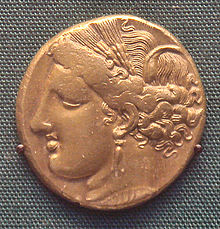
Should we pledge to enact sanctions against ancient Carthage?

It’s time to start marginalizing Grover Norquist.

Haven’t heard of him?  That’s because he hasn’t really done anything noteworthy.  Sure, he got an M.B.A. from Harvard, and he did write speeches for the U.S. Chamber of Commerce for one year in the 1980’s, but other than that he’s done nothing except be a lobbyist.  He’s never had an elected position.  His reputation is based on lobbying.

Have I said he’s just a lobbyist?

Now, to the guy’s credit, he’s good at his job, and he wields power through his personal instrument Americans for Tax Reform.  That’s the lobbying group he founded.  Its only purpose is to advocate for Norquist’s world view.  Part of that world view is to lower tax rates in America, and I won’t comment on whether that’s a good idea or not…that’s a problem for economists to sort out.  But part of that world view is getting politicians (by scare tactics and intimidation) to commit to a “no tax raises” pledge.

I can’t think of anything sillier than a politician making such a pledge.  What is this, the days of Hamilton and Burr at Weehawken?

First of all, tactically, it’s always better to have options than to not have options.  If you pledge to never raise taxes, ever, then you’re a fool, plain and simple.  You’re locking yourself into a position that might make no sense at some point in the future.  When taking such a pledge, you’re saying, basically, the following: “I don’t think raising taxes is a good idea.  In fact, I feel strongly that it’s a bad idea.  But I am also convinced that I will never change my mind; I will never let new data change my mind; even if the circumstances change, it is logically inconceivable that I will ever change my mind; and even if I want to change my mind I won’t be able to because I am locked into a pledge.”  By taking a pledge, you are thumbing your nose at a future self (and potential wiser self) and forcing them down a path they might not agree with.

[Of course, there’s another reason to take such a pledge: you may not agree with it, but you take the pledge anyway in order to get elected.  Anyone who falls into that category is beneath contempt.]

What if scientists took pledges?  Newtonian physics was on very firm footing in 1904.  What if every physicist signed a pledge saying that Newtonian physics was 100% correct and was never to be doubted ever again?  What, then, would have happened with patent clerk Einstein in 1905?

Suppose everyone in Congress took the Norquist pledge.  And then suppose that aliens visited Earth, and offered to give us an unlimited source of clean energy.  The catch is, we have to raise taxes on upper incomes by, say, 1%, in order to pay for distribution costs.  I guess we’d have to say, “Sorry, we all took a ‘pledge’ so we can’t do it.  Fealty to Grover Norquist and his 18th century ‘pledge’ takes precedence over the country, over science, over common sense, and over anything else you can think of.  Have fun with your infinite energy, rest of the world.”

My point has nothing to do with the merits (or lack thereof) of the pledge.  I have a problem with the idea of such a pledge itself.  A pledge is indicative of an anti-science mentality; a tendency towards dogmatism; a lack of mental flexibility—and those are not traits I want to see in our country’s leaders.  Leaders need to keep everything on the table.  You have to decide based on current data what the best course for the country is.  You cannot let a decision made 20 years ago affect your thinking today.  I’m sure that 2200 years ago I might have been in favor of sanctions against Carthage; I may have even signed a pledge to that effect.  Today, though, that pledge wouldn’t mean very much…

Let’s all agree to never mention Grover Norquist again.  He’s irrelevant.  He’s a lobbyist, and his only purpose is to push his own agenda.  His tax foundation doesn’t do scientific research, doesn’t create jobs, doesn’t build things, doesn’t design things, doesn’t contribute to science, or culture, or human knowledge, or service, or humanity.  Norquist himself is not a super villain.  He’s just a random dude with a loud megaphone.  Luckily, we have the ability to ignore him if we like.  Maybe then he’ll just go away.

Then again, probably not.  After all, he is a lobbyist.

(Photo credit: http://en.wikipedia.org/wiki/File:CarthageElectrumCoin250BCE.jpg)

Read Full Post »

Poor Einstein.  Is there anyone else who is misquoted more often?  Is there anyone else to whom more nonsense is attributed?

I have no desire to rehash things that Einstein said about “God”.  Einstein was by all accounts an atheist, an agnostic, or a pantheist—depending upon your definitions—and various religious apologists have been trying to co-opt the man for years by misquoting him.  Others have already discussed this at length.

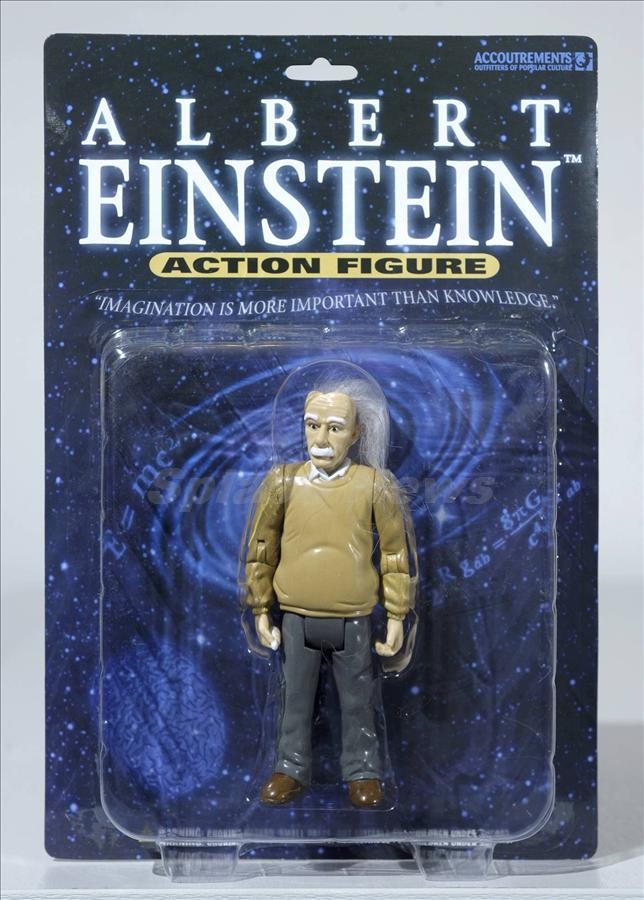
My goal today is to tackle that old chestnut, “Imagination is more important than knowledge,” as seen on T-shirts, bumper stickers, and even on the packaging of the Albert Einstein action figure.  Did Einstein really say this, and if so, what did he mean?

Here’s the quote in context:

“At times I feel certain I am right while not knowing the reason.  When the [solar] eclipse of 1919 confirmed my intuition, I was not in the least surprised.  In fact I would have been astonished had it turned out otherwise.  Imagination is more important than knowledge.  For knowledge is limited, whereas imagination embraces the entire world, stimulating progress, giving birth to evolution. It is, strictly speaking, a real factor in scientific research.”  [From A. Einstein, Cosmic Religion: With Other Opinions and Aphorisms, p. 97 (1931).]

So Einstein did say this.  However, I maintain that the full quote in context has a different feel to it than the quote in isolation.

When I see “Imagination is more important than knowledge” on a bumper sticker, I think this: “Flights of fancy and imagination are more important than learning stuff.  So why should I study?  Einstein didn’t study.  He just sat around and daydreamed and came up with the most remarkable breakthroughs about the workings of our universe.  Imagination is more important than learning all the proofs and figures ranged in columns before me.  So I am going to follow good ol’ Einstein and daydream about being Batman.”

The New Age meaning of the quote is this: “I’d rather daydream than study.”  It’s Walt Whitman’s “learn’d astronomer” nonsense all over again.

In context, it’s clear that Einstein was talking about doing science.  Imagination is more important in making scientific breakthroughs than knowledge, but that doesn’t mean that knowledge is not important.  Einstein worked very, very hard to learn an awful lot of physics.  By all accounts, it took him almost 10 years to flesh out general relativity, during which time he had to acquire a lot of mathematical knowledge about Riemannian geometry and tensor analysis.  The “intuition” that Einstein developed during this time frame is what allowed him to be so confident of the results of Eddington’s expedition.  What Einstein calls “intuition” is just knowledge that has become so ingrained that you are no longer cognizant of it.

Einstein may have been more famous than most of his contemporaries, and it was probably due to his superior imagination.  But take Einstein’s imagination today and give it to a twenty-five year old high school dropout, and he’d be lost in obscurity, stocking shelves at Wal-Mart.  Imagination is more important than knowledge.  But only slightly more.

[Note: my book Why Is There Anything? is now available for download on the Kindle!]

Read Full Post »

Einstein circa 1905

There are a lot of people who, to this day, deny the truth of Einstein’s special relativity (SR).  I’m not even referring to the OPERA superluminal neutrino debacle—an anomaly that was eventually found to be caused by a misconnected fiber optic cable.  No, I’m referring to laymen who deny SR because it goes against common sense.

A Google search will find such people readily.  Most of the time, their arguments aren’t even worth refutation, since it’s obvious in most cases that they haven’t mastered even the simplest algebra, much less sophomore-level physics.  (I am planning to use this gem in my Modern Physics class in the spring as a homework problem: for 20 pts., find the elementary flaw in this person’s logic.)  However, as a working physicist, I sometimes find myself dismissing such people too readily: it is easy, and self-gratifying, to call such people cranks.

A person who doubts SR is not necessarily a crank.  After all, relativity is very counter-intuitive, and our brains have been exquisitely fine-tuned by natural selection to perceive the world as inherently classical.  In fact I will go so far as to say that if you accept SR whole-cloth, without any mathematical or scientific background, then you’re basically showing a blind faith in science in the same way that Iotians have a blind faith in “The Book”.  I would rather beginning physics students showed some skepticism; it makes their final “conversion” that much more intellectually pleasing.

I think the main problem with perceptions of SR is the way it is normally presented.  My thesis is this: most physicists are teaching it wrong.  And as a consequence, many people who have studied SR come away with a misguided notion of what SR is all about.

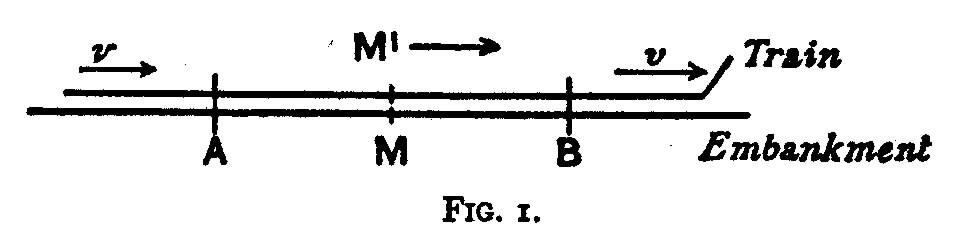
The old way to teach SR begins with Einstein’s two postulates.  The first is that the laws of physics should be the same, in any inertial reference frame.  The second is that the speed of light is the same for all inertial observers.  There is then an obligatory picture of a train and lightning bolts, and talk about how simultaneity isn’t preserved in SR.  This leads (usually after a lengthy derivation) to time dilation and length contraction.  And then, out of the blue, there might be talk of the twin paradox and the obligatory pole vaulter in the barn.

Shudder.  Such a pedagogically confusing approach!  No wonder very few first-time SR students “get it” at all.

The original train picture from Einstein’s 1916 book

This approach has a long history.  In Relativity: The Special and General Theory (1916), by Einstein himself (!) the discussion begins with the two postulates, and there is then a diagram of a train and a discussion of simultaneity (see above).  Seriously?  I’m not blaming Einstein, mind you; I’m blaming the textbook authors today who can’t let go of that stupid train.  It’s been almost 96 years.  Get over it.  Hop off that train, please.  There are more intuitive approaches that are easier for the layman to grasp.

Here’s the approach I use in my classes.  This is not the only approach, of course, nor do I claim it is the best approach.  However in my experience (admittedly, just one data point) this approach is a better way to get students to gradually accept SR.  The trick is to present information one plausible chunk at a time, and then only gradually derive all the weird stuff.  Thus, without realizing it, the students have been convinced of the truth of SR despite themselves.  If you start with simultaneity and time dilation and length contraction then half of the students will get turned off immediately (because their common-sense alarms will be blaring full-force).

  1. Talk about classical (Galilean) relativity.  That is, discuss how the laws of physics should be the same in any (inertial) reference frame you choose.
  2. Talk about coordinate transforms: how you can take the spatial coordinates of an object (x,y,z) and find what the coordinates (x’,y’,z’) would be in a different coordinate system.
  3. Talk about how some coordinate transforms are “good” and some are “bad”.  For example, a translation in space such as x’ = x – L preserves distance, but a rescaling transform like x’ = ax does not.
  4. Mention how the good ol’ Pythagorean theorem s2 = x2 + y2 + z2 gives you an invariant quantity (s2) that is preserved under “good” transforms.
  5. Mention that the (experimental) behavior of light throws a monkey wrench into this analysis.  For whatever reason, all observers measure the same speed c for light, and this actually makes things a little harder.  (Don’t do any math at this point!)
  6. Here you should start talking about time as being a 4th dimension.  The earlier you introduce the idea of an event P as a point P=(x,y,z,ct) in space-time, the better.
  7. State Einstein’s postulate about the speed of light.
  8. Show that the light postulate implies that s2 = x2 + y2 + z2 is no longer an invariant quantity, when talking about transforms as applied to space-time.
  9. If s2 = x2 + y2 + z2 is no longer invariant, can we modify the formula in any way so as to make s2 invariant, while still preserving the light postulate?  The answer is yes; and so you should derive the 4D version of the distance formula, s2 = x2 + y2 + z2c2t2.

To me, this is the core idea of SR.  Everything else follows from the invariant interval s2.  One should no longer think of our existence as being 3D; time represents another “direction”.  And it turns out that the time you perceive depends upon your vantage point (time is “relative”), just like position.

For example, suppose you are looking at a row of trees.  From one location, the trees are lined up in front of you (they all share the same x-coordinate).  From another vantage point, they are separated by 1 m each (x=0, 1m, 2m, 3m, etc.)  No one, not even Galileo, would find this controversial.

But now imagine that you think of time as just another “direction”.  Why is it so hard to believe that your time coordinate could have one value in one reference frame, and another value in a different frame?  Why is it so hard to believe that events that are simultaneous in one frame are not simultaneous in another?

Time dilation and length contraction follow from this in a straightforward way.  And they are much easier to visualize if you buy into the paradigm (I’ll say it again) that time is another “direction”, and therefore relative just like position.

[Caveat: I do know that time is special, in the sense that there’s a minus sign in the s2 = x2 + y2 + z2c2t2 formula.  That minus sign is crucial.  But discussing its importance should be deferred to a later (pun-intended) time.]

If you’re interested, here’s the rest of my SR program:

10.  Discuss space-like, time-like, and light-like intervals, and the ideas of proper length and proper time.
11.   Show how the Galilean boost (which is a “good” transform in classical relativity) must be modified into the Lorentz boost in order to preserve s2.
12.   Show how the Lorentz boost implies length contraction and time dilation.
13.   Discuss relative velocity in SR.
14.   Discuss so-called paradoxes like the twin paradox and the pole vaulter paradox.

The discussion can then go into advanced topics: momentum, energy, E=mc2, forces, etc.  However, with the foundation I have described, I believe these topics are much easier to present.

I’m sure there are some great professors out there who have had great success with the “traditional” program of SR instruction.  I’m sure Feynman could teach circles around me, even with the train and lightning bolts.  But I prefer this different approach, as I have presented it, and I hope others will realize that there’s more than one way to explain special relativity.

Read Full Post »
What if there were a way to increase donations to worthy causes, while at the same time help fight this country’s obesity problem?


I think there is a way, and it would be simple to test.  Suppose fast food restaurants that offer “meal deals” (burger + drink + one side, say) offered a $1 donation to Oxfam (or any other charity) as one of the side dish options?


There are two obvious benefits.  One, I believe that people donate to charities more if they can do so conveniently.  I myself had never given money personally to a hungry family, but when a local grocery store asks me if I want to buy a box of food “for the children” I do so almost automatically.  Convenience allows us to then feel good about ourselves.


Secondly, people who choose this “side dish” are clearly missing out on calories that most don’t need anyway.  How often do people get french fries, even when they don’t want them, just because they “came with the meal”?  And subsequently, how many people eat the fries, because they paid for them–-even if they are no longer hungry?  I’ve done this myself, although it seems irrational in hindsight.


What if instead I order a $5 meal deal and the cashier asks, “What side?” and my response is, “give it to the hungry”, and the restaurant then has some automatic money transfer mechanism in place to make the donation in an instant?  I don’t know which would do society more good: the money raised, or the calories not consumed.  Why isn’t this a win/win?  Or a win/win/win, since the restaurant doesn’t lose anything, and only gains the positive PR?  It would even show evidence that the restaurant has heard the message of “Supersize Me” and taken it to heart.


I think this idea is a good one, and I hope someone reads this post and shares the idea.  All it would take would be one restaurant to start doing this, and before long all of them would be doing it.  I can’t see a single downside at all.


Admittedly, this may have been tried before.  If so: I wonder why it hasn’t caught on?  What are the economics of such institutionalized charity?  I think there are other interesting questions at play here…does charity in fact increase when it is convenient to give?  (I’d love to see the research data on this.)  Would people forgo empty calories in such a scenario?  What would be the economic benefit of millions of calories not being consumed?  Might there even be an adverse effect for, say, the potato industry, if less fries are scarfed down?


Let me know what you think.  And please share this if you think that someone, somewhere, will see it and have the possibility of implementing it.


[Note: this blog post was originally written on Dec. 15, 2010, and emailed to a celebrity who will remain nameless.  Needless to say, there was never a response…not even an automated one.]

Read Full Post »

As I was driving to school today, there was a story on NPR about an upcoming ballot initiative in Missouri.  Proponents want to raise the cigarette tax from $0.17 per pack (the lowest rate in the nation) to $0.90 per pack.  The idea is to generate some revenue and at the same time discourage smoking.

Missourians love their cancer sticks.

Now, I’m not going to go into the pros and “cons” of the initiative.  I would be for it, based on some pretty common-sense data, but I don’t live in Missouri so I guess my opinion doesn’t matter.  However, I’d like to comment on some squishy reasoning put forth on the radio by an opponent of the measure.

In a nutshell: “The measure,” the opponent says, “wouldn’t raise money at all.  It would actually lower revenue.  That’s because any gains made by raising the tax would lower the amount of regular sales tax accrued.” [Note: this isn’t a verbatim quote but a recreation based on my imperfect memory]

You see, Missouri has a 4.225% sales tax which also applies to cigarettes.  And, the “logic” goes, if less people are buying cigarettes, the less sales tax revenue would be generated.

Really?  Is this person completely innumerate?  Let’s say that a pack of cigarettes costs $6.00.  Without the ballot initiative, a Missourian would pay $6.00, plus $0.25 in sales tax, plus $0.17 in cigarette tax, for a total of $6.42.  The state gets $0.42 cents a pack.

Under the new plan, a smoker pays $6.00, plus $0.25 in sales tax, plus $0.90 in cigarette tax, for a total of $7.15.  The state gets $1.15 cents a pack, obviously an increase.

To be fair, the state does actually lose money if the gain in revenue per pack is offset by the loss in the number of sales.  But when would this occur?  Let’s use algebra to find out.  Suppose that N1 is the number of packs of cigarettes bought in Missouri in a given year.  Under the current system, and for a $6.00 average price per pack, the yearly intake for the state is just N1 x 0.42.  Now let N2 be the number of packs bought under the new plan.  It’s easy to see that if the proposal passes, the yearly intake for the state is N2 x 1.15.

The problem is that N2 < N1 (presumably).  So the proposal loses money if N1 x 0.42 > N2 x 1.15, which, after one line of 8th-grade algebra, is the same as N1/ N2 > 2.74.  That is, translated into English, the new proposal loses money compared to the current system if state cigarette purchasing goes down by a factor of almost 3.

I don’t know about you, but I seriously doubt this initiative will cut smoking in Missouri by that much.

The numerically savvy will notice that there is a subtlety.  This result is for a $6.00 pack of cigarettes.  What if the price is much different?  This matters, because the cigarette tax is a flat number added to a pack, whereas the sales tax is a percentage.  If cigarettes cost the same as houses the ballot initiative would be ridiculous, since 4.225% of a huge number is much, much greater than a measly $0.90.  No one would buy cigarettes at all, and the state would lose a lot of revenue.

Is there a tipping point?  That is, is there a price for a pack of cigarettes for which the proposal loses money for any decrease in purchasing? Surprisingly, the answer is no.  Mathematically, we would say that N1/ N2 = 1 only when the price of a pack is infinite.

But setting the bar at N1/ N2 = 1 is unrealistic.  Any tax hike will cause some smokers to buy less.  So let’s make an educated guess:  looking at the first graph at this site, I can see that a price hike of $0.73 produced a corresponding decrease in consumption of about 25%.  (The actual drop would probably be less than this, since in the 1980’s and 1990’s $0.73 represented a higher percentage of the cost of one pack).  So we let N1/ N2 = 1/0.75 = 1.33, and solve for the price of cigarettes.

You get $48.33.  For one pack of cigarettes.

Conclusion: the proposed tax increase would increase revenue even with a plausible decrease in sales, unless cigarettes cost around $48 or more per pack.

Yay algebra!

Some close analogue to Mark Twain or E. B. White (with so many misquotes on the web, you can’t be very sure these days) said that analyzing humor is like dissecting a frog: you don’t learn much, and the frog dies.  So why did I dissect this frog, and show all the gory math details?

I wanted to point out that there is a lot more mathematical detail in most stories you hear, most issues you examine, than you suspect.  And I want to emphasize: if you don’t know math, if you are not mathematically literate, then you don’t know much of anything.

There.  I said it.

Go study your algebra.

Read Full Post »

« Newer Posts - Older Posts »