Feeds:
Posts
Comments

In 1992, ranch dressing overtook Italian to become the most popular salad dressing in the USA.  If you’re interested in why that happened, click here.  I don’t care for ranch dressing.  I don’t really like milk on my lettuce.

-110118_0238.tif

Yuck.

But thinking about ranch dressing made me wonder: whatever happened to thousand island?  Growing up, thousand island dressing seemed ubiquitous; ranch was unheard of.  I don’t recall even tasting ranch until around the mid 1980’s; cool ranch Doritos came out around that time.  But thousand island dressing was everywhere.  If you asked a waiter in 1980 what salad dressings were available, he’d be likely to say “Thousand island, Italian, oil and vinegar, blue cheese, or French.”

Today you’d get “Honey mustard, ranch, vinaigrette, Caesar, or balsamic.”

What has happened?

I have no pat answers; I offer no sweeping theories; I haven’t got a clue.  I can only point to the slings and arrows of outrageous fortune.  The mind searches for a pattern, for answers, when in reality there’s just arbitrariness, fashion, randomness.  Balsamic is in, thousand island is out.  End of story.  Move on to something more interesting.

And yet…

And yet I do have a theory, nebulous, half-formed, rising to the surface.  My theory is this: most people don’t feel strongly for any particular salad dressing.  But people are strongly against.

I have a brother who is disgusted by ketchup.  I bet he wouldn’t go near thousand island, because (according to popular folklore) thousand island is just ketchup + mayonnaise.  True or not, it’s the reputation that counts; a reputation built in part on the “secret sauce” of the Big Mac and the Reuben and god knows what else.  How many people have the following associations in their mind: thousand island…Big Mac…disgusting fast food?  I wonder if the backlash against fast food (Supersize me!) is mirrored by the downfall of thousand island.

A lot of people today find thousand island, well, gross.

What about French?  Or about my personal favorite, Russian…a dressing so rare, now, that you can barely even find it in the grocery store?  I’m going to guess that these dressings suffer because of their names.  Russians have been gauche since the cold war 1950’s; the French since…well, since the last incident in which the French incurred the wrath of America.  (It’s sad, really, that I remember a movement to rename French fries to “freedom fries”, but have long since forgotten the international incident that sparked such outrage.)  Anyway, if you eat Russian dressing then you’re a commie, and if you eat French dressing then you wear a beret, enjoy Jerry Lewis movies, and hate America.

I love both French and Russian dressings.

I dislike ranch.

C’est la vie.

[Note: I’d be curious to hear from the denizens of other countries.  What salad dressings are de rigueur in the UK, or in South Africa, or Argentina, or Macao?  And how have the fashions changed over time?  Please don’t say you like ranch, too.]

When I was in elementary school, at some indeterminate age, I made a model of the atom with pipe cleaners and Styrofoam balls.  It probably looked something like this:

atom2

These models are about as accurate as depicting the Taj Mahal as a decrepit hovel:

hovel

The Taj Mahal, built from 1632–1653.

Sure, the atom has a nucleus; this nucleus has protons and (usually) neutrons.  And electrons “orbit” the atom (although quantum mechanics tells us that this “orbit” is a much more nebulous concept than Bohr would have us believe).  But—and here’s the main problem with 5th grade Styrofoam ball models—the scale is completely, totally, massively wrong.

Let’s do a simple calculation.  A typical atomic radius is one the order of 0.1 nm.  A typical nucleus, about 10 fm.  What is the ratio of these two lengths?

About 10,000 to 1.

This bears repeating.  A nucleus is something like 10,000 times smaller than an atom, by length.  By volume, it’s even more dramatic:

A nucleus is 1,000,000,000,000 times smaller than an atom, by volume.

You don’t really get that impression from the Styrofoam ball model, do you?

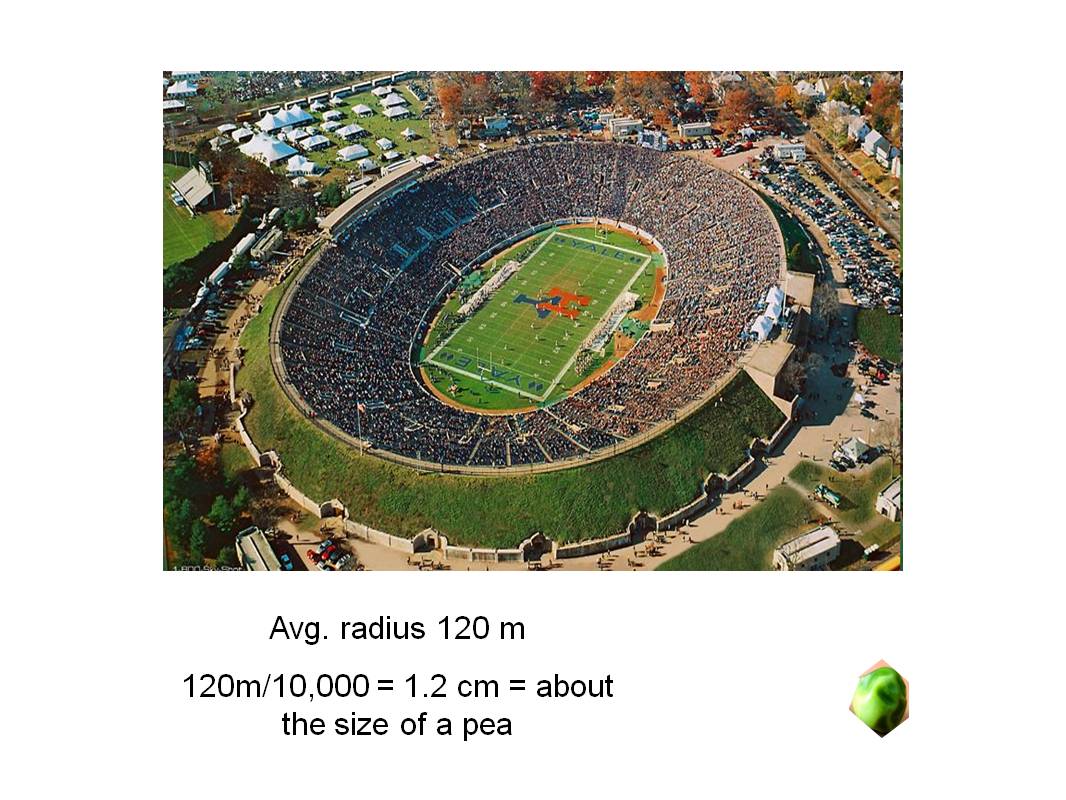
A typical football stadium has a radius of maybe 120 m.  One ten-thousandth of this is 1.2 cm, about the size of a pea.  To get a sense of what an atom really looks like,  place a pea at the center of a field in the middle of a football stadium.  Then imagine, at the outskirts of the stadium, there are a few no-see-um gnats (biting midges, of the family Ceratopogonidae).  These bugs represent the electrons.  The atoms are the bugs and the pea.  That’s it.  The rest of the atom is empty space.

stadium

Another way to think about it is this:

In terms of volume, a nucleus is only 0.0000000001% of the volume of the atom.

That means, for those of you scoring at home, that 99.9999999999% of an atom is nothing.

That is, you are mostly nothing.  So am I.  So is Matt Damon.

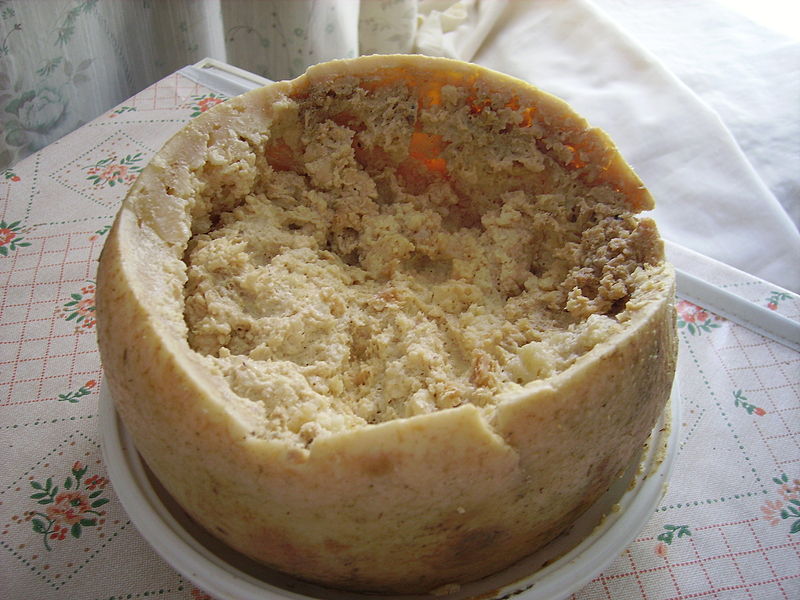
So the next time you’d like to help your kids make a model of the atom, just forget it.  Whatever model you make will be about as accurate as the physics in The Core.  I’d recommend instead getting some nice casu marzu, having a strong red wine, and watching True Grit.  You’ll thank me for it.

Casu_Marzu_cheese

There’s flies in this, too.

I am going to argue that the Zimmerman verdict (for the shooting of Trayvon Martin) was the correct one.  You will either agree with me or you will not.  And then I will argue that either way, it doesn’t matter in the slightest to most people’s lives.

Let me just say, before you dismiss this post entirely because of some preconceived notion about my politics, then I am very liberal on social issues.  (As I’ve mentioned in the past, I literally don’t have an opinion on many complicated economic issues.)  I’m strongly supportive of privacy rights, voting rights, women’s rights, LGBT rights, and animal rights.  I think the idea of building a giant wall to keep out every illegal alien is absurd.  I am for the legalization of marijuana and for the decriminalization of other drug use in general.  I think man-made global warming is a self-evident fact.  I think big monolithic corporations, in the long term, have a negative effect on the happiness of the masses because they operate as entities without conscience, self-awareness, or humanity.

But when the Zimmerman verdict came back on July 13 as not guilty, I wasn’t surprised.  I wasn’t even outraged.  I just sort of shrugged and moved on.

Granted: there is still racism in this country.  I will even argue that there are often two disparate systems of justice in the U.S.: one for whites, and one for non-whites.  But still…what does that have to do with the Zimmerman verdict?

Scenario 1.  Let’s suppose the George Zimmerman is a total card-carrying KKK racist.  He may be, he may not be…I don’t have any evidence one way or another.  And most of you don’t, either.  But let’s just suppose he is.  Let’s say he follows Trayvon Martin looking for trouble; hoping for a confrontation; hoping to scare the boy.  A scuffle ensues and Martin is shot.

Is that murder?

I’m not a lawyer, but it doesn’t sound like murder.  Manslaughter seems a better fit.

Scenario 2.  Let’s be more realistic.  Let’s assume Zimmerman is a racist, but not the frothing-at-the-mouth kind.  He just feels uncomfortable having a black guy in his neighborhood.  However, if you asked him, he’d claim to not be a racist, claim to have black friends, and try to seem like a reasonable guy.

He follows Martin, hoping to scare him off, but not actively hoping for a fight; he genuinely wants to keep the peace.  If Martin gets scared, well that’s OK: he’s got no business being in this part of town.  A scuffle ensues and Martin is shot.

Is that murder, or even manslaughter?

Again, I don’t think so.  In this case, if Zimmerman is guilty of something, it’s…I don’t know…reckless endangerment?  Putting himself and another in a situation where only bad things could happen?

I didn’t follow the trial all that closely, but I will say that some people who followed the trial even less than I did were outraged at the verdict.  I can understand this, on some level; if a travesty occurs (the shooting of Trayvon Martin was certainly a travesty) then people want justice; they may even want revenge.  If Zimmerman wasn’t to blame, then who is?  Saying “the system” or “society” or “endemic racial profiling” are the root causes of Martin’s death isn’t satisfying, because you can’t put those nouns behind bars and throw away the key and feel good about yourself.  If no one gets blamed, then how does Trayvon Martin get justice?

Here are four ways Trayvon Martin could have gotten justice, or may still get justice:

  1. Florida’s inane stand-your-ground law gets repealed.  That would be justice.
  2. Community watch volunteers stop carrying guns and instead call trained police professionals if they see suspicious behavior.  That would be justice.
  3. Politicians stop listening to NRA lobbyists, and start listening to common sense: that would be justice.
  4. Zimmerman admits what he did was horribly bad judgment; pleads guilty to reckless endangerment; then performs 300 hours of community service as a sort of penance.  (In the long run this outcome would have been better for Zimmerman than the not guilty verdict, because I suspect Zimmerman may be a pariah for the rest of his life.  A little bit of remorse would have gone a long way.)

Anyway, all things considered, I think the jury did what 99% of juries would have done in this case, which was let Zimmerman go free.  The prosecution did not succeed in proving their case.  In retrospect, I think that going for a murder charge was ill-advised and entirely political; they should have aimed a little lower.  Going for manslaughter from the start had a much better chance of success.  Putting Zimmerman away for life on a murder rap isn’t justice; it’s revenge.

OK then.  Feel free to agree, or rabidly disagree.

It doesn’t matter.

The Zimmerman case was just one case.  One case, out of thousands of criminal cases in the U.S. every year.  That is, the Zimmerman trial was just one data point.

I’ve talked about this before.  You can’t really draw any conclusions about anything from one data point.  And yet, people do it all the time.  It’s a fallacy that probably has a name, but the name eludes me.  But to most people, it’s not a fallacy.  It has the weight of proof.

“I don’t believe in global warming.”  [Katrina devastates New Orleans]  “Wait, now I do!”

“I don’t think M. Night Shyamalan is a good director.”  [Watches The Sixth Sense] “Wait, now I do!”

“I don’t think racial profiling is a real thing.”  [Martin gets shot and his Skittles spill to the ground]  “Wait, now I do!”

I hope all three of these arguments is equally absurd to you.  If not, I think you lack the scientific mindset.  Now, don’t get me wrong: I think global warming is real, and I think racial profiling is real.  It’s just that you can’t make the case for those things with only one data point.  (Indeed, the case of M. Night Shyamalan shows that one data point can lead you horribly astray: after the wonderful The Sixth Sense Shyamalan has directed six turkeys in a row.)

I do think that racism still pervades the country.  I do think that whites get a different kind of justice than non-whites in our judicial system.  I do think that our country is obsessed…in an unhealthy way…with small metal devices whose sole purpose is to kill other human beings.  But I don’t believe any of these things solely because of a single data point.  You have to look at the big picture, look at the data in aggregate.  A preponderance of evidence is required to separate fact from fiction, truth from rumor, knowledge from urban legend.  As much as politicians love to bring up pithy examples, tell symbolic anecdotes, those examples and anecdotes are really rather meaningless.  Give me the data or go home.

And that is why the Zimmerman verdict is really rather meaningless.  Not to the family of Trayvon Martin, of course; I feel for them and am very sorry for their loss.  But as to what the trial says, in a larger context, about our society in general?  It says nothing.  A single data point says nothing.  It cannot say anything; that’s a simple mathematical fact.  It takes at least two points to make a line.

If you want to know how prevalent racism is, or how two “separate-but-equal” judicial systems pervade the U.S., or even whether putting guns in the hands of rent-a-cops endangers citizens, look at the data.  Data, plural.  Give Nate Silver a call.  Don’t argue by colorful anecdote.  And if you don’t have the hard data, at least have the courage to admit to yourself that what you believe is based on nothing.

That’s what I believe.  And yes, it’s really just based on nothing.  But I’m OK with that, because somewhere, hunched over a desk, Nate Silver is crunching all the numbers, and he’s still not a witch.

Florence Nightingale

Here’s an interesting game.  First, think of a famous person or event that you really don’t know much about.  I’ll start with Florence Nightingale.  Next, write down every “fact” you can think of associated with this person or event.  The idea is to then check yourself: what did you know that was correct, and what was incorrect?  Your misconceptions can be as illuminating as your successes.

OK, here goes.  I’ll list my “facts” as bullet points for easy analysis.

Florence Nightingale…

  • …was a nurse
  • …administered to the wounded during the Crimean War
  • …was a founder (?) or inspiration for (?) the Red Cross
  • …lived from 1828 to 1900 (?)
  • …was from the UK (?)

That’s about all I can think of.  I have no idea whether she married, or had children, or ever had another profession other than nurse.  And the years in which she was born and died are entirely guesses, based on the idea that she was roughly 30 (?) during the Crimean War and lived to be 72 (?).  I know she lived to old age because I vaguely recall a photo of her as an older woman.

Let’s see how I did:

Florence Nightingale…

  • …was a nurse TRUE
  • …administered to the wounded during the Crimean War TRUE
  • …was a founder (?) or inspiration for (?) the Red Cross FALSE
  • …lived from 1828 to 1900 (?) CLOSE; the actual dates are 1820-1910
  • …was from the UK (?) TRUE

I think I did fairly well.  I have no idea why I thought Nightingale was associated with the Red Cross; she was awarded the Royal Red Cross (a nursing award) by Queen Victoria.  As for Nightingale’s other achievements, she was also a noted statistician—she was a pioneer in statistical graphics, and among other things popularized the pie chart.  She never married nor had any children.

Apart from being fun, this exercise certainly helps one learn.  Because of my mistake, I doubt that I will ever associate the Red Cross with Nightingale again.

Let’s try one more:

Captain James Cook…

  • …was a navy man
  • …was an explorer
  • …was killed in Hawaii (?)
  • …sailed all the way around Australia (?)
  • …explored much of the Pacific Ocean
  • …was from the UK
  • …lived from 1720 to 1770 (?)

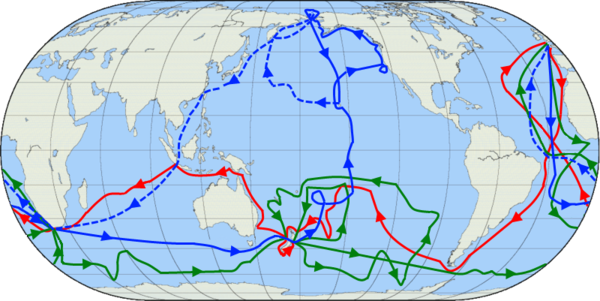
600px-Cook_Three_Voyages_59

Do you think I did better or worse than I did with Florence Nightingale?  Let’s see:

  • …was a navy man TRUE
  • …was an explorer TRUE
  • …was killed in Hawaii (?) TRUE
  • …sailed all the way around Australia (?) FALSE (this was actually the achievement of Matthew Flinders)
  • …explored much of the Pacific Ocean TRUE
  • …was from the UK TRUE
  • …lived from 1720 to 1770 (?) CLOSE; the actual dates are 1728-1779

What I missed about Cook is his cartography (especially around Newfoundland) and his circumnavigation of New Zealand.  I did correctly remember that the Hawaiians killed him for some reason.

If you’d like to play, here are some suggested topics.  I tried to pick some that most people wouldn’t know all that much about.

  • Michelangelo
  • The Battle of Kursk
  • J. S. Bach
  • Coriolanus, by W. Shakespeare
  • The kangaroo
  • T. S. Eliot

Good luck!

DisintegrationofPersistence

Disintegration of the Persistence of Memory (Dalí, 1954)

Here I deconstruct the poem that was posted on Monday, June 24.  The rest of this post was written prior to the poem’s genesis.

I’m going to write a poem.  What’s unusual about this poem is that I’m going to meticulously document every step of the creative process.  Then, if the poem is good, there will be a scientific record of how the poem was composed.  If the poem is not good, then at least I tried, right?

Step 1: What qualities do I want my poem to have?

Here are some poems I admire:

“The Conqueror Worm”, Edgar Allen Poe

“Second Coming”, W. B. Yeats

“Out out –”, Robert Frost

“Beija-Flor (Hummingbird)”, Diane Ackerman

“pity this busy monster, manunkind”, e. e. cummings

“Chicago”, Carl Sandburg

“Kubla Khan”, by Samuel Taylor Coleridge

As you can tell, most of these poems are rather famous, which indicates that I haven’t read much poetry in my life.  Nonetheless these poems are highly regarded, for the most part; I don’t really know how critics rate “The Conqueror Worm”.

Now, I’ve listed these poems not for inspiration, but for analysis.  If these are the poems I like, if these are the poems that come to mind when I think of poetry, then what is the common denominator?  What do these poems have that others do not?  If I can figure this out, then I am that much closer to writing a poem that I would enjoy.

First observation: only two of the poems rhyme, the first and the last.  But all of the poetry is alliterative: all of it is meant to be read aloud:

“The darkness drops again but now I know
That twenty centuries of stony sleep
Were vexed to nightmare by a rocking cradle…”

“And the saw snarled and rattled, snarled and rattled…”

“When you kiss me,
the waters wed in my ribs,  dark and pale
rivers exchange their potions—she gives him
love’s power,  he gives her love’s lure…”

I think my poem needs to be alliterative, then, and maybe even rhyme…I like poetry that is meant to be read aloud.

Dirac once said “The aim of science is to make difficult things understandable in a simpler way; the aim of poetry is to state simple things in an incomprehensible way.”  With that in mind, let’s look at themes.  Here are the poems, “translated” into plain English under Dirac’s dictum:

“The Conqueror Worm”

“Human life is mad folly ending in hideous death, the universe is controlled by dark forces man cannot understand, and the only supernatural forces that might help are powerless spectators who can only affirm the tragedy of the scene.” [from Wikipedia]  i.e. Life is folly.

“Second Coming”

Things are getting more chaotic.  Things are getting out of hand.  It almost reminds one of the legend of the “Second Coming” of Christ, which—rather than giving comfort—disturbs me.  It’s almost as if Christ and the Antichrist were one and the same.  i.e. Things are getting worse.

“Out out –”

Chainsaws are dangerous.  But more than that: if you die, that’s sad, sure, but the world will move on and ultimately not give a crap about your passing.  i.e. The world is indifferent.

“Beija-Flor (Hummingbird) ”

When you kiss me, all sorts of emotions and feelings and thoughts and chemical imbalances swirl through me.  One can almost describe this myriad of reactions with organic, jungle-like imagery, strung together like a shaman’s chant.  i.e. Passion is jungle-like.

“pity this busy monster, manunkind”

Mankind is not kind.  Progress is not good.  Science and reason ignore what’s important: things such as nature and spirituality.  Death would be better.  In fact, let’s kill ourselves.  i.e. Progress sucks.

“Chicago”

Chicago is a big, sprawling, messy, industrious, colorful place.  And that’s just fine.  i.e. A city can be beautiful.

“Kubla Khan”

Imagination is a powerful thing.  I can create visions of entire worlds in my mind.  And those visions are more beautiful than any place that’s really real, even if I cannot convey them to you, the reader.  Visiting such places in one’s mind is as close as you can get to visiting paradise.  i.e. Imagination is an escape.

[These summaries, with the exception of the first, are my interpretations only.  If one of these interpretations is “wrong” (whatever that means) then it is the fault of the poet, for writing something vague enough to be misinterpreted.]

It’s interesting to note that I like all of these poems, if even I do not agree with their sentiment.  All told, I disagree with approximately two of them.  I will not say which.

Is there a common thread?  Well, most of them are dark in tone; most of them are rational; most of them convey a sense of complexity (in the sense that they view black/white dichotomies as being too facile to describe real-world realities).  They touch on death, life, the universe around us, love, beauty, aesthetics, and creativity.  There is no talk of gods, magic, superstition, or philosophy.  I would classify them all as rational (although the e. e. cummings poem is ranting against the rational).  “Beija-Flor” is rational in that it reminds me that passion (and lust) are natural, organic, biological, biochemical processes…it’s only natural to describe passion in humid, wet, zoological terms.  And what of “Kubla Khan”?  Isn’t it mystical, spiritual?  In my view, it is only mystical in a metaphorical sense.  It evokes a mysterious, wondrous place that we can only journey to in our imagination; I don’t think anyone reading the poem would think that it describes a real place.  That is, the poem is fiction, and as such, mysticism and spirituality are perfectly welcome.

This is an aside, but I’ve often felt that some people enjoy obtuseness for its own sake.  They like there to be a message in a poem, a theme; but they want the message to be hidden in some clever way.  This has three purposes, in my view.  Firstly, it acts as a shibboleth, a kind of in-joke.  “You don’t get the poem?  Well of course you don’t.  You haven’t studied 19th century existential Flemish poetry like I have.  But those of you that have studied 19th century existential Flemish poetry, oh boy!  You’re in for a treat!”  Many poets sprinkle obscure references all over the place, to reward those who are “in” on the joke.  The problem is, if you’re not in on the joke, those references seem obtrusive and condescending.  How many more people would enjoy “The Second Coming” if it lacked the phrase “Spiritus Mundi”, which today just sounds like bragging: “Hey!  I took Latin at the Godolphin School!”  If I were writing the poem today I would replace the phrase with “collective consciousness” and the poem might be improved thereby.

The second purpose to “hide” a message or theme is to provide enjoyment for the reader when they figure things out.  It’s much like a literary version of a Sudoku puzzle.  “Oh I get it!  I figured it out!  The knight represents honor, and the plowman represents pragmatism!  He’s just trying to say that honor is sometimes dangerous, but being pragmatic will feed you in the end!”

Q. But why didn’t the poet just say that, instead of obscuring his meaning?

A. So you could enjoy figuring things out.  It’s the same reason that 1000-piece puzzles don’t come out of the box already assembled.

So what’s the third reason to hide a theme?  I hate to admit it, but maybe, in rare instances, you can say something with more power when you allude to it tangentially than when you say it directly.  It’s why Lincoln referred to the “better angels of our nature” rather than to our “consciences”.  Here’s where the real art in poetry lies; name dropping Latin phrases and hiding meaning behind contrived façades is craft, not art.  But I may be wrong.

So.  Let’s set a modest goal.  Let’s make the poem (my poem; the one I want to write) rational, complex, dark, and layered.  By layered, I mean that I want some of the imagery to have more than one meaning.  But I won’t think too deeply on the meaning: I’ll choose words and phrases that have connections, that resonate with one another, but I will let my intuition guide me.  There may be a few references (only a few!) that require some thought to unravel (we have to throw a bone to the literary Sudoku people, after all) but, on balance, I want the meaning of the poem to be obvious.  That being said, I think how the poem sounds is more important than what it says.  I like “The Second Coming” but let’s be clear: the message “things are getting worse” is rather banal.  It’s just that the poem sounds so cool when you read it aloud…

OK then.  What should the poem say?  I’ll decide that later.  Let’s start with some images first, selected at random, based on books on my desk.

I have Peterson’s Field Guide to Eastern Birds of North America; turning to a random page I see the Pileated Woodpecker on p. 189.

Let’s brainstorm and see what happens:

The Pileated Woodpecker is a large bird; I’ve seen them several times in my life, usually in dark woods.  Being a woodpecker, they eat insects out of trees, especially ants.  So some poetic thoughts already bubble to the surface: here’s this bird that thrives on grubs, on larvae, that live in the woodwork; from the dead stump grow grubs that tunnel through the wood, and are eaten by this large large bird that reminds one of the mythic (and probably extinct) ivory-billed woodpecker.  And there is a local connection, in the mountains, here; I’ve seen these birds in my very own yard on two occasions.  Including once last week.  Is that a sign?  Is the universe saying something to me?  Was I meant to see a Pileated Woodpecker just then?  Or is it just coincidence; the kind of coincidence that acts as a grace note to our lives, a sort of turn or trill?

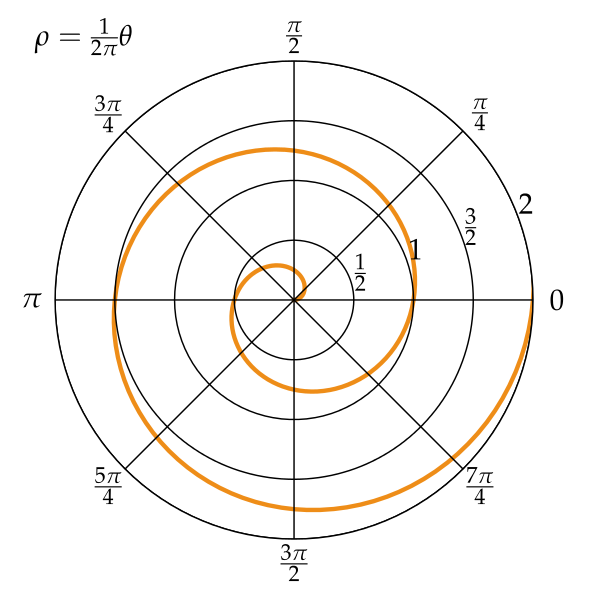
Next we have toilet paper modeled by an Archimedean spiral (I’m not kidding).  Not surprisingly, it’s from a Clifford Pickover book (Mazes for the Mind, 1992).

The vilest thing can be modeled with mathematical beauty.  Although toilet paper is not vile; it’s actually quite nice…hence all the teddy bears and babies…much better than corn cobs… I wonder what Archimedes would think of his spiral being used to represent Charmin.  Poor guy; tradition has it he was skewered on a pike by some Roman brute, while drawing circles in the sand…we can spiral outward for greater meaning, spiral inward for greater focus…and in the end if the poem means nothing we can wipe it all away and flush it down…

Then there’s the Borromean rings on p. 296 of Baez and Muniain, Gauge Fields, Knots, and Gravity (1994).

Borromean_Rings_Illusion

No two of the rings are linked; yet all three are inseparable.  It’s going to be hard to get away from Trinity allusions.  I could go the other direction…invoke knot theory: 6 crossings.  9 sticks.  This makes me think of Led Zeppelin’s Four Sticks, and so of course I have some Led Zeppelin playing now…Ramble On…Gollum, the evil one…

And to tie it all together, a random quote:

“During our sunset dash through Portland the muttering commenced again, more distinctly than before, and as I listened I caught a stream of utterly insane drivel about Asenath.” (H. P. Lovecraft, 1933)

Now the ideas go into the hopper…this is easier with Ctrl-C and Ctrl-V:

You thrive on grubs…that live in the woodwork…from a dead stump grow grubs that tunnel through the wood… this large, large mythic bird…with ivory shining in the sun… in the mountains…is that a sign?  What is the universe saying?  It is the kind of coincidence that acts as a grace note to our lives…a sort of turn or trill…The vilest thing can be modeled with mathematical beauty…I wonder what Archimedes would think of his spiral being used to wipe away our sins…skewered on a pike by some Roman brute…drawing circles in the sand…we spiral outward for greater meaning, spiral inward for greater focus…and in the end if our lives mean nothing it is nonetheless wiped away and all flushed down… No two of the rings are linked; yet all three are inseparable.  But this is not the Trinity.  3,6,9…Three is the magic number…6 crossings;  9 sticks.  But now I ramble… During our sunset dash through Portland the muttering commenced again, more distinctly than before, and as I listened I caught a stream of utterly insane drivel…

A theme has emerged to me, from the haze: an amalgam of Poe, Frost, and Sandburg, and the theme is this: the world is indifferent, life is folly, but there is a beautiful structure underneath.  So can we turn our phrases into a poem?

I’ll let the reader judge the results.

Archimedean_spiral_polar.svg

Artwork: Guillaume Jacquenot.

The old man turns, a circle, and watches his death approach.

At that moment, what is the universe whispering?

It says something, I fear, beyond reproach.

Is there turn or trill to grace the old man’s sorrow,

Or fill his burning tears with grace?

Does he see a vortex flushing blood and ink

Out, out into the darkest place?

Spiral outward, now, for greater vision,

Spiral inward for greater force—

It is sunset.  Equations flow around us few.

Though not linked, we are inseparable, divine.

Take nine sticks and make the sign

Of aleph naught and cross

A bridge from you to you.

We thrive on larvae which twist in a woodwork of our making;

But only when the light refracts just so

Does anyone see ivory glinting in the sun—

~~~

[If you liked this post, don’t forget my book Why Is There Anything? is now available for download on the Kindle!]

A poem

DeathSlide35

The old man turns, a circle, and watches his death approach.

At that moment, what is the universe whispering?

It says something, I fear, beyond reproach.

Is there turn or trill to grace the old man’s sorrow,

Or fill his burning tears with grace?

Does he see a vortex flushing blood and ink

Out, out into the darkest place?

Spiral outward, now, for greater vision,

Spiral inward for greater force.

It is sunset; equations flow around us few.

Though not linked, we are inseparable, divine.

Take nine sticks and make the sign

Of aleph naught and cross

A bridge from you to you.

We thrive on larvae which twist in a woodwork of our making;

But only when the light refracts just so

Does anyone see ivory glinting in the sun—

~~~

[In a later post I will deconstruct the poem, most probably to its detriment]

Physics is hard!

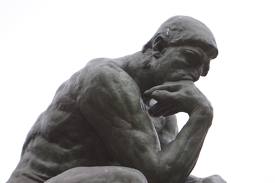
thinker

I’ve had the following conversation at least a few dozen times:

“So where do you work?”

Me: “I’m a professor over at the university.”

“What do you teach?”

“Physics.”

“Physics?  Yikes!  Physics is hard.”

Mathematics and chemistry folks that I know get similar responses.  The unspoken assumption is, why would you want to study something so difficult?

Well, why wouldn’t you?

This leads me to my main point.  When asked why I decided to study physics in the first place, my response is usually “Because physics is hard.”  To me, that’s a sufficient reason.  Not necessary, but sufficient.  I can’t imagine having a job that wasn’t mentally challenging.  Well, unless they paid me enough.

My first exposure to physics (not just science but physics) was in high school, 10th grade I think, when I read a copy of The Dancing Wu Li Masters.  Today I know this book is full of new age nonsense, Deepak Chopra-esque mumbo jumbo, but of course I couldn’t know that at the time.  All I could see at the age of 15 was this great bizarre world of quantum weirdness, and what’s more people were still investigating it.  There was work to be done.  Any copy of Bullfinch’s mythology, or any religious text for that matter, was full of similar bizarre weirdness, but those fields of study seemed static and dead.  But quantum mechanics?  You mean people get paid to think about this shit, and study it in a laboratory?  Count me in!

I was lucky enough to recognize at the time that I didn’t yet have the toolkit for thinking about these kinds of things.  Without a working understanding of calculus, without following the trajectory of physics history into the early 20th century, without seeing the careful, subtle arguments of the physics greats, one can’t really get a handle on quantum mechanics at all.  I wish I had a dollar for every time I met someone who claimed to know “all about” quantum mechanics because they watched a Nova episode about Schrödinger’s cat.  But sorry, quantum mechanics is primarily (arguably entirely) a mathematical theory and as such there are no shortcuts to understanding.  Read as many Brian Greene books as you like…read my book, while you’re at it…but all that can really do is whet your appetite for more advanced study.

That’s what happened to me.  I read a new age book filled with nonsense, but that had enough physics to get me interested.  I wanted to learn more than the author; I wanted to be able to tell him where he was wrong.  (I can certainly do this now.)  And I stuck with physics because it’s maddeningly difficult.

Don’t be afraid of learning difficult things.  Study physics.  Take up quilting.  Learn to play the violin.  Learn how to fix a boat.  Read a book about the Crimean war.  Invent a recipe for Baked Alaska.

If it’s not difficult, then why are you bothering with it?

Every Halloween, a steady stream of trick-or-treaters visits my house.  They’re looking for handouts, of course: Snickers, Pixy Stix, Reese’s, jawbreakers.  A simple mathematical model of the children’s visits can help explain the Doppler effect.

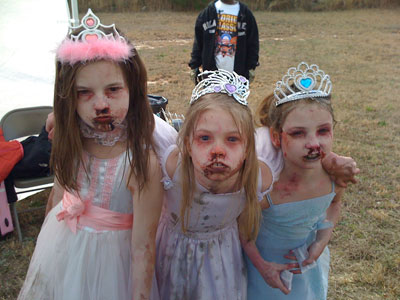
zombieland-princesses

Let’s say the children are dressed as zombies (zombies are all the rage).  Let’s further assume that the children act like zombies—not from premature candy consumption and subsequent hyperglycemia—but from a desire for greater verisimilitude.  Thus, we make the following assumptions:

  • The children move at a uniform speed v.
  • The children are separated by a uniform distance λ.

With what frequency f do the children visit my house?

It’s obvious that a greater speed v means that that children visit more often.  So:

f  v,

meaning that frequency is proportional to speed.  Further, it seems clear that a larger distance λ between children means less visits, so that

f  1/ λ.

It is logical to take these proportionalities and combine them, giving

= v/ λ.

In the study of waves, this is the fundamental relation between frequency and wavelength.  We see that in this analogy, the zombie children are meant to represent successive peaks of a wave, and the distance between the children represents wavelength.

(I haven’t defined what a “wave” actually is.  If you’re curious, a wave is something that is periodic in both space and time.  The space periodicity of the zombie kids is codified by the number λ, since if you travel a distance λ in space, you get another zombie kid just like the first.  The time periodicity is codified by the period T = 1/f, since if you’re at the house and you wait for time T, an identical zombie kid will show up at your door.)

So, what about the Doppler effect?

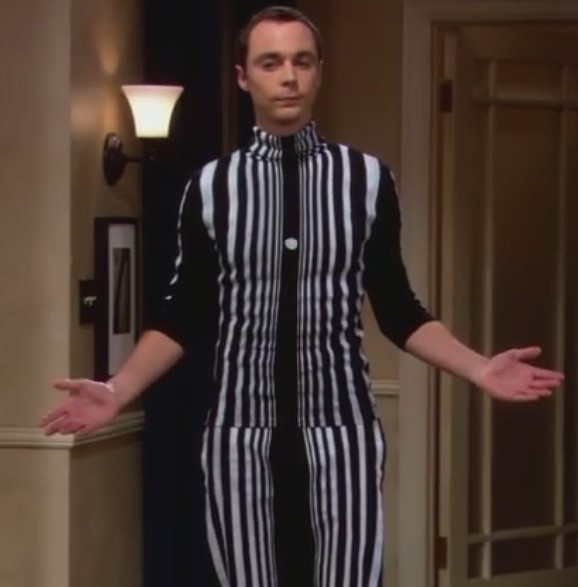
doppler

Sheldon models the Doppler effect.

We now imagine that I live in a mobile home.  ( I don’t, actually, but I was injured in a tornado in 2011, so I guess I am an “honorary” mobile home denizen.)  What is the effect of me driving the mobile home either towards or away from the zombie kids?

Suppose I drive towards the kids at a gentle 1 m/s.  If they are walking 2 m/s towards me, our relative speed is 3 m/s.  The kids show up at my doorstep more frequently.

If instead I drive away, the kids aren’t visiting as often, since our relative speed is now just 1 m/s.  In fact if I drive away at 2 m/s or greater, the kids never catch me and f drops to zero.

The same thing happens with sound.  Regions of less dense/more dense air propagate from a source to a receiver (presumably, your ears).  Each “pulse” is analogous to a zombie kid, and the frequency with which the pulses jostle your eardrums is interpreted by your brain as a pitch.  Higher frequency, higher pitch.  Now, in air the speed of sound is roughly constant, so the f that you hear depends upon one thing: the wavelength.  The more separation between pulses, the lower the pitch you hear.

You can guess what comes next.  If you run away from a sound source, the pulses can’t hit your eardrums as often; you hear a lower pitch.  Conversely, running towards a sound source makes the pitch sound higher.  The f has increased.

Of course its not just the house (the receiver) that can move; the source of the sound (i.e. the zombie kids) can move as well.  I can implement this idea next October 31 by installing a moving walkway outside my house.  If the kids walk at 2 m/s on my moving walkway, but the walkway itself is set at 1 m/s towards me, then the kids are actually moving at 3 m/s relative to me and will visit more often.  (A moving sound source such as a siren sounds higher in pitch if moving towards you.)  I could likewise set the walkway to move away from me, and have the kids visit less often or not at all.  (A siren traveling away from you sounds lower in pitch.)

This analogy is not perfect by any means.  For one thing, the zombie children (who are actual, flesh-and-blood material objects) represent wave maxima, which are mathematical abstractions.  In the case of sound, if I shout and you hear it, that does not mean that any actual physical object traveled from me to you.  A series of wave pulses traveled, sure; but no individual atoms or molecules went all the way across the room.  In a typical wave, energy travels from A to B but matter does not.

If you have trouble seeing how this can be, recall the wave (also known as the Mexican wave) that appears in large sports stadiums.  Wikipedia says it best: “The result is a wave of standing spectators that travels through the crowd, even though individual spectators never move away from their seats.”  Similarly sound can travel from me to you, even though the individual oxygens and nitrogens don’t really move that far.

Which brings up another idea of mine, which I’d like to patent.  Waves (in football stadiums) are always transverse: people raise their arms and then lower them, in a direction perpendicular to the motion of the wave itself.  But if we really wanted to model sound with a stadium wave, we should instruct the audience to move their arms from side to side.  This would set up a longitudinal wave.  I think it would look a little different.

Next time you’re directing festivities for a crowd of 10,000+, get them to do a longitudinal wave.  You’ll thank me for it.  And if you have kids of an appropriate age, dress them as zombies this Halloween.  At my house, zombie trick-or-treaters get the best candy.

When I was young, I once looked at a box of cereal and had an epiphany.  “Why is that cereal there?”  A universe of unfathomable complexity, with 100,000,000,000 galaxies, each with 100,000,000,000 stars, making 10,000,000,000,000,000,000,000 possible solar systems with planets around them—all that, and I’m sitting across from a box of Vanilly Crunch?

Vanilly

Since that existential crisis, I’ve always wondered why there was something instead of nothing.  Why isn’t the universe just one big empty set?  “Emptiness” and “nothingness” have always seemed so perfect to me, so symmetric, that our very existence seems at once both arbitrary and ugly.  And no theologian or philosopher ever gave me an answer I thought was satisfying.  For a while, I thought physicists were on the right track: Hawking and Mlodinow, for example, in The Grand Design, describe how universes can spontaneously appear (from nothing) according to the laws of quantum mechanics.

I have no problem with quantum mechanics: it is arguably the most successful theory devised by mankind.  And I agree that particles can spontaneously create themselves out of a vacuum.  But here’s where I think Hawking and Mlodinow are wrong: the rules of physics themselves do not constitute “nothing”.  The rules are something.  “Nothing” to me implies no space, no time, no Platonic forms, no rules, no physics, no quantum mechanics, no cereal at my breakfast table.  Why isn’t the universe like that?  And if the universe were like that, how could our current universe create itself without any rules for creation?

But wait—don’t look so smug, theologians.  Saying that an omnipotent God created the universe doesn’t help in any way.  That just passes the buck; shifts the stack by one.  For even if you could prove to me that a God existed, I would still feel a sense of existential befuddlement.  Why does God herself exist?  Nothingness still seems more plausible.

Heidegger called “why is there anything?” the fundamental question of philosophy.  Being a physicist, and consequently being full of confidence and hubris, I set out to answer the question myself.  I’d love to blog my conclusions, but the argument runs about 50,000 words…longer than The Great Gatsby.  Luckily for you, however, my book Why Is There Anything? is now available for the Kindle on Amazon.com:

rave book

You can download the book here.

You might wonder if my belief in the many-worlds interpretation (MWI) of quantum mechanics affected my thinking on this matter.  Well, the opposite is true.  In my journey to answer the question “why is there anything?” I became convinced of MWI, in part because of the ability of MWI to partially answer the ultimate question.  My book Why Is There Anything? is a sort of chronicle of my intellectual journey, one that I hope you will find entertaining, enlightening, and challenging.

HINT: The letters I gave were grouped in a particular way, using a particular criterion.  If I had used a different font…one with serifs, let’s say…the groupings would have been totally different…

Here are the groupings once again…

DO

B

PQ

CGIJLMNSUVWZ

AR

EFTY

HKX

ANSWER: Notice that one of the keywords I gave was “topology”.  That’s it.  The letters are grouped based on topological similarity.