Feeds:
Posts
Comments

Archive for the ‘Uncategorized’ Category

DisintegrationofPersistence

Disintegration of the Persistence of Memory (Dalí, 1954)

Here I deconstruct the poem that was posted on Monday, June 24.  The rest of this post was written prior to the poem’s genesis.

I’m going to write a poem.  What’s unusual about this poem is that I’m going to meticulously document every step of the creative process.  Then, if the poem is good, there will be a scientific record of how the poem was composed.  If the poem is not good, then at least I tried, right?

Step 1: What qualities do I want my poem to have?

Here are some poems I admire:

“The Conqueror Worm”, Edgar Allen Poe

“Second Coming”, W. B. Yeats

“Out out –”, Robert Frost

“Beija-Flor (Hummingbird)”, Diane Ackerman

“pity this busy monster, manunkind”, e. e. cummings

“Chicago”, Carl Sandburg

“Kubla Khan”, by Samuel Taylor Coleridge

As you can tell, most of these poems are rather famous, which indicates that I haven’t read much poetry in my life.  Nonetheless these poems are highly regarded, for the most part; I don’t really know how critics rate “The Conqueror Worm”.

Now, I’ve listed these poems not for inspiration, but for analysis.  If these are the poems I like, if these are the poems that come to mind when I think of poetry, then what is the common denominator?  What do these poems have that others do not?  If I can figure this out, then I am that much closer to writing a poem that I would enjoy.

First observation: only two of the poems rhyme, the first and the last.  But all of the poetry is alliterative: all of it is meant to be read aloud:

“The darkness drops again but now I know
That twenty centuries of stony sleep
Were vexed to nightmare by a rocking cradle…”

“And the saw snarled and rattled, snarled and rattled…”

“When you kiss me,
the waters wed in my ribs,  dark and pale
rivers exchange their potions—she gives him
love’s power,  he gives her love’s lure…”

I think my poem needs to be alliterative, then, and maybe even rhyme…I like poetry that is meant to be read aloud.

Dirac once said “The aim of science is to make difficult things understandable in a simpler way; the aim of poetry is to state simple things in an incomprehensible way.”  With that in mind, let’s look at themes.  Here are the poems, “translated” into plain English under Dirac’s dictum:

“The Conqueror Worm”

“Human life is mad folly ending in hideous death, the universe is controlled by dark forces man cannot understand, and the only supernatural forces that might help are powerless spectators who can only affirm the tragedy of the scene.” [from Wikipedia]  i.e. Life is folly.

“Second Coming”

Things are getting more chaotic.  Things are getting out of hand.  It almost reminds one of the legend of the “Second Coming” of Christ, which—rather than giving comfort—disturbs me.  It’s almost as if Christ and the Antichrist were one and the same.  i.e. Things are getting worse.

“Out out –”

Chainsaws are dangerous.  But more than that: if you die, that’s sad, sure, but the world will move on and ultimately not give a crap about your passing.  i.e. The world is indifferent.

“Beija-Flor (Hummingbird) ”

When you kiss me, all sorts of emotions and feelings and thoughts and chemical imbalances swirl through me.  One can almost describe this myriad of reactions with organic, jungle-like imagery, strung together like a shaman’s chant.  i.e. Passion is jungle-like.

“pity this busy monster, manunkind”

Mankind is not kind.  Progress is not good.  Science and reason ignore what’s important: things such as nature and spirituality.  Death would be better.  In fact, let’s kill ourselves.  i.e. Progress sucks.

“Chicago”

Chicago is a big, sprawling, messy, industrious, colorful place.  And that’s just fine.  i.e. A city can be beautiful.

“Kubla Khan”

Imagination is a powerful thing.  I can create visions of entire worlds in my mind.  And those visions are more beautiful than any place that’s really real, even if I cannot convey them to you, the reader.  Visiting such places in one’s mind is as close as you can get to visiting paradise.  i.e. Imagination is an escape.

[These summaries, with the exception of the first, are my interpretations only.  If one of these interpretations is “wrong” (whatever that means) then it is the fault of the poet, for writing something vague enough to be misinterpreted.]

It’s interesting to note that I like all of these poems, if even I do not agree with their sentiment.  All told, I disagree with approximately two of them.  I will not say which.

Is there a common thread?  Well, most of them are dark in tone; most of them are rational; most of them convey a sense of complexity (in the sense that they view black/white dichotomies as being too facile to describe real-world realities).  They touch on death, life, the universe around us, love, beauty, aesthetics, and creativity.  There is no talk of gods, magic, superstition, or philosophy.  I would classify them all as rational (although the e. e. cummings poem is ranting against the rational).  “Beija-Flor” is rational in that it reminds me that passion (and lust) are natural, organic, biological, biochemical processes…it’s only natural to describe passion in humid, wet, zoological terms.  And what of “Kubla Khan”?  Isn’t it mystical, spiritual?  In my view, it is only mystical in a metaphorical sense.  It evokes a mysterious, wondrous place that we can only journey to in our imagination; I don’t think anyone reading the poem would think that it describes a real place.  That is, the poem is fiction, and as such, mysticism and spirituality are perfectly welcome.

This is an aside, but I’ve often felt that some people enjoy obtuseness for its own sake.  They like there to be a message in a poem, a theme; but they want the message to be hidden in some clever way.  This has three purposes, in my view.  Firstly, it acts as a shibboleth, a kind of in-joke.  “You don’t get the poem?  Well of course you don’t.  You haven’t studied 19th century existential Flemish poetry like I have.  But those of you that have studied 19th century existential Flemish poetry, oh boy!  You’re in for a treat!”  Many poets sprinkle obscure references all over the place, to reward those who are “in” on the joke.  The problem is, if you’re not in on the joke, those references seem obtrusive and condescending.  How many more people would enjoy “The Second Coming” if it lacked the phrase “Spiritus Mundi”, which today just sounds like bragging: “Hey!  I took Latin at the Godolphin School!”  If I were writing the poem today I would replace the phrase with “collective consciousness” and the poem might be improved thereby.

The second purpose to “hide” a message or theme is to provide enjoyment for the reader when they figure things out.  It’s much like a literary version of a Sudoku puzzle.  “Oh I get it!  I figured it out!  The knight represents honor, and the plowman represents pragmatism!  He’s just trying to say that honor is sometimes dangerous, but being pragmatic will feed you in the end!”

Q. But why didn’t the poet just say that, instead of obscuring his meaning?

A. So you could enjoy figuring things out.  It’s the same reason that 1000-piece puzzles don’t come out of the box already assembled.

So what’s the third reason to hide a theme?  I hate to admit it, but maybe, in rare instances, you can say something with more power when you allude to it tangentially than when you say it directly.  It’s why Lincoln referred to the “better angels of our nature” rather than to our “consciences”.  Here’s where the real art in poetry lies; name dropping Latin phrases and hiding meaning behind contrived façades is craft, not art.  But I may be wrong.

So.  Let’s set a modest goal.  Let’s make the poem (my poem; the one I want to write) rational, complex, dark, and layered.  By layered, I mean that I want some of the imagery to have more than one meaning.  But I won’t think too deeply on the meaning: I’ll choose words and phrases that have connections, that resonate with one another, but I will let my intuition guide me.  There may be a few references (only a few!) that require some thought to unravel (we have to throw a bone to the literary Sudoku people, after all) but, on balance, I want the meaning of the poem to be obvious.  That being said, I think how the poem sounds is more important than what it says.  I like “The Second Coming” but let’s be clear: the message “things are getting worse” is rather banal.  It’s just that the poem sounds so cool when you read it aloud…

OK then.  What should the poem say?  I’ll decide that later.  Let’s start with some images first, selected at random, based on books on my desk.

I have Peterson’s Field Guide to Eastern Birds of North America; turning to a random page I see the Pileated Woodpecker on p. 189.

Let’s brainstorm and see what happens:

The Pileated Woodpecker is a large bird; I’ve seen them several times in my life, usually in dark woods.  Being a woodpecker, they eat insects out of trees, especially ants.  So some poetic thoughts already bubble to the surface: here’s this bird that thrives on grubs, on larvae, that live in the woodwork; from the dead stump grow grubs that tunnel through the wood, and are eaten by this large large bird that reminds one of the mythic (and probably extinct) ivory-billed woodpecker.  And there is a local connection, in the mountains, here; I’ve seen these birds in my very own yard on two occasions.  Including once last week.  Is that a sign?  Is the universe saying something to me?  Was I meant to see a Pileated Woodpecker just then?  Or is it just coincidence; the kind of coincidence that acts as a grace note to our lives, a sort of turn or trill?

Next we have toilet paper modeled by an Archimedean spiral (I’m not kidding).  Not surprisingly, it’s from a Clifford Pickover book (Mazes for the Mind, 1992).

The vilest thing can be modeled with mathematical beauty.  Although toilet paper is not vile; it’s actually quite nice…hence all the teddy bears and babies…much better than corn cobs… I wonder what Archimedes would think of his spiral being used to represent Charmin.  Poor guy; tradition has it he was skewered on a pike by some Roman brute, while drawing circles in the sand…we can spiral outward for greater meaning, spiral inward for greater focus…and in the end if the poem means nothing we can wipe it all away and flush it down…

Then there’s the Borromean rings on p. 296 of Baez and Muniain, Gauge Fields, Knots, and Gravity (1994).

Borromean_Rings_Illusion

No two of the rings are linked; yet all three are inseparable.  It’s going to be hard to get away from Trinity allusions.  I could go the other direction…invoke knot theory: 6 crossings.  9 sticks.  This makes me think of Led Zeppelin’s Four Sticks, and so of course I have some Led Zeppelin playing now…Ramble On…Gollum, the evil one…

And to tie it all together, a random quote:

“During our sunset dash through Portland the muttering commenced again, more distinctly than before, and as I listened I caught a stream of utterly insane drivel about Asenath.” (H. P. Lovecraft, 1933)

Now the ideas go into the hopper…this is easier with Ctrl-C and Ctrl-V:

You thrive on grubs…that live in the woodwork…from a dead stump grow grubs that tunnel through the wood… this large, large mythic bird…with ivory shining in the sun… in the mountains…is that a sign?  What is the universe saying?  It is the kind of coincidence that acts as a grace note to our lives…a sort of turn or trill…The vilest thing can be modeled with mathematical beauty…I wonder what Archimedes would think of his spiral being used to wipe away our sins…skewered on a pike by some Roman brute…drawing circles in the sand…we spiral outward for greater meaning, spiral inward for greater focus…and in the end if our lives mean nothing it is nonetheless wiped away and all flushed down… No two of the rings are linked; yet all three are inseparable.  But this is not the Trinity.  3,6,9…Three is the magic number…6 crossings;  9 sticks.  But now I ramble… During our sunset dash through Portland the muttering commenced again, more distinctly than before, and as I listened I caught a stream of utterly insane drivel…

A theme has emerged to me, from the haze: an amalgam of Poe, Frost, and Sandburg, and the theme is this: the world is indifferent, life is folly, but there is a beautiful structure underneath.  So can we turn our phrases into a poem?

I’ll let the reader judge the results.
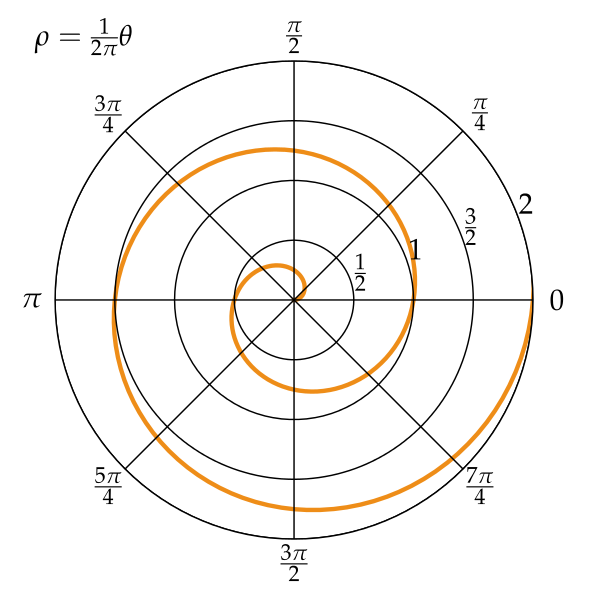
Archimedean_spiral_polar.svg

Artwork: Guillaume Jacquenot.

The old man turns, a circle, and watches his death approach.

At that moment, what is the universe whispering?

It says something, I fear, beyond reproach.

Is there turn or trill to grace the old man’s sorrow,

Or fill his burning tears with grace?

Does he see a vortex flushing blood and ink

Out, out into the darkest place?

Spiral outward, now, for greater vision,

Spiral inward for greater force—

It is sunset.  Equations flow around us few.

Though not linked, we are inseparable, divine.

Take nine sticks and make the sign

Of aleph naught and cross

A bridge from you to you.

We thrive on larvae which twist in a woodwork of our making;

But only when the light refracts just so

Does anyone see ivory glinting in the sun—

~~~

[If you liked this post, don’t forget my book Why Is There Anything? is now available for download on the Kindle!]

Read Full Post »

DeathSlide35

The old man turns, a circle, and watches his death approach.

At that moment, what is the universe whispering?

It says something, I fear, beyond reproach.

Is there turn or trill to grace the old man’s sorrow,

Or fill his burning tears with grace?

Does he see a vortex flushing blood and ink

Out, out into the darkest place?

Spiral outward, now, for greater vision,

Spiral inward for greater force.

It is sunset; equations flow around us few.

Though not linked, we are inseparable, divine.

Take nine sticks and make the sign

Of aleph naught and cross

A bridge from you to you.

We thrive on larvae which twist in a woodwork of our making;

But only when the light refracts just so

Does anyone see ivory glinting in the sun—

~~~

[In a later post I will deconstruct the poem, most probably to its detriment]

Read Full Post »

Whenever I think of numbers, I form a mental image in my head.  This is not a conscious process; it happens consistently and involuntarily.  For example, whenever I imagine the numbers 1 through 100, I see something like this:

Numbers

You will note several interesting features of this mental map.  Firstly, there is always a 90° left turn at the number 20; there is always a 90° right turn at the number 100.  These two kinks are the only kinks in my mental number line; the lines are perfectly straight before zero and after 100.  Why the kinks are there is mysterious.

Notice also that the image is not to scale.  That is, 50 occurs half-way between 20 and 100 (why isn’t 60 there instead?)

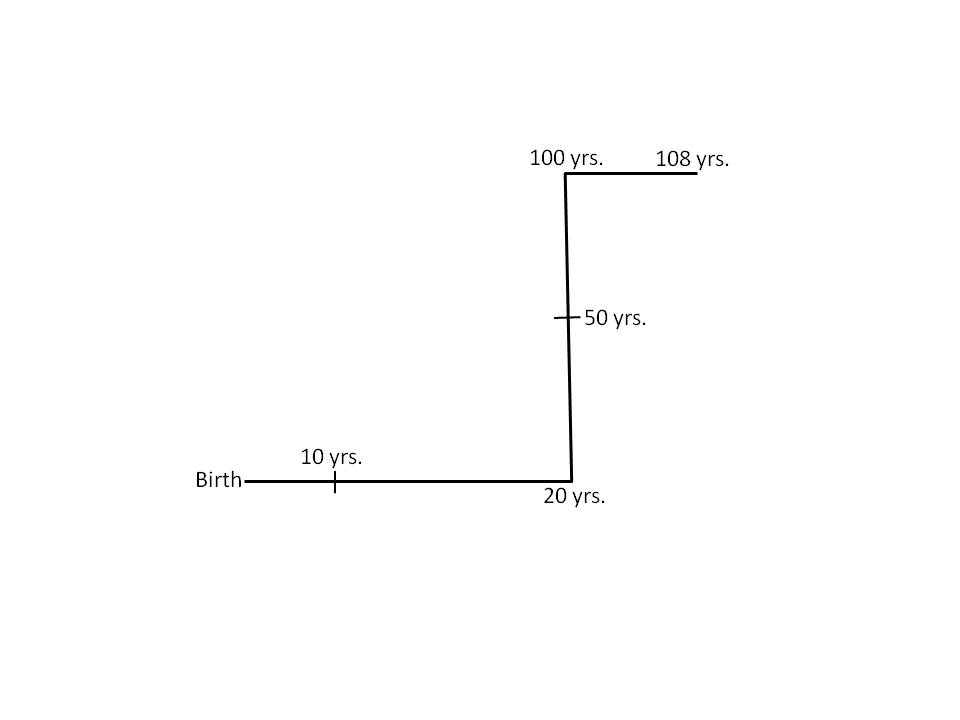
Here’s another mental map I have, one that appears whenever I imagine a person’s age:

Age

You will note that this mental image is similar to the previous one, but rotated 90° to the right.  The scale is also warped: not only in the location of 50 yrs., but in the location of 10 yrs.  I believe this stems from my childhood belief that the years from age 10 to age 20 would seem to last longer than the years from 0 to 10.

Why childhood?  Well, I’ve had such mental images for as long as I can remember; it follows that they were first “constructed” in my brain at an early age.  And there is a sort of logic to the idea that 10-20 lasts “longer” than 0-10.  After all, we don’t normally recall anything about our first 5 years or so; to a child, it’s almost as if you missed those years.  So if I am 10 years old, say, and looking back at my life so far, it won’t seem nearly as long as the decade looming in front of me.  (I must stress that I am not a neuroscientist and that this is all pure speculation.)  As for why 50 is half-way between 20 and 100, I can only conclude that I wasn’t so good at calculating averages when I was younger.  The similarity of the two mental maps is best explained by positing that one of the maps is derived from the other, although which came first I cannot say.

But still, that kink…

I only became aware very, very recently that there is a name for this phenomenon.  These maps I make are called “number forms” and they are a form of synesthesia.  I have a friend who experiences grapheme-color synesthesia, seeing letters and numbers as if they had very specific colors.  It never occurred to me that my mental number maps were a related phenomenon in any way.

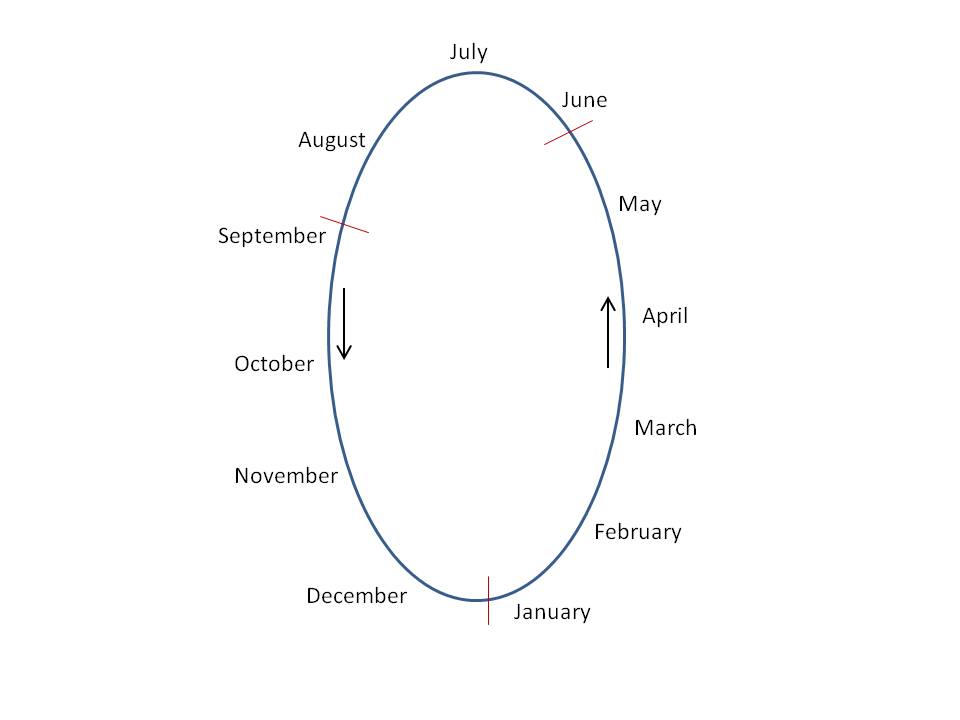
Here’s how I see the months of the year:

Calender

The order is always counterclockwise.  Strangely, the months are not quite evenly distributed: July is always at the top, but December/January are level at the bottom, with the (strange) consequence that there is one more month in the first “half” of the year than the second.  I also mentally divide the year into three partitions, starting at Sept. 1, Jan. 1, and June 1.  I am confident that this partitioning is a product of having attended school (on a semester system) for 25 years of my life.

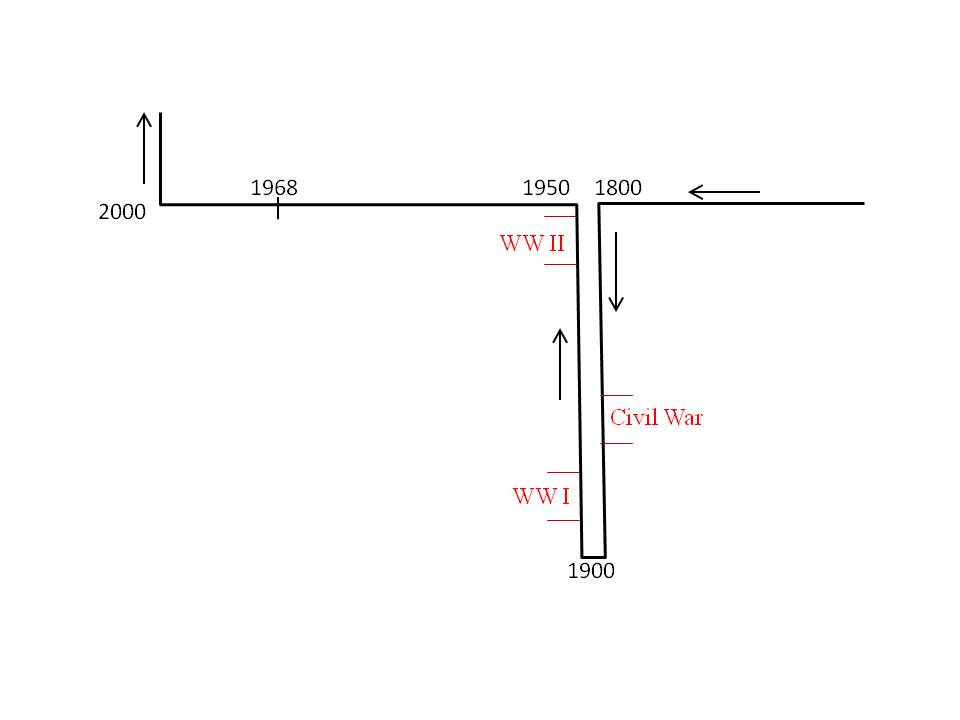
Here’s the strangest map of all, but one that has (I think) the easiest explanation:

Years

This is how I picture the recent history of the world, from the late 1700’s to the present.  There are four kinks: at 1800, 1900, 1950, and 2000.  The three biggest wars (to an American, at least) are marked in red; 1968 is also clearly “labeled” in my mental map (obviously because it’s the year of my birth).  Again, there is a lack of scale: 1800-1900 takes up as much “space” as 1900-1950.  One might conclude that I regard the 20th century as more “important” than the 19th, since I relegate more space to the former.  But there is a simpler explanation.

I can still vividly recall a timeline of history that I saw, perhaps in the 3rd or 4th grade, that has the exact same topology as this last mental map of mine.  The years from 1800 to 1970 (or so) were graphically depicted in a timeline; there were folds at 1900 and 1950, simply to make the timeline fit on the printed page.  Above key years (such as 1939) were cartoonish drawings of world events, such as World War II or Man Lands on the Moon.  Beyond the 1970’s there was nothing.  I wish I could find this image, which I believe in some sense “triggered” this form of synesthesia; I want to say that the image was in a World Book Encyclopedia but I have no proof of this claim.

In any case, I think other forms of synesthesia may also be linked to the way we first learn certain things.  My friend (who sees colors for every letter of the alphabet) once told me the probable origin of his synesthesia.  He first learned letters and numbers through colored refrigerator magnets; the colors and letters became inextricably tied in his mind, and the connections exist to this day.  For any real neuroscientists out there, I believe this is a fruitful area for further research.

Anyway, I’d be curious to see how many other people experience “number forms”.  It doesn’t make you crazy.  After all, Sir Francis Galton called his book on the subject The Visions of Sane Persons.

But still, that kink…

Read Full Post »

flight

I don’t like to fly.

I will do it; I have flown dozens of times before; I will do it again.  But I don’t particularly enjoy the experience.  It has nothing to do with the perceived risk of flying…I know, of course, that driving on the highway is much, much more dangerous than getting into an airplane.  No, I don’t like to fly because it seems to me a particularly stressful way to die.  Seeing the wing shear off, then having the plane spiral down, gradually…

I don’t really want to talk about flying today.  What I want to talk about is a paradox that I discovered recently.  The paradox is this: the knowledge that magic is non-existent, that the universe is indifferent, that you are not special in the grand scheme of things—that knowledge can be both a comfort and a source of fear, simultaneously.  And that’s weird to me.  Shouldn’t one’s beliefs comfort you, or not comfort you, as the case may be?

Let’s say that you do think that you’re special, that you were meant for some grand purpose.  This would certainly be a comfort if you were afraid of flying.  After all, you’d say to yourself “why should I be afraid to get into an airplane?  It won’t crash—I’m special somehow!”

Now, suppose you are superstitious, and think you are special in the opposite way: you think you’re cursed, that the world is out to get you, that God hates you, whatever.  I bet that your beliefs don’t make flying a fun experience.

But what about me?  I am a physicist, a determinist, an agnostic, a free thinker.  You know how some people describe themselves as spiritual?  Whatever the opposite of spiritual is, I am that.  There’s no guardian angel watching over my shoulder; I was not meant for some higher destiny, and the universe doesn’t care about me one way or the other.  Given such beliefs, should I be comforted when I get on a plane, or not comforted?  Therein lies the paradox.

When I get on a plane, I often start thinking, “the wing’s going to rip off in mid-flight, I just know it…that would just be my luck…you just know I’m going to be on that one-in-a-million flight that crashes into the Grand Canyon.”  But then I comfort myself by saying “there’s no such thing as ‘being unlucky’.  I am no more likely than anyone else to be on an ill-fated Grand Canyon flight.  So I should take comfort, because objectively, plane crashes are really rather rare.”

The problem is, my beliefs also make me more nervous at times.  “There is no guardian angel.  I am not remarkable in any way, so I can’t be comforted by the idea that I am somehow special.  Planes sometimes crash, and there’s certainly a chance that I will be on such a flight.”

So: should I be comforted, or not comforted?

I should be comforted if I think (in some deep recess of my brain) that there really is something called bad luck, and that I really am “cursed” in some way, because when I remember that this is nonsense, I will feel better…my belief has erased a sense of foreboding that I was irrationally experiencing.

I should not be comforted if I think (in some deep recess of my brain) that there really is something called destiny, and that I really am “blessed” in some way, and that I was meant for some higher purpose than disintegration in a smoldering pile of twisted metal, because when I remember that this is nonsense, I will feel worse…my belief has erased a sense of protection and comfort that I was irrationally experiencing.

So again: should I be comforted, or not comforted?

Well, which is greater?  (1) My irrational belief (that everyone has to some degree) that I am cursed in some way, and that there is a “doom” hanging over me… or (2) my irrational belief (that everyone has to some degree) that I am blessed in some way, and that I was meant for something more?  In the first case (the pessimistic case) I should be comforted when I come to my senses, and in the second case (the optimistic case) I should be more worried when I come to my senses.

Hence the paradox:

  1. Pessimists are comforted when they remember that the universe is indifferent;
  2. Optimists are more worried when they remember that the universe is indifferent.

On balance, I am an optimist, which means my deterministic world view gives me even less comfort than it should.

Of course, given the fact that I am an optimist, I am comforted by the fact that there’s probably something wrong with my analysis.  Only, wouldn’t that make me a pessimist?  I’m so confused…

[Image is from the movie Flight (2012), directed by Robert Zemeckis.  It’s a good movie.  You should watch it.]

Read Full Post »

Kevin_Bacon

He should play Erdős in a movie…

My current Erdős number is 6.  I have collaborated recently with a mathematician (Jeff Lawson) whose number is 4; thus I fully expect to be “promoted” to an Erdős number of 5 within a year.

(What’s an Erdős number?  Basically, it’s the mathematical equivalent of the “Bacon number”.  You can read about Erdős numbers here.)

But I want to blog today about a different number that (frankly) I invented yesterday.  I call it a “Google number” (GN).  Here are the rules: what is the minimum number of words, none of which are proper nouns, that you must type into Google and do a Google search, such that the first search result is about you or one of your discoveries, written by you, or is a website written/maintained by you primarily?

I am very proud to say that my Google number is 2 (more on this later).

A Google number of 1 is very, very rare.  Type “president” into Google and you get a link to President of the United States…so Obama has a Google number of 1, but this will definitely change in 2017.  Type in “basketball” and you do not get Michael Jordan.  Type in “chess” and you do not get Carlsen, Kasparov, or even Fischer.

Einstein has a Google number of 1: “relativity” gives you an article on relativity.  James Cameron also has GN=1: “avatar” sends you to a James Cameron website, although you could argue that “avatar” is too close to the proper noun “Avatar” (there’s a lot of subjectivity here).    I’d be inclined to give a 1 to Thomas Edison since “incandescent” goes to an article on the incandescent bulb.  It’s not that easy to come up with more examples.  Try it yourself.

If you think about it, even the most educated person can’t have a vocabulary of much more than 30,000 words.  So logically, there can’t really be more than 30,000 or so people in the entire world with a Google number of 1.  This is 0.0004%, or 1 in 233,333.  Pretty select company.  And of course the actual number of people with Google number 1 is much, much lower, because a lot of words are “wasted”:  try searching for “harpsichord”, for example.  The lead search result does not point to any one individual person that I can see.  (Note: for simplicity, I define “Google number” as being English-specific; if we were talking about words in Spanish we might instead define a número Google, and so forth.)

What about a Google number of 2?  In theory there could be 30,000^2 = 900,000,000 people with a 2, but in practice this is fantasy.  Remember, you can’t use proper nouns.  Getting a 2 is very tricky.  Let’s try it with a famous person, to see how hard it is.  Let’s try Stephen Hawking.  “Black hole” doesn’t work; nor does “famous physicist” or “famous astrophysicist”.  “Hawking radiation” is off the table (see: proper noun.)  Even “grand design” doesn’t work because you get a British TV show first.  “History time” is a near-miss.  Finally, success: “brief history” works.  A Brief History of Time.  Hawking has a Google number of 2.

I would contend that anyone with some internet presence will have a finite Google number.  For example, my colleague Jeff (with the Erdős number of 4) has a Google number of 3: just type in “heuristic geometric phase” and you will get a talk he gave in Toronto on our joint research.  For all I know he may have a lower Google number, but it wasn’t that hard to get 3.

Now for some shameless self-promotion: my Google number is 2.  Type in “metaphor loop”.  I’m quite proud of this for some irrational reason.

One problem with this game is that it is fluid, ever-changing.  Douglas Hofstadter could very well write a book in which “metaphor loops” were integral; soon I would find my modest paper pushed to the side.  But that will happen to Obama, too, eventually, so I’m in good company.  C’est la vie.  For now, I’ll enjoy the fact that GN(me)=2, and I’ll await the vagaries of fate.

Read Full Post »

The following is a list of foods I love today, at the age of 44.  I can’t imagine the 10-year-old me even trying any of these foods, much less liking them.  But we grow up; our tastes change, and hardly a day goes by without me craving Marmite.  I mean, come on?  Isn’t that weird?  Please tell me I’m not crazy!

10. Fresh spinach

WU0210H_perfect-spinach-salad

I didn’t really learn to enjoy salads all that much until I discovered that fresh spinach is infinitely tastier than lettuce.  As a kid, I think I tried spinach, in a can, like Popeye; the problem is, canned spinach is barely edible.  When you eat a fresh spinach salad, maybe with apples and a splash of bacon vinaigrette, you can only wonder: is this really the same plant as found in canned spinach?  Hard to believe.


9. Snails

Escargot

I’ll be honest; I’ve only had snails (at most) 10 times in my life, and always in a fancy restaurant.  But they’re tasty.  They taste even better when you call them snails, since calling them escargot leaves a bit of a snooty aftertaste.


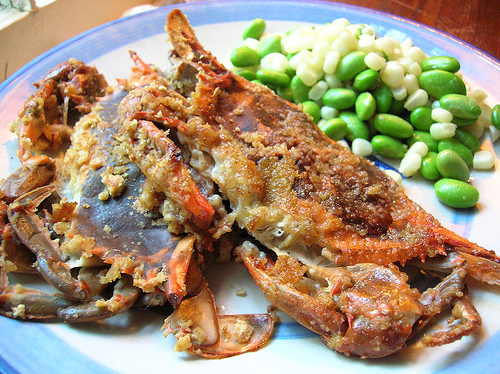
8.Soft-shelled crab

crab


I first tried this in a Thai curry dish.  I still find the texture a bit strange, but overall I find the taste delectable.


7. Mushrooms

mushrooms


I’ve liked mushrooms for a long time, but can’t recall whether I tried them as a kid or not.  I think most Americans are first exposed to mushrooms as a topping on pizza, but I don’t really like mushrooms that way.  They invariably go straight from a can to the pizza.  Fresh mushrooms are better, and stuffed mushrooms may be the best of all.  As a bonus, there are many, many varieties, and they all taste different.


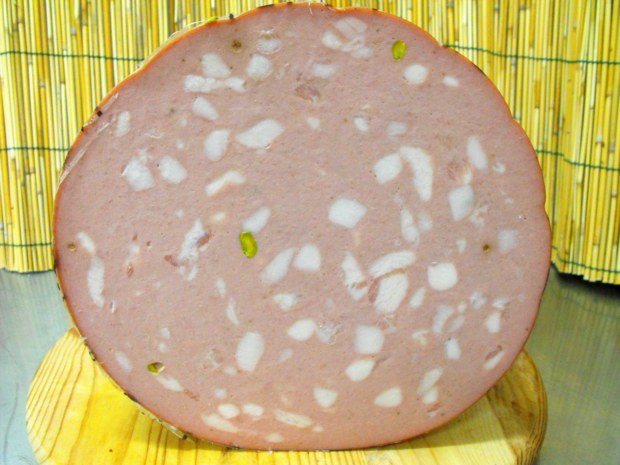
6. Mortadella

mortadella_620x465

To my mind, mortadella is the king of sandwich meats.  It’s a bit like deli bologna, but more flavorful: it is marbled with pork fat, and often has pistachios and olives mixed in.  I might have liked this as a kid, but I never tried it.  I had never even heard of it.  I’d have to drive over a hour from where I live to find this today.


5. Runny eggs

eggs

Yolk freaks kids out.  But not me.  Over-easy is the way to go.  And when the Hollandaise in an Eggs Benedict runs together with the yolks…


4. Coffee

coffee

I guess I haven’t grown up entirely.  I don’t drink coffee, unless it’s cold with plenty of milk and sugar.  Sort of like a melted coffee ice cream.  My favorite way to have coffee is the way they serve it in the Vietnamese restaurants: over ice, with sweetened condensed milk.


3. Pomegranate juice

POM

So bitter.  Yet so good somehow.  I don’t really know why I like it.


2. Stilton

stilton1

The king of cheeses.  Radically strong flavor; almost hallucinogenic.  Not just for Wallace and Gromit anymore.


1. Marmite

marmite

What can I say?  Marmite, objectively, doesn’t taste all that great: it’s almost pure umami, like chewing on a bouillon cube.  And yet it is alluring for some unfathomable reason.  On bread, with butter, it is divine; mixed with honey and corn syrup, it is the ideal pizza sauce.  I can get Marmite (or its complex conjugate, Vegemite) where I live, but I don’t eat it all that often.  I may go 6 months without having any.  Then, on a random day…the 19th of February, say…I will start to crave it, and even start to blog about it.

Read Full Post »

In the 1985 film Young Sherlock Holmes, Holmes tells Watson the following riddle:  “You’re sitting in a room with an all-southern view.  Suddenly, a bear walks by the window. What colour is the bear?”  (He says “colour” not “color” because he’s from the UK.)  As I recall it takes Watson most of the movie to give the obvious answer—white—because the bear must be a polar bear.  All southern view…North Pole…polar bear…you get the idea.

young-sherlock-holmes-watson-sherlock

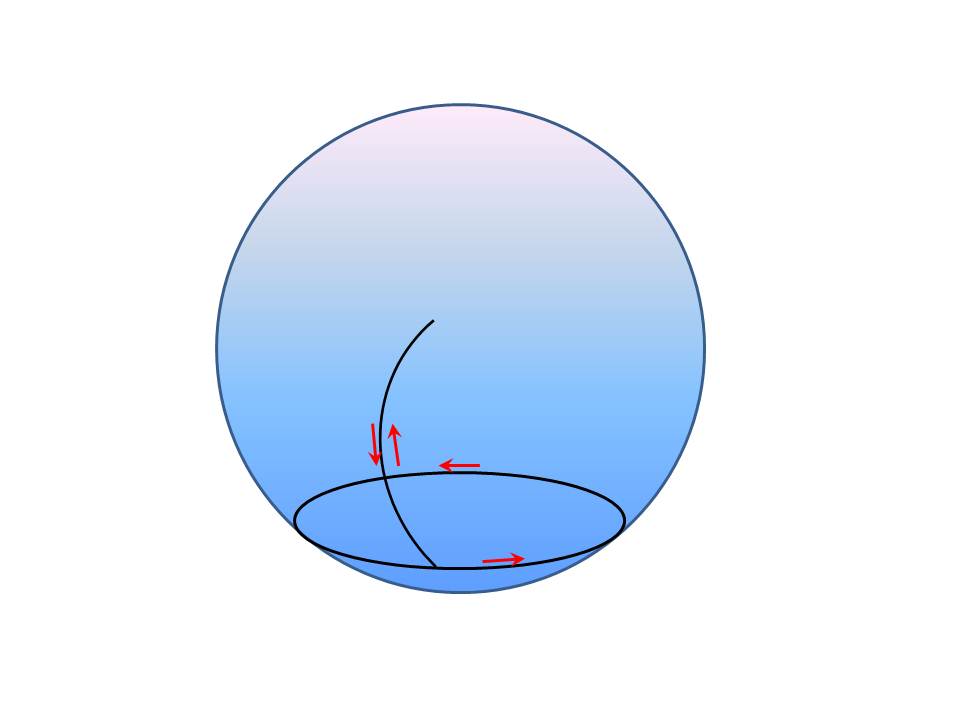
Over the years I’ve hear other versions of this riddle.  The most common seems to go something like this: “A hunter travels a mile south, a mile east, shoots a bear, then travels a mile north to her starting point.  What color was the bear?”  People assume that this riddle is isomorphic to the previous one, because (supposedly) there is only one place on Earth you can travel the same distance south, then east, then north, and return to the beginning.  But this is wrong.  There are an infinite number of places on Earth you can travel in a loop that is 1 mile south, then 1 mile east, then 1 mile north.

Of course, starting at the North Pole is one solution.  But there are also many, many more solutions close to the South Pole.  Imagine, for example, a latitude roughly 1/(2π) miles north of the South Pole; in such a case the parallel along that latitude is the circumference of a circle, given by

C = 2πr = 2π [1/(2π)] = 1 mile.

(I said roughly because we’re on the surface of a sphere, so the circumference of a parallel is not exactlyr—because r is an arc length, not a straight line—but 1 mile is so much smaller than the radius of the Earth that we can assume a locally flat geometry.)  If a hunter started his journey 1 mile north of this latitude, then of course he could go 1 mile south, then 1 mile east (circumnavigating the South Pole!) and then 1 mile north, and return to his starting point; I presume there would be no bears.

South Pole

There are actually infinitely many solutions that work.  In each case, after going a mile south, the hunter would have to reach a latitude in which the circumference C was an integer fraction of 1 mile.  That is, it must be true that

C = 1/n miles,

where n is an integer.  This means that the parallel would have to be

r = C/(2π) = 1/(2πn)

miles from the South Pole (again, this is a flat approximation to a spherical problem).  So the most general South Pole solution is that the hunter should begin 1 + 1/(2πn) miles north of the South Pole.  For example, take n = 5.  If a hunter starts 1.0318 miles from the South Pole, she can go south 1 mile, east 1 mile (circumnavigating the South Pole exactly 5 times) then north 1 mile, and relax in her hot tub.  No bears will be harmed, unless some evil genius has released them in Antarctica.

The original version of the riddle, as given by the young Sherlock Holmes, is superior, since it has only one solution.  We can conclude that Sherlock Holmes was good at math.

I mean, maths.

Read Full Post »

One day in the summer of 2011, while mowing the lawn, I saw a strange creature flying through the air.

Actually, “flying” is too generous a term.  The creature was lilting through the air.  Lurching.  It appeared to have ten legs, and was about the size of a silver dollar.  I was puzzled, to say the least, but that lawn wasn’t going to mow itself so I went back to work.

dip_phantom_crane_fly01

The mystery bug…

I live in a rural area in the mountains of North Carolina, only 30 minutes away from the entrance to the Great Smoky Mountains National Park.  There’s a lot of wildlife here: I’ve seen bear, elk, deer, raccoons, opossums, groundhogs, voles, and squirrels; our bird feeders are always full of cardinals, chickadees, towhees, finches, and titmice; and I once came home to a 4-foot black snake inside my house.  As for arthropods, I’m very familiar with flies, no-see-ums (family Ceratopogonidae), moths, wasps, honeybees, crickets, ants, beetles, and spiders of all kinds.  I’ve had close encounters with black widow spiders no less than 3 times in my life.

But this thing?  With 10 legs?  Lurching through the air like a drunken hang glider?  Incomprehensible.

Over the course of that summer, I saw such creatures on numerous occasions.  I gradually came to realize that they were insects, since subsequent sightings showed 6 legs, not 10.  My working hypothesis was that what I saw that first day was a mating pair: two of these things stuck together.  But I still had no idea what the confounded creatures were.

In appearance, the insects were bizarre to say the least.  They were striped, like zebras, and their legs appeared  to have at least 3 joints each, so that the legs took on a zigzag character.  They didn’t appear to use their wings, which I guessed were vestigial; rather, picture a 6-legged starfish up on one end, clawing and grasping its way forward.  As a physicist, it looked very much like the creatures were literally swimming through the air.  And so I resolved, with the help of the internet, to positively identify them.

Rutherford said that “all science is either physics or stamp collecting.”  A lot of people take this to be a disparaging comment about sciences other than physics, but I don’t.  I kind of like stamp collecting.  I like being meticulous, and being detailed.  That’s why I like pastimes such as putting together 1000-piece puzzles.

But my search for the identity of the “mystery bug” took stamp collecting to a whole new level.  It literally took me a month of sleuthing to identify the things.  I tried the obvious first: I googled things like “strange zebra striped bug” and “bug that swims in the air” but had no luck.  I posted a question on an entomology bulletin board.  I looked at websites dedicated to “insects of the Appalachians.”

Finally, I had a breakthrough: I saw one of the bugs hitting up against a window in our house.  For the first time, I could see the creature close up and for more than just a second or two.  I verified that the creature did have six legs; I verified that it did have wings, although they seemed useless.  I realized that my mystery bug was a crane fly.  Here’s a more typical, run-of-the-mill crane fly:

800px-Crane_fly_halteres

A typical crane fly

Regular crane flies are common where I live; kids often mistake them for gigantic mosquitoes (which they are not).

Once I realized that the mystery bug was a type of crane fly, my task was eased enormously.  And eventually I found this assortment of photographs.  Eureka!  I had done it!  They were phantom crane flies, of the family Ptychopteridae.  Specifically, they were the species Bittacomorpha clavipeswhich, according to this Wikipedia article, are “known for the odd habit of spreading out [their] legs while flying, using expanded, trachea-rich tarsi to waft along on air currents.”

It turns out that the phantom crane fly is one of the very, very few creatures on Earth that fly without using their wings.  They are literally swimming, somehow taking advantage of a high Reynolds number (let’s say, 265?) to sludge through the atmosphere without those wings that evolution gave them.  Consequently they look more like seed pods drifting on the wind than they do insects.

What is my point?  I don’t have one.  I just think these bugs are cool, and you should try to find them if you ever visit the Eastern United States.  They hang out in marshy areas in late summer.  Oh, and if you’re a physicist or an entomologist, think about studying these little guys.  The field’s wide open as far as I can tell.  Somebody needs to video the flight of the phantom crane fly, so get on it!  [Note added later: I did find this video which shows the weird flight, are there more?]

Read Full Post »

An Oulipo story

A friend of mine recently made the following challenge: can you start a story with one sentence, and logically end with another sentence?  The sentences were:

(1)   The washing machine repairman grunted.

(2)   The archbishop vowed never to eat figs again.

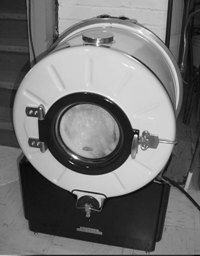
In the spirit of Oulipo (Ouvroir de littérature potentielle) I present my efforts here.  Don’t forget : if you’re a many-worlds adherent, then this is a true story.

bendix

The 1938 Bendix washing machine

The Foundation that Saves

The washing machine repairman grunted.  “I don’t know as you remember as much of the Bible as you think, your Excellency.”  He wiped his hands on his boilersuit.

“You may be right.  But still—can the Bendix be saved?”

“Well sir, that’s what I was referrin’ to.  Saving.  This here contraption, it wobbles a great bit, drifts, if you will.  So if’n you need it to stop walkin’ across the floor, well sir, it needs a foundation, like.”  His eyes glittered.

Lang nodded.  “I get your reference now.  You said the machine couldn’t be shaken by the steam if it were founded upon a rock.  That’s what, Luke Chapter 6?”

“Just so, your Excellency.  When the steam from the intake beats vehemently, well sir, the pantry here gets a might flooded, with all your Canterbury particulars and vestments getting wet and so forth.  ‘less of course we was to bolt the ol’ Bendix to the floor so as it didn’t walk.  And so I thought of my Sunday canon, sir, and heard my ol’ rector saying clear as a bell: ‘He is like a man which built an house, and digged deep, and laid the foundation on a rock: and when the flood arose, the stream beat vehemently upon that house, and could not shake it: for it was founded upon a rock’.”

“I am impressed.”

“As long as you ain’t impressed by no rock, sir, then we’re good, sir, if you get my meaning.”

Lang smiled.  “You have a deep knowledge of scripture, for—”

“You can say it, Excellency.  For a handyman.  My mum raised me proper, in the ecclesia anglicana if you will, sir.”

“And you were saying, I don’t remember as much of the Bible as I might think I do.”

Mr. Suttles stood up, cracking his knuckles and turning to face Archbishop Cosmo Lang.  “Well, you was talkin’ about the Lady’s feast upstairs, the bounty, how it was ‘a land of wheat, and barley, and vines, and fig trees, and pomegranates; a land of olive oil, and honey’.”

“Deuteronomy 8:8.”

“But our Lord Jesus didn’t go in for any figs, you understand, despite what the Old Testament might say.”

The archbishop smiled.  “You refer to Mark Chapter 11.  When our Lord comes across the fig tree, and finds it barren—”

“Yes, sir.  With all respect, Excellency, Jesus forbade us to eat figs ever again, and I for one don’t want to disobey.”

“Well, it was a parable, son.  The point was that—”

“Plus, them figs that grow on Dr. Speelman’s farm, well sir, they’re infested.  Wasps, you know.  They lay their eggs in the figs, and them larvae hatch inside, and eat up the seeds, sir, and get right fat and happy.  You ever bite into a fig, sir, and feel that crunchy, gritty texture?  Like them little globules that get stuck in your teeth, kinda soft yet kinda firm at the same time?  They as get stuck like that, are wasp eggs.  I kid you not, Excellency.  Jesus knew what he was talking about.  He didn’t want to eat no wasp eggs, and didn’t want his disciples eating no wasp eggs, neither.  That’s one foundation I can get behind.  So forget about no land of bounty with wheat and honey and figs.  Stay away from those larvae.”

The archbishop vowed never to eat figs again.

Read Full Post »

2012 in review

The WordPress.com stats helper monkeys prepared a 2012 annual report for this blog.

Here’s an excerpt:

The new Boeing 787 Dreamliner can carry about 250 passengers. This blog was viewed about 1,700 times in 2012. If it were a Dreamliner, it would take about 7 trips to carry that many people.

Click here to see the complete report.

Read Full Post »

« Newer Posts - Older Posts »