Feeds:
Posts
Comments

There’s been a lot of press lately about all the plastic crap in our oceans. For example, this Mother Jones article of a week ago has metastasized and been re-posted many times. In the article, there are some (seemingly) alarming claims, such as:

  • There are up to 28 billion pounds (12.7 million metric tons) of plastic in the oceans;
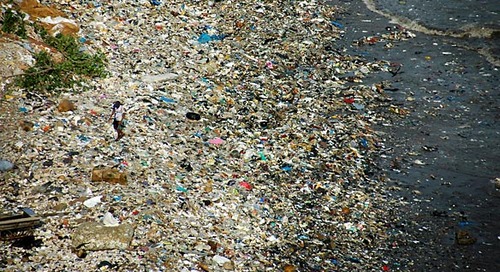
  • There’s an accumulation of junk (the great Pacific garbage patch) which is twice the area of Texas.
M972418479af64f8fd4710e9e14e4494d

Now, I will be the first person to condemn pollution, promote biodegradability, and sing the praises of sustainability. However, these numbers (if taken at face value, and I have no reason not to) don’t necessarily make a very strong case that the oceans are filled with junk.

The problem is that the oceans are just so ridiculously huge to begin with.

Let’s do some simple math. All of the oceans on the planet have a combined volume of about 1.3 billion km3, which is 1.3 x 10¹⁸ m3. At roughly 1000 kg/m3, this has a total mass of 1.3 x 10²¹ kg, which corresponds to a weight of 2.87 x 10²¹ pounds. So we get the following ratio:

28 billion pounds ÷2.87 x 10²¹ pounds = 9.8 x 10⁻¹².

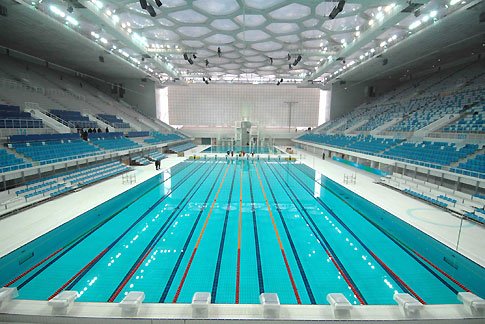
That’s a pretty small fraction. To put it into perspective, let’s say the world’s oceans were an Olympic sized swimming pool, with volume of 2500 m3 and a mass of 2.5 x 10⁶ kg. On this scale, all of the plastic in all the world’s oceans would have a mass of (2.5 x 10⁶ kg) x (9.8 x 10⁻¹²) = 24.5 mg, which is about the mass of a housefly.

Let me stress: all the plastic we’ve dumped in all the oceans is about like a housefly tossed into an Olympic-sized swimming pool.
swimming

But what about that Texas thing? A pile of junk, twice the size of Texas, just floating around? That has to be bad, right?

The area of the world’s oceans is ~3.6 x 10⁸ km2. Twice the size of Texas is 2 x 696,241 = 1.39 x 10⁶ km2.

This gives a ratio of 1.39 x 10⁶ km2/3.6 x 108 km2 = 0.0039 = 0.39%. That’s small, but a much bigger fraction that before. Not surprisingly, our plastic junk takes up a higher fraction of the oceans’ area than it does the mass, because the junk floats on the surface.

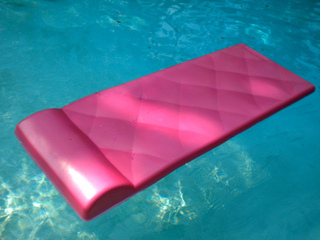
Returning to the Olympic sized swimming pool: its area is 50 m x 25 m = 1250 m2. Since 0.39% of that should be floating junk, we get 1250 m2 x 0.39% = 4.875 m2. That’s a floating trash pile 2.2 m x 2.2 m on a side, bigger than the area of a swimmer…it’s about the area of two pool floats. That’s big enough to notice. That’s big enough to worry about.

To summarize: the great Pacific garbage patch is like two pool floats in an Olympic sized swimming pool.  But these are thin floats: remember, they can’t weigh more than a housefly!
foam-pool-float-pink

This analysis is optimistic and pessimistic in equal measures. On the one hand, in terms of mass, the amount of plastic we’ve chucked into the ocean is a pittance, in part because the oceans are so deep. On the other hand, since plastic floats, it takes up a disproportionate amount of the oceans’ surface area (a place where most marine life lives anyway). Even if it’s less than 1% of the area of the whole pool, a couple of pool floats is certainly a distraction if Olympic swimmers are trying to have a race. My suggestion is that we should strive to…

Oh, who am I kidding. Look at this graph (again, from that Mother Jones article):
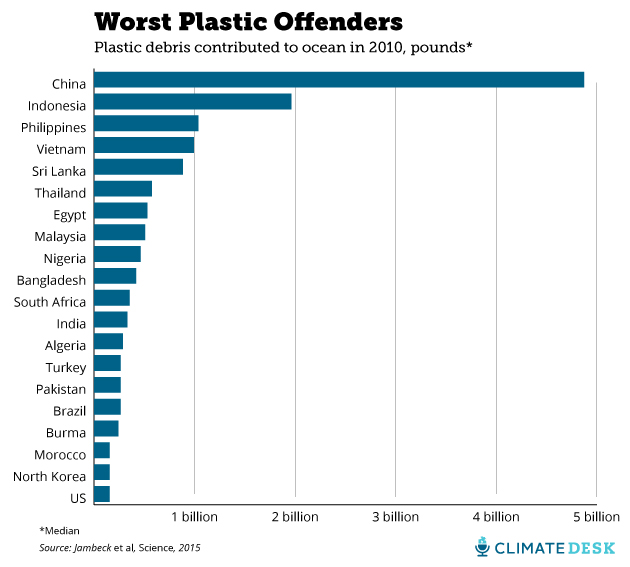
plastic-ranking_1

If China doesn’t change its ways, it doesn’t matter what we do.

How an American evolves

Graffiti

Gigolo

History X

Pie

Beauty

Psycho

Splendor

Gangster

Hustle

Sniper

finster2

Art by Howard Finster.

I once wrote a palindrome. I think it’s a good one. Here it is:

I maim Nigel’s leg in Miami.

I’ve googled this palindrome; I’m reasonably certain no one else has thought of it. But I can’t be sure. That’s because the process by which I wrote the palindrome seems so simple and inevitable in hindsight.

How on Earth did I ever come up with this? Was it a moment of inspiration? Hours of toil? Therein lies a tale.

Here’s a secret of mine: I automatically reverse words, in my head. Not when I’m reading a book, and not when I’m writing, but when I see a word on a sign, or displayed prominently somewhere. If I see a stop sign, I immediately (and subconsciously) notice that it says “POTS” backwards. When I see the jar in a restaurant that says “tips”, I instantly notice that it is “spit” backwards. And so on. I don’t know how common this is, but I’ve always done it. It’s a sort of “word-dyslexia” although it has never inconvenienced me in any way.

Tip-Jar-Rehoboth-DE

Spit on no tips!

Just the other day, I saw the word “Avalon”. Immediately, I saw that it is “no lava” in reverse. As a mental exercise, I tried to make a palindrome using Avalon. After 30 seconds, I had composed the lame “No lava tub, but Avalon.” Hardly impressive.

But the one about Nigel’s leg…I think it’s a grade-A palindrome. Up there with “A man, a plan, a canal, Panama!” and “Dog food lid: dildo of God.” How, exactly, did I write the palindrome?

One day, I saw “Miami” on a sign. I thought: “I maim”. Hmmm. Looks like a palindrome is possible. Here, then, are my attempts, palindromic at every step:

I maim Miami.

I maim Ni in Miami.

[Ni is not really a name. What names begin with Ni? Nikita, Nick, Nina, Nigel. Hey!]

I maim Nigel leg in Miami.

I maim Nigel’s leg in Miami.

That’s it. The whole process took maybe 3 minutes, and was triggered by seeing a sign with the word “Miami” on it. Nigel is not a common name in the USA, so maybe the palindrome gets an A- as opposed to an A. But hopefully my 3 fans in the UK (including chess grandmaster Nigel Short?) will give me a top score.

I’ll keep working on writing new palindromes. My latest observation is that “Pacer” is “recap” backwards. So I wonder if sports writers in Indiana give a “Pacer recap” after every game. If they don’t, they should. The world needs more palindromes.

1881906_orig

Leg (in Sparta) traps Nigel?

I’ll start with a limerick:

The Becquerel has me morose;

These units I can’t diagnose.

The rads and the Grays

Don’t measure decays—

But what of equivalent dose?

becquerel_postcard

1 Becquerel = 1 decay/s

There are at least seven units of radioactivity floating around out there, measuring at least three different kinds of things; a veritable zoo of scientific terms. Unfortunately, most people don’t know a rad from a Gray from a Becquerel. Here, then, is my attempt to sort out the confusion.

You’re welcome.

First, let me just say that most people (to my dismay) equate the terms “radioactivity” and “radiation”. There’s some disagreement on the meanings of these terms; I find myself in the conservative camp on this issue. To me, “radioactivity” refers to junk flying out of an unstable nucleus: alpha particles, gamma rays, and the like. “Radiation”, on the other hand, refers exclusively to electromagnetic radiation (anything from long-wavelength radio waves to ultra-short-wavelength gamma rays). By my fuddy-duddy standards, “radiation” is just light; it may or may not be biologically dangerous. Radiation is just one of the possible kinds of radioactivity.

Unfortunately, through the inevitable process of “language creep” (the same process by which the original four “collie” birds became four “calling” birds in the Twelve Days of Christmas, because people are just ignorant) the term “radiation” has come to encompass any ionizing junk from a nucleus.  So some people now call alpha particles and beta particles “particle radiation” to distinguish them from gamma rays, which is “electromagnetic radiation”. This usage bothers me, but I’ll get over it. Just note that I won’t use this terminology here.

So: unstable nuclei exist. They occasionally spit out things—a phenomenon I call radioactivity. These things can often knock electrons free from atoms (i.e. they can ionize atoms). Such ionization events can be detected by a Geiger-Müller tube (among other devices).

Activity. The first way to measure radioactivity is to measure these ionization events in a given amount of time, which in turn tells you how often decays are occurring. So we measure R, the “activity” of a nuclear sample. The metric system unit of activity is the Becquerel (Bq), which is defined to be one decay/second. (Note that 1 Bq is essentially equivalent to 1 Hz = 1 s–1.)

Unfortunately, the Becquerel is a small unit—if we’re talking about radioisotopes used in medicine, for example, we might have to speak of billions of Becquerels. So there’s another unit of activity: the Curie (Ci). One Curie is defined to be the activity of 1 gram of 226Ra. If you want to convert, 1 Ci = 3.7 x 10¹⁰ Bq.

There is a problem with measuring activity: it doesn’t really tell you how dangerous a particular sample is. Not all radioactivity particles are the same. Getting hit with millions of weak particles might be preferable to being hit by only a few high velocity ones. One bullet is more dangerous than 500 rapidly-fired marshmallows.

Absorbed dose. To get a feel for the dangerousness of a sample, we talk about absorbed dose: a measure of energy absorbed per kilogram of target material. In metric units, the applicable unit is the Gray (Gy): 1 Gy = 1 Joule/kg. Other people use the rad, with the conversion 1 rad = 1 erg/g = 0.01 Gy. Use of the rad is discouraged by the international scientific community but is still common in (surprise surprise!) the United States.

There’s still a problem. Suppose I’m exposed to 1 Gy of radioactivity (meaning that I expect to absorb a joule of energy per kilogram of my mass). It matters whether I’m absorbing beta particles (say) or alpha particles, because the damage done by alpha particles is worse, pound-for-pound. That is, different kinds of radioactivity are more or less dangerous, depending on the predilection of the given particle(s) for causing genetic damage and possibly causing cancer. This leads us to introduce…

Equivalent dose. Equivalent dose is basically just absorbed dose, times a “fudge factor” that depends upon the kind of radioactivity involved. The unit we use is the Sievert (Sv) = 1 J/kg (weighted). X-rays, gamma rays, and beta particles are all in a sense “equally” dangerous and have a weight factor of 1. So for those kinds of particles, 1 Gy → 1 Sv. Alpha particles, though, are around 20 times as “dangerous”, so if we’re dealing with alpha particles then 1 Gy → 20 Sv.

Of course Americans are contrary when it comes to units, and so the rem is still in common use; 1 rem = 100 erg/g (weighted) = 0.01 Sv. If you’re a science writer, you’d be best served by eliminating rad’s and rem’s altogether; why perpetuate archaic units? You don’t use furlongs/fortnight to measure speed, do you?

I can’t help but mention a seventh unit of radioactivity: the Banana Equivalent Dose, or BED; 1 BED = 0.1 μSv, and so represents an equivalent dose. It (roughly) equates to the amount of radioactive exposure you would get if you ate a banana. (Bananas are naturally radioactive, as they contain significant amount of radioactive potassium, 40K.) This kind of unit helps people put the hobgoblin of “radioactivity” into perspective. “Oh my God! The nuclear plant let off some radioactive steam! Am I doomed?” “Well, your exposure was about 10 BED’s. So basically eat 10 bananas for the same effect.” (There are some issues with the BED as a unit; see this for more information.)

tumblr_ndk1altiWI1r3kmkso3_400

In summary:

Unit                                                     Symbol            Note

Activity

Becquerel: one decay/s                     Bq                   Same as 1 Hz

Curie: activity of 1g of 226Ra              Ci                    Not SI unit, 1 Ci = 3.7×10¹⁰ Bq

Absorbed dose

Gray: 1 J/kg                                         Gy

rad: 100 erg/g                                     rad                  Not SI unit; 1 rad = 0.01 Gy

Equivalent dose

Sievert: 1 J/kg                                     Sv

rem: 100 erg/g rem                             rem                 Not SI unit; 1 rem = 0.01 Sv

Banana equivalent dose                      BED                Not SI unit; 1 BED = 0.1 mSv

Anyone who studies physics and/or mathematics has often encountered the following conundrum:

How do you distinguish 18th-century French mathematicians with surnames beginning with an “L”? (I call these E.C.F.M.W.S.B.W.A.L.’s)

For example, you might recall that an E.C.F.M.W.S.B.W.A.L. invented the calculus of variations, some time around 1760.  Was it Legendre?  Lagrange? Laplace?  Or maybe you remember that an E.C.F.M.W.S.B.W.A.L. was the father of probability theory, and worked on the Buffon needle problem.  Was that Laplace?  Legendre? Lagrange?

So as a public service, I’ve sorted this out for you.  I henceforth talk about these three great mathematicians, and hope to distinguish them in your mind.

Lagrange: perhaps the best mathematician of the 1700’s.

Lagrange is the oldest of the E.C.F.M.W.S.B.W.A.L.’s, born in 1736.  Some call him the greatest mathematician of the century, although I might give that title to Euler.  In any case, he’s responsible for a host of discoveries: he pretty much invented an entire branch of mathematics, the calculus of variations; he used this tool to reformulate classical mechanics (think L = T – V) making it suitable for non-Cartesian coordinates, such as polar; he invented Lagrange multipliers, an elegant way to deal with constraints in differential equations; and he introduced the f(x),f'(x),f”(x)…notation for derivatives.

His greatest work was Mécanique analytique; all of the above achievements are found in this book.  Hamilton described the work as a “a scientific poem,” for its elegance is astounding.

lagrange

Lagrange

Lagrange was rigorous and abstract: he bragged that the Mécanique analytique did not have a single diagram.  To Lagrange, math was an art; the aesthetics of a theory took precedence over utility.

Laplace: the “applied” mathematician

Laplace was seven years younger than Lagrange, born in 1749.  He also is associated with classical mechanics, but unlike Lagrange, he did not reformulate the field per se.  Rather, he took Newtonian mechanics to its “apex” with his work Mécanique céleste.  This work is brilliant, but it’s also clunky and difficult.  It analyzes the orbits of all known bodies in the solar system, and concludes that there is no need of God to keep the whole mess going.  In fact, Napoleon supposedly asked why Laplace didn’t mention God in the Mécanique céleste.  He reportedly said “I have no need for that hypothesis.”

ban-laplace

Laplace

Laplace didn’t place as much emphasis on “beauty” in mathematics.  To him, math was just a tool.  Not surprisingly, he contributed to the “applied” field of probability theory; in fact, he’s arguably the founder of probability theory as we know it today.

Legendre: the elliptic integral guy

Although highly regarded in his day, Legendre (b. 1752) is really a tier below the first two guys.  Basically, he worked out how to do some elliptic integrals, and he introduced the Legendre transformation, which is used in many branches of physics.  For example, you can go back and forth between the Hamilton and Lagrange approaches of classical mechanics by means of Legendre transformation.  Also, such transformations are ubiquitous in thermodynamics (think U → H → A → G).

Legendre is also know for the portrait debacle.  Only a single known image of Legendre exists, and that image is not flattering:

Legendre

Legendre

Every other supposed portrait of Legendre is actually the picture of some obscure politician, because of a mistake which has propagated forward for 200 years.

In summary:

Lagrange: the beauty of math; reformulated mechanics in the Mécanique analytique

Laplace: math as a tool; Newtonian mechanics reaches its zenith in Mécanique céleste; probability theory

Legendre: the creepy looking elliptic integral guy

Note: I have not mentioned Lavoisier (b. 1743) because he was a chemist.  But if you really need him:

Lavoisier: a chemist who was guillotined in the French Revolution.

[Note added Dec. 4, 2014]  I could have included L’Hopital (French, died 1704) but all he did was write a textbook.  Laguerre was French, but he was born in 1834;  Lebesgue was French, but he was born in 1875.

Recently Virgin Galactic suffered a horrible setback: their SS2 “spaceplane” crashed, killing one and injuring another. My deepest sympathies go out to their families; this blog post is not meant to disrespect these brave men in any way.

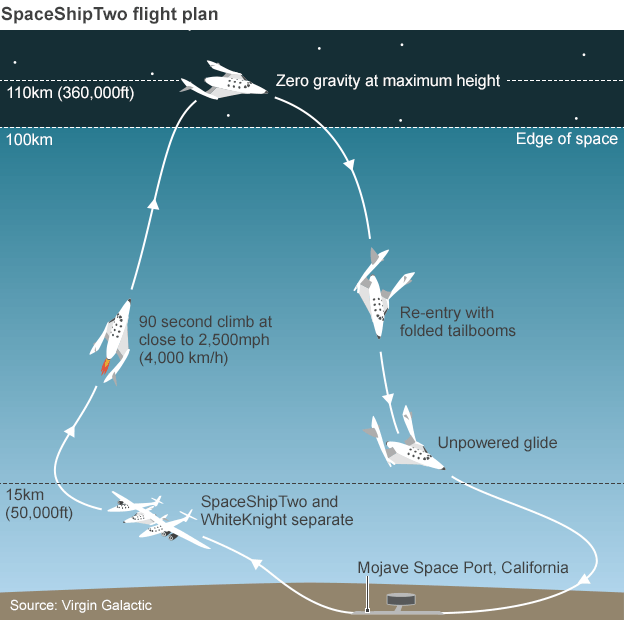
My beef is with the graphic-design bozos at Virgin Galactic, who give us this laughable graphic:

ss2

It looks nifty, sure. But the science (as represented by this travesty) is weak to say the least. In fact, I’ll say more: the science in this graphic is laughable.

First of all, notice how there’s a dotted line that says “edge of space”. It’s like the Mason-Dixon line: on one side, you can buy sweet tea, on the other side, you can’t. It’s nice how they colored space “black” and colored “not space” blue. Thanks. That clarifies things.

In point of fact, of course, there is no “Edge of space”. The atmosphere decreases gradually as you move away from the Earth. Where do you draw the line? Should it be the upper limit of human survivability, around 10,000 meters, or maybe the upper limit of commercial airline flights, at around 18,000 meters? The Fédération Aéronautique Internationale (FAI) puts “space” at 100,000 meters, but that is arbitrary. Nothing special “happens” at that height.

Secondly, notice how the graphic says that there’s “zero gravity” at that height. Sigh. Don’t they go over this in 6th grade?

There’s plenty of gravity in space; at least, where satellites orbit. (I discuss this at greater length in an earlier post.) At 100,000 meters, the acceleration due to gravity g has the value of 9.5 m/s2, compared to 9.8 m/s2 at sea level. That’s not “zero gravity.”

I’m sure what they meant was that the plane is traveling in some parabolic arc, and at that the top of that arc the plane is in free fall, so (momentarily) people on the plane experience the absence of any normal force, otherwise known as a state of “apparent weightlessness”. Oh, who am I kidding. They didn’t mean that…they meant what they said, and what they said was nonsense.

I’m not pointing any fingers for the SS2 disaster, and anyway, the NTSB will figure it out eventually. Until then, don’t rely on the Virgin Galactic design team to know anything beyond 6th grade physics.

As promised, the solutions…

1.   681472 [Um, Didn’t we answer this one earlier?]

2.   3927.27272… seconds This represents the amount of time it takes the minute hand of a clock to lap the hour hand.  For example, the hands coincide at midnight; they next coincide 3927.27272 seconds later, or at about 1:05:27 AM.

3.   23.14069… This is just e^π.

4.   2.1656 x 10^185 This is how many cubic planck lengths fit in the observable universe…basically, if our universe were a 3D computer, this is how many pixels you’d need.

5.   1.03 light year/year^2 This is the acceleration due to gravity g, in non-standard units.  It has the following interpretation: if you ignored relativity and accelerated at a rate of 1 g (reasonable for a starship), after a year you’d have reached the speed of light.

6.   133956 This is the number of possible combinations of two birthdays, since 133956 = 366^2.  If everyone on Earth had a significant other, there would be over 26,000 couples with the exact same two birthdays as you and your other.

7.   About 19.5 million people The number of people on Earth who share your birthday.

8.   0.739085… This is called the “Dottie number”…an irrational number that solves the equation cos x = x.

9.   1.72048 m^2 The area of a pentagon with sides of 1 m.

10.   0.004295 % This is what percent of Earth’s history homo sapiens has been around.

As promised, here are hints to puzzle #3…

1.   681472 [Um, I did this one as an example?  Do you really need a hint?]

2.   3927.27272… seconds [clocks]

3.   23.14069… [transcendentals]

4.   2.1656 x 10^185 [universe]

5.   1.03 light year/year^2 [Newton’s apple]

6.   133956 [birthdays]

7.   About 19.5 million people [birthdays]

8.   0.739085… [trigonometry]

9.   1.72048 m^2 [area]

10.   0.004295 % [humanity]

Detailed solutions to follow…

Many Worlds Puzzle #3

Today there are really 10 puzzles. Can you figure out the significance of each number below? I’ve answered the first to get you started.

1.   681472

This number has a prime factorization of 2^9 x 11^3, which indicates that it equals 88^3. There are 88 keys on a piano…so one obvious interpretation is that the number 681472 is the number of possible three-note permutations that could start any piece on a piano (not counting rests, and ignoring duration). I wonder how many of the permutations have actually ever been played over the years?

2.   3927.27272… seconds

3.   23.14069…

4.   2.1656 x 10^185

5.   1.03 light year/year^2

6.   133956

7.   About 19.5 million people

8.   0.739085…

9.   1.72048 m^2

10.   0.004295 %

Because many of these problems are challenging, I will post hints in a week or so.

Here I present three new mathematical discoveries for your edification.

1. According to Alexander Pope, “The proper study of mankind is man.” Symbolically,

S(mankind) = man,

where S(x) is the study of x. Now, Aldous Huxley tells us that “The proper study of mankind is books,” or

S(mankind) = books,

from which we can use the transitive relation to see that

man = books.

Of course, “Man is the measure of all things,” [Protagoras] so we immediately find that

man = books = μ(ξ).

Recall that μ(x) is the notation for the measure on a set, and we’ll use ξ to denote the universal set (ignoring Russell’s paradox as being too annoying). We already have a number of new apothegms, including

  • The proper study of mankind is the measure of all things
  • Books are the measure of all things
  • Women are books

where in the final example we have used Henry Adams’ quote “The proper study of mankind is woman”. Of course, the astute reader will note that Cicero’s quote “So many books, so little time” then takes on a whole new meaning, as noted by the Robert Cray band.

2. We now move on to the observation that theology is the study of theology, a fact which is self-evident. In our notation this becomes

S(theology) = theology.

We can then do multiple substitutions to learn that

theology = S(S(S(S(S(S(S(···))))))).

It is now evident that theology, at its core, is the study of an ellipsis; it’s turtles all the way down.

Barney-The-Dinosaur-Creator-Malibu-Shooting-by-son3. We end with the following logical proof. Consider Nietzsche’s observation that “that which does not kill you makes you stronger.” Let

K = something which kills you,

                   S = something which makes you stronger.

Then Nietzsche’s quote is simply

~KS.

Applying the contrapositive, we see that

~SK,

meaning that anything which does not make you stronger must kill you. Barney the dinosaur certainly doesn’t make anyone stronger; therefore Barney kills.

You’re welcome.